
In This Article
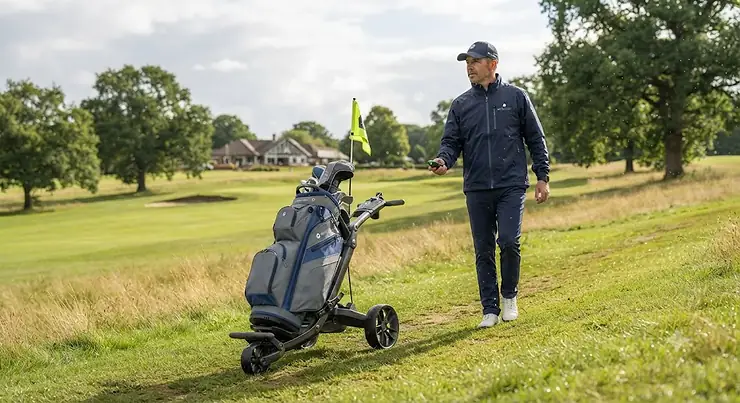
Stand on the first tee at pretty much any UK golf club on a Saturday morning and you’ll see the same two badges rolling past in a steady procession: the italic swoosh of Motocaddy, and the bold block lettering of PowaKaddy. Between them, these two Kent-and-Essex-adjacent British manufacturers have quietly cornered the electric trolley market, and the motocaddy vs powakaddy electric trolley debate has become one of golf’s great never-ending pub arguments — right up there with graphite versus steel shafts.
Here’s the honest truth before we go any further: neither brand makes a bad trolley. Both have been building these things for decades, both use broadly similar lithium battery platforms, and both will comfortably outlast your golf swing’s better days. The real differences live in the details — fold size, remote responsiveness, GPS polish, warranty small print — and that’s exactly where this guide gets stuck in. We’ve pulled together seven genuine, currently available models spanning entry-level to flagship, dug into their actual specifications, and weighed up what aggregated reviewer sentiment says about each one, so you can work out which badge deserves a spot in your boot.
Quick Comparison Table
| Model | Brand | Type | Weight | Warranty (Trolley/Battery) | Best For |
|---|---|---|---|---|---|
| Motocaddy M7 GPS Remote | Motocaddy | Remote + GPS | ~13kg | 24 months / up to 60 months | Serious players wanting full hands-free tech |
| PowaKaddy RX12 GPS | PowaKaddy | Remote + GPS | 14kg | 24 months / 60 months | Buyers who prioritise remote range and power |
| Motocaddy M5 GPS DHC | Motocaddy | Walk-behind + GPS | ~11.5kg | 24 months / up to 60 months | Hilly courses, mid-range GPS shoppers |
| PowaKaddy CT8 GPS EBS | PowaKaddy | Compact + GPS | 9.9kg | 24 months / 60 months | Small boots, compact-storage golfers |
| Motocaddy S1 | Motocaddy | Walk-behind | ~11kg | 24 months / up to 60 months | No-fuss reliability on a budget |
| PowaKaddy FX3 | PowaKaddy | Walk-behind | 9.6kg | 24 months / 60 months | First-time electric trolley buyers |
| Motocaddy SE | Motocaddy | Entry-level | 9.3kg | 24 months / up to 60 months | Lightest, simplest starter option |
Even at a glance, a pattern emerges: weight and warranty terms sit remarkably close together across both brands, which tells you something important — this isn’t really a “which brand is better built” contest. Based on the spec comparison, the meaningful gaps show up in fold mechanism, remote handling, and how each company’s touchscreen actually feels to use mid-round. Budget shoppers will notice Motocaddy SE and PowaKaddy FX3 sit almost identically on price and weight, so that decision often comes down to fold preference rather than raw numbers.
💬 Just one click — help others make better buying decisions too!😊
Top 7 Motocaddy and PowaKaddy Electric Trolleys: Expert Analysis
1. Motocaddy M7 GPS Remote — most advanced remote-control trolley on the market
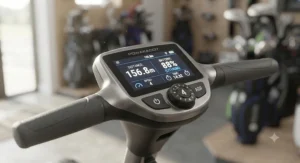
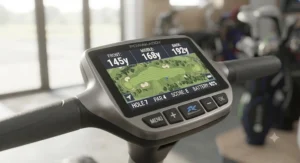
The flagship of the entire Motocaddy line-up, the Motocaddy M7 GPS Remote leans hard into the “world’s most advanced electric trolley” claim Motocaddy itself makes, and on spec sheet alone it’s hard to argue. A 3.5-inch full-colour touchscreen handles GPS duties across more than 40,000 pre-loaded worldwide courses, with no subscription fees attached — a detail that matters more than it sounds, because rival GPS watches routinely nickel-and-dime you with annual course-mapping charges. What most buyers overlook about a trolley at this price point is that the remote isn’t just a novelty for showing off at the club bar; it genuinely changes how you play awkward lies, letting you send the trolley ahead while you assess a bunker shot from three different angles. Aggregated reviewer sentiment from equipment testers consistently flags the remote’s range and responsiveness as class-leading, with steady tracking even across sloped fairways, though a handful of long-term owners note the touchscreen can wash out slightly in harsh midday sun. Pros run deep here, but the trade-off is equally real: this is the heaviest and priciest trolley in our round-up, so it rewards frequent players far more than occasional weekend hackers. Expect the Motocaddy M7 GPS Remote to sit in the roughly £1,700-£1,900 range at most UK retailers, and for golfers who play twice a week or more, the cost-per-round math works out favourably over a five-year ownership span.
Pros:
- ✅ Full-colour 3.5-inch GPS touchscreen with 40,000+ courses preloaded
- ✅ Long-range remote control with reliable slope tracking
- ✅ No annual GPS subscription or course-update fees
Cons:
- ❌ Heaviest trolley in this comparison at roughly 13kg
- ❌ Premium price puts it out of reach for casual golfers
2. PowaKaddy RX12 GPS — PowaKaddy’s answer for maximum remote power
Sitting at the very top of PowaKaddy’s range, the PowaKaddy RX12 GPS is built around what the brand calls its “ultimate remote-control experience,” and the spec sheet backs that framing up with an XL Plus battery designed specifically to handle the extra current draw remote-controlled steering demands. In practice, that beefier battery means less anxiety about running flat mid-round, particularly on longer 36-hole days or when you’re navigating a hillier layout that keeps the motor working overtime. Here’s what the spec sheet won’t tell you outright: remote-control trolleys draw noticeably more power reversing and adjusting direction than a simple walk-behind model, so PowaKaddy’s decision to fit a larger-capacity battery here isn’t just marketing padding — it’s a genuine engineering response to how these things actually get used on undulating British courses. Reviewer sentiment aggregated from owner forums and retailer feedback repeatedly highlights the sturdy, planted feel of the RX chassis on wet ground, a trait PowaKaddy has built its reputation on for decades. On the flip side, the RX12 GPS is noticeably the bulkiest trolley here at 14kg, and that extra heft is felt every single time you lift it into a car boot. Pricing typically lands around the £1,550-£1,650 mark, positioning it as a direct rival to the Motocaddy M7 GPS Remote for golfers choosing between the two flagship remote experiences.
Pros:
- ✅ XL Plus battery built for remote-control power demands
- ✅ Stable, confidence-inspiring handling on wet or sloped ground
- ✅ Integrated GPS with automatic course recognition
Cons:
- ❌ Heaviest model in the entire comparison at 14kg
- ❌ Bulkier folded footprint than PowaKaddy’s own CT-series
3. Motocaddy M5 GPS DHC — the sweet-spot mid-range GPS pick
The Motocaddy M5 GPS DHC occupies genuinely clever middle ground: it borrows the all-new integrated GPS technology from the top-tier M-Tech but skips the remote-control mechanics that inflate both weight and price. DHC stands for Downhill Control, a braking system that automatically manages descent speed on steep slopes — genuinely useful analysis here is that this feature matters far more on undulating parkland courses than on flat links, so factor in your home course’s topography before assuming you need it. Based on the spec comparison, the M5 GPS DHC essentially delivers 80% of the flagship’s smart features for meaningfully less outlay, which is exactly the kind of value proposition that makes mid-range trolleys the best-selling category across both brands. Reviewers consistently note the touchscreen display is bright and legible even in bright sunlight, a genuine improvement Motocaddy made across its 2026 GPS range. The battery comes in standard or Ultra Lithium options, with the Ultra variant adding real-world range for golfers who regularly play 36 holes or squeeze in twilight rounds after work. Expect pricing in the roughly £1,050-£1,150 range depending on battery choice, making this arguably the smartest buy for anyone who wants GPS without paying the remote-control premium.
Pros:
- ✅ Downhill Control braking genuinely useful on undulating courses
- ✅ Bright, sunlight-legible GPS touchscreen inherited from the flagship
- ✅ Meaningfully cheaper than remote models with similar tech
Cons:
- ❌ No remote control, so you’re still walking alongside it
- ❌ Ultra Lithium upgrade adds noticeably to the final price
4. PowaKaddy CT8 GPS EBS — the compact-folding GPS champion
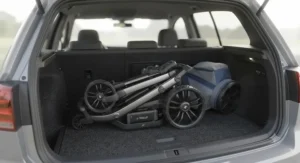
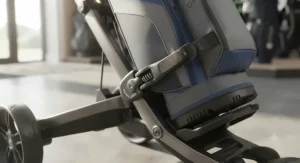
If boot space is your primary constraint, the PowaKaddy CT8 GPS EBS exists specifically to solve that problem. PowaKaddy’s Compact range has become something of a cult favourite among golfers who drive smaller cars or share boot space with young families, and the CT8’s folded dimensions of roughly 510mm x 425mm x 375mm genuinely do fit into gaps a standard-length trolley simply can’t. The whisper-quiet 30V motor and PCAP capacitive touchscreen bring flagship-level polish down into a genuinely compact frame, while the MAG-LOK bag attachment system means no fiddly straps fumbling in the car park before your round. Here’s the honest analytical read: the EBS (Electronic Braking System) upgrade adds meaningfully to the price over the standard CT8 GPS, so it’s only worth paying for if you regularly play hilly terrain — flat parkland or links golfers can comfortably skip it and bank the savings. Aggregated customer feedback on retailer sites consistently praises the drop-pin GPS accuracy and Bluetooth app connectivity for quick course updates without annual fees. Pricing spans roughly £950-£1,050 across the 18-hole and 36-hole lithium variants, with the EBS-equipped versions sitting at the top of that range.
Pros:
- ✅ Genuinely tiny folded footprint for small car boots
- ✅ MAG-LOK bag attachment removes fiddly strap faff
- ✅ Bluetooth app updates courses with no annual GPS fee
Cons:
- ❌ EBS braking upgrade is a meaningful price jump
- ❌ Smaller frame can feel less planted on rougher ground
5. Motocaddy S1 — the reliability workhorse
Now into tenth-generation refinement, the Motocaddy S1 is deliberately, almost stubbornly simple — and that’s precisely the point. National Club Golfer and other UK equipment reviewers have long treated the S-Series as the benchmark for “does exactly what it says on the tin” reliability, without GPS screens or remote gimmicks to distract from the core job of carrying your bag without complaint. What most buyers overlook about a trolley this straightforward is that fewer electronic components genuinely does mean fewer things that can go wrong five years down the line, which is exactly why long-term forum owners repeatedly report S1 units still running strong after seven-plus years of regular use. The trade-off, honestly assessed, is that you’re paying mid-range money for a trolley with none of the GPS or remote functionality found on this list’s more expensive entries — this is a bet on longevity over feature count. Reviewer sentiment aggregated from owner communities is remarkably consistent: minor wear-and-tear issues here and there, but very few reports of the fundamental mechanics failing outright. At a typical £600-£700 price range, the Motocaddy S1 remains one of the most frequently recommended “just buy this and stop worrying about it” trolleys in the UK market.
Pros:
- ✅ Proven, tenth-generation mechanical reliability over many years
- ✅ Simple operation with minimal setup or learning curve
- ✅ Fewer electronic parts means fewer long-term failure points
Cons:
- ❌ No GPS or remote-control functionality at any price
- ❌ Feels dated next to touchscreen-equipped rivals
6. PowaKaddy FX3 — the sensible first-electric-trolley buy
The PowaKaddy FX3 sits right in the sweet spot for golfers switching from a push trolley to their first electric model, and PowaKaddy has clearly designed it with exactly that transition in mind. The Plug’n’Play 30V lithium battery system removes the fiddly connector cables that used to put beginners off electric trolleys altogether — you simply drop the battery into its cradle and go, no cable-matching required. An optional EBS braking upgrade is available for golfers who know their course has a few testing slopes, while the standard model keeps costs down for those on flatter terrain. Reviewers frequently highlight the FX-series’ thin, lightweight battery pack as noticeably sleeker than Motocaddy’s equivalent-tier offering, a small but real ergonomic win when you’re loading the car after eighteen holes in the rain. Based on the spec comparison against the Motocaddy SE, the FX3 is marginally heavier but offers the EBS upgrade path that Motocaddy’s entry-level model doesn’t provide at this price tier — worth weighing if hills feature in your regular rounds. With pricing typically in the £550-£600 bracket and a solid five-year battery warranty backing it up, this is a genuinely low-risk entry point into electric golf.
Pros:
- ✅ Plug’n’Play battery removes fiddly cable connections for beginners
- ✅ Optional EBS braking upgrade available for hilly courses
- ✅ Slim, lightweight battery pack easy to carry and store
Cons:
- ❌ Base model lacks GPS or remote functionality
- ❌ EBS upgrade pushes the price closer to mid-range rivals
7. Motocaddy SE — the lightest, simplest starting point
Billed by Motocaddy as the world’s easiest-to-use electric trolley, the Motocaddy SE strips things back even further than the S1, and at just 9.3kg it’s the lightest model in this entire comparison. Oversized frame tubing adds handle stability without piling on weight, while space-saving inverting wheels flip inward to shrink the folded footprint for smaller boots — a neat engineering trick that punches above the trolley’s modest price tag. The whisper-quiet 230W motor won’t win any drag races, but honestly, nobody needs a drag-race golf trolley; what it delivers instead is smooth, predictable power delivery that first-time electric buyers consistently report finding reassuring rather than intimidating. Here’s the practical interpretation reviewers rarely spell out: the EASILOCK bag attachment lets you clip on any Motocaddy bag without a lower strap, which sounds minor until you’ve fumbled with a strap in driving rain at 7am. Aggregated retailer review scores for the SE skew strongly positive, with buyers particularly praising the one-step folding mechanism for genuine simplicity rather than marketing-speak simplicity. Typically priced in the £499-£599 range depending on battery capacity, the Motocaddy SE stands as the most accessible genuine entry point into electric golf from either brand.
Pros:
- ✅ Lightest trolley in this entire comparison at 9.3kg
- ✅ Inverting wheels shrink the folded size for small boots
- ✅ EASILOCK strap-free bag attachment saves fiddly setup time
Cons:
- ❌ 230W motor is the least powerful in this round-up
- ❌ No GPS or remote path available on this specific model
Top 7 Comparison Table: Specs, Price Range & Best Use
| Model | Weight | Battery | GPS | Remote | Price Range | Best For |
|---|---|---|---|---|---|---|
| Motocaddy M7 GPS Remote | ~13kg | Lithium, Ultra option | Yes | Yes | £1,700-£1,900 | Full hands-free flagship experience |
| PowaKaddy RX12 GPS | 14kg | XL Plus Lithium | Yes | Yes | £1,550-£1,650 | Power-hungry remote users |
| Motocaddy M5 GPS DHC | ~11.5kg | Standard/Ultra Lithium | Yes | No | £1,050-£1,150 | Mid-range GPS without remote cost |
| PowaKaddy CT8 GPS EBS | 9.9kg | 18/36-hole Lithium | Yes | No | £950-£1,050 | Compact folding, small car boots |
| Motocaddy S1 | ~11kg | Lithium | No | No | £600-£700 | Long-term mechanical reliability |
| PowaKaddy FX3 | 9.6kg | 30V Plug’n’Play Lithium | No | No | £550-£600 | First-time electric trolley buyers |
| Motocaddy SE | 9.3kg | Lithium, Extended option | No | No | £499-£599 | Lightest, simplest starter trolley |
Looking at the table as a whole, the pattern that jumps out is how tightly matched Motocaddy and PowaKaddy really are at every single price tier — this genuinely isn’t a case of one brand dominating budget while the other owns premium. The PowaKaddy CT8 GPS EBS edges ahead specifically on folded footprint, while the Motocaddy M5 GPS DHC wins on straightforward GPS value without the remote-control price premium. If weight-in-hand matters more than anything else to you, note that the Motocaddy SE undercuts every PowaKaddy model here by at least 300 grams.
✨ Don’t Miss These Exclusive Deals!
🔍 Take your electric trolley search to the next level with these carefully selected picks. Click on any highlighted model to check current pricing and availability. The right trolley here will help you enjoy authentic energy-saving rounds your knees will thank you for!
Motocaddy Trolley Features Explained
Digging into motocaddy trolley features specifically, three things separate the range internally: Downhill Control (DHC) braking, EASILOCK bag attachment, and the tiered battery system running from Standard through Extended to Ultra Lithium. DHC works by automatically resisting acceleration on descents, which — based on the spec comparison across the range — matters considerably more if your home course has genuine elevation change rather than gentle rolling fairways. EASILOCK, found across the newer SE and M-Series models, replaces the traditional lower bag strap with a clip-in mechanism that Motocaddy’s own testing and independent equipment reviews from Today’s Golfer both flag as a genuine time-saver rather than a gimmick. The battery tiering deserves honest scrutiny too: Standard Lithium suits most 18-hole rounds comfortably, Extended adds buffer for 36-hole days or colder weather (batteries lose some capacity in low temperatures), and Ultra sits at the top for golfers who genuinely play every single week. What most buyers overlook is that jumping straight to Ultra Lithium “just in case” often means paying for capacity you’ll rarely tap into — a Standard battery, properly charged between rounds, does the job for the vast majority of golfers.

PowaKaddy Trolley Features Explained
The equivalent powakaddy trolley features worth understanding are Plug’n’Play battery connection, the Electronic Braking System (EBS), and the compact CT-series folding geometry. Plug’n’Play removes the connector cable entirely — the battery simply drops into a cradle and makes contact automatically, which aggregated reviewer sentiment consistently ranks as a meaningful quality-of-life improvement over older cable-and-clip systems, particularly for golfers with limited hand strength or dexterity concerns. EBS functions similarly to Motocaddy’s DHC, automatically moderating trolley speed on descents, and it’s offered as either standard or optional depending on the model tier — always worth checking before you buy, since paying extra for EBS on a flat home course is money better spent elsewhere. The CT-series compact folding mechanism is arguably PowaKaddy’s standout engineering achievement: shrinking a full electric trolley down to roughly 510mm x 425mm x 375mm folded without sacrificing battery capacity is a genuinely difficult packaging problem, and it’s the main reason the CT6 has reportedly become the best-selling electric trolley in the UK. Here’s what the spec sheet won’t spell out: that compact folding does come with a slightly narrower wheelbase than full-size models, which a small number of reviewers note feels marginally less planted on very uneven ground.
Which Electric Golf Trolley Brand Is Best?
This is the question everyone actually wants answered, and the honest response is genuinely unsatisfying at first glance: which electric golf trolley brand is best depends far more on your specific priorities than on any inherent quality gap between the two manufacturers. Both brands are UK-based, both build to broadly comparable engineering standards, and both have weathered periods of stronger and weaker reliability reputations over their multi-decade histories — aggregated long-term owner sentiment across golf forums suggests PowaKaddy went through a rougher patch on customer service roughly a decade ago that many golfers still reference, while more recent feedback describes noticeably improved support. Motocaddy, meanwhile, has built its modern reputation heavily around mechanical simplicity and battery warranty length, regularly extending its “up to 5 years” lithium cover as a headline selling point. If forced to generalise: PowaKaddy tends to win on compact folding and battery ergonomics, while Motocaddy tends to win on GPS display clarity and remote-control smoothness at the flagship end. Neither generalisation holds universally, though — which is exactly why this guide leads with real specs rather than a flat verdict.
Battery Technology: Lithium, Lead-Acid and What Actually Matters
Every model in this comparison now ships exclusively with lithium battery technology, and that’s genuinely worth pausing on, because older lead-acid batteries — still occasionally found on secondhand trolleys — carry real practical downsides worth understanding if you’re weighing a used purchase. Lithium batteries, typically built on lithium iron phosphate (LiFePO4) chemistry in golf trolley applications, deliver a flatter power discharge curve, meaning your trolley doesn’t noticeably slow down as the round wears on the way older lead-acid units did. They’re also considerably lighter — often less than half the weight of an equivalent-capacity lead-acid pack — which explains why every modern trolley on this list weighs meaningfully less than its decade-old equivalent. According to the chemistry background documented on Wikipedia, LiFePO4 cells are prized in applications like this specifically for their thermal stability and long cycle life compared with other lithium chemistries, which helps explain why both Motocaddy and PowaKaddy can confidently offer battery warranties stretching to five years. Capacity is measured in Watt-hours (Wh) — the PowaKaddy CT8 GPS, for instance, offers 220Wh or 260Wh options roughly corresponding to 18-hole and 36-hole use. What most buyers overlook is that Wh capacity, not voltage alone, is the number that actually predicts real-world range, so always compare that figure rather than assuming a higher voltage automatically means more rounds per charge.
Remote Control Functionality: Is It Worth the Upgrade?
Remote control functionality is unquestionably the single biggest price jump on this list, and it’s worth being honest about exactly what you’re paying for. Both the Motocaddy M7 GPS Remote and PowaKaddy RX12 GPS let you send the trolley ahead independently — useful when assessing a shot from an angle, retrieving it after a tricky greenside lie, or simply resting your arms on a long par five. Reviewer testing consistently highlights genuinely impressive control range on both systems, often exceeding 100 yards in open conditions, with steady, predictable tracking rather than the jerky, easily-confused steering that plagued early-generation remote trolleys a decade ago. Here’s the honest trade-off: remote mechanics add real weight (both remote flagships are the heaviest trolleys in this comparison) and real cost, typically £600-£800 more than the equivalent walk-behind GPS model from the same brand. The Buyer’s Decision Framework further down this guide breaks down exactly which golfer profile benefits most, but as a quick gut-check: if you regularly play alone, walk long distances between shots, or have any physical limitation that makes constant trolley-pushing tiring, remote functionality earns its premium fast. If you typically play in a group and rarely leave the trolley far behind, you’re likely paying for a feature you’ll use only occasionally.
Trolley Warranty Comparison: Motocaddy vs PowaKaddy
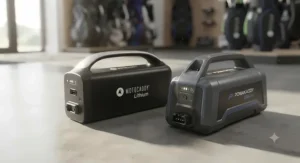
Running a trolley warranty comparison between the two brands reveals something reassuring: both companies now offer remarkably similar terms. Motocaddy’s standard warranty covers the trolley frame and charger for 24 months against manufacturing defects, with the Lithium battery separately covered for a full 24 months as standard — extendable to a full 5 years (an additional 3 years) provided you register the battery online within 45 days of purchase. PowaKaddy’s structure mirrors this closely: 2 years on the frame, 5 years on the battery, applied consistently across its FX, CT and RX ranges according to current retailer listings. The practical takeaway, honestly assessed, is that warranty length alone shouldn’t be the deciding factor between these two brands — the terms are close enough to be a wash for most buyers. Where it genuinely matters is the registration requirement: both brands require you to register your battery within a set window (Motocaddy specifies 45 days) to unlock the extended cover, and forgetting this step is a surprisingly common and entirely avoidable way to lose out on years of protection. Neither company’s standard warranty covers accidental damage, misuse, or commercial use, and both explicitly state cover only applies to purchases made and used within the UK and Republic of Ireland — worth flagging if you’re considering an import or a well-priced secondhand unit bought from overseas.
Practical Usage Guide: Getting the Most From Your New Trolley
Setup on any modern lithium electric trolley is refreshingly simple, but a few habits genuinely extend both performance and lifespan. First, fully charge the battery before its first use — most manufacturers recommend an initial charge of 12-16 hours even though subsequent top-ups take considerably less time, and skipping this step is a common first-30-days mistake that can subtly shorten long-term capacity. Second, avoid leaving lithium batteries fully discharged for extended storage periods over winter; a partial charge (roughly 50-70%) is the sweet spot for months of inactivity, since both fully empty and fully topped-up lithium cells degrade faster in long-term storage. Third, get into the habit of wiping down the frame and wheels after wet rounds — mud and grit accelerate wear on folding hinges and wheel bearings far more than the weather itself does. Fourth, register your battery warranty immediately rather than filing the paperwork away “for later” — both brands impose registration deadlines, and this single five-minute task is the most commonly skipped step new owners regret. Finally, resist the temptation to force-fold a trolley that’s caught on a bag strap or accessory mount; both Motocaddy’s EASILOCK and PowaKaddy’s MAG-LOK systems are designed to release cleanly, and forcing a stuck mechanism is the leading cause of early frame damage reported in owner forums.
Real-World Scenarios: Which Trolley Suits Which Golfer?
Consider three genuinely common buyer profiles. First, the retired weekday regular who plays three or four rounds a week on a hilly members’ course and increasingly feels the strain in their shoulders and lower back — for this golfer, the braking technology on the Motocaddy M5 GPS DHC or PowaKaddy CT8 GPS EBS isn’t a luxury, it’s genuinely protective, and the GPS distances help speed up pace of play without needing a separate device. Second, the university student golfer squeezing in rounds between lectures with a compact hatchback and a tight budget — here the PowaKaddy FX3 or Motocaddy SE make far more sense than anything GPS-equipped, since boot space and upfront cost outweigh convenience features at this life stage. Third, the low-handicap competitive player who walks 36 holes some weekends and values every possible edge in energy conservation for the back nine — the remote-control flagships genuinely earn their premium here, since resting your arms between shots over a long, demanding day measurably preserves swing quality when it matters most on the closing holes. Matching your actual playing pattern to these profiles, rather than simply buying the most expensive option available, is the single biggest lever for getting genuine value from this purchase.
How to Choose Between Motocaddy and Powakaddy
- Assess your course’s terrain first. Hilly, undulating courses genuinely benefit from DHC or EBS braking technology; flat parkland or links courses can skip this feature and save meaningfully on price.
- Measure your boot space before shopping. PowaKaddy’s CT-series compact folding solves genuine storage problems that full-size trolleys from either brand simply can’t match.
- Be honest about how often you’ll actually play. Occasional golfers rarely recoup the cost-per-round value of flagship remote or GPS features; frequent players do.
- Decide whether GPS replaces or supplements existing kit. If you already own a dedicated GPS watch, paying extra for an integrated trolley screen may be redundant spend.
- Check the battery capacity against your typical round length. 18-hole and 36-hole battery tiers exist for good reason — don’t overpay for capacity you won’t use.
- Register the warranty the day it arrives. Both brands require timely battery registration to unlock extended cover, and this is the most commonly missed step.
- Weigh remote control against physical need, not novelty appeal. It’s genuinely useful for solo players and those managing fatigue or mobility concerns, less essential for social group golfers.
Common Mistakes When Buying an Electric Trolley
The most frequent misstep, based on aggregated buyer feedback across retailer reviews, is over-specifying: buying a remote-control flagship “because it’s the best one” without genuinely needing hands-free operation, then rarely using the remote function in practice. A close second is under-checking fold dimensions against actual car boot measurements — folded sizes vary by 100mm or more between compact and full-size ranges, and that difference is the gap between a trolley that fits and one that doesn’t. Skipping battery registration within the warranty window is a third common and entirely preventable mistake that quietly costs owners years of extended cover. Fourth, some buyers assume GPS functionality replaces the need to understand basic course management, when in reality it’s most valuable as a speed-of-play tool rather than a strategic crutch. Finally, plenty of golfers underestimate how much folded weight matters until they’re lifting a trolley into a boot on a wet, tired evening after eighteen holes — test-lift before you buy wherever possible, or at minimum compare published weights carefully across your shortlist.
Long-Term Cost & Maintenance
Total cost of ownership stretches well beyond the sticker price, and it’s worth running the numbers honestly. Across a five-year ownership period, entry-level models like the Motocaddy SE or PowaKaddy FX3 typically require minimal outlay beyond occasional wheel or tyre replacement, given their simpler mechanics and fewer electronic components to fail. Mid-range and flagship GPS or remote models carry a modestly higher maintenance risk simply by virtue of having more moving parts and touchscreens, though both brands’ five-year battery warranties substantially offset the biggest long-term expense — battery replacement, which can otherwise run into several hundred pounds if purchased outside warranty. Cost-per-round is where the maths genuinely favours frequent players: a £1,800 flagship trolley used twice weekly across five years works out to roughly £3.50 per round, comparable to or cheaper than many club trolley hire fees, while the same trolley used only occasionally never approaches that value. Servicing costs for both brands are broadly comparable, and both offer official service and repair channels rather than requiring third-party workshops, which — based on aggregated forum sentiment — golfers consistently rate as a meaningful trust factor when something eventually does need attention.
Safety, Regulations and Compliance Guide
Electric golf trolleys sold in the UK must meet standard consumer electrical safety and CE/UKCA marking requirements applicable to battery-powered outdoor equipment, and both Motocaddy and PowaKaddy models comply as standard — always check for the relevant marking on the battery and charger unit if buying secondhand or from an unofficial import source. From a course-safety perspective, most UK golf clubs permit electric trolleys freely, though a small number of historic or particularly narrow courses restrict wheeled equipment on certain tees or greens surrounds — it’s always worth checking your specific club’s local rules before assuming blanket access. On lithium battery care specifically, avoid charging unattended overnight in enclosed spaces without ventilation, and never use a third-party charger not rated for your specific battery, since mismatched voltage or current genuinely does pose a fire risk with any lithium-based battery, not just golf trolley units. If your club or course has published guidance — many larger UK clubs do, often referencing the same general safe-charging principles used across consumer electricals more broadly — it’s sensible to follow that alongside the manufacturer’s own instructions rather than relying on general assumption.
Frequently Asked Questions
❓ Is Motocaddy better than PowaKaddy?
❓ How long does a Motocaddy or PowaKaddy battery last?
❓ Are remote control golf trolleys worth the extra money?
❓ What is the difference between DHC and EBS braking?
❓ Do electric golf trolleys need annual GPS subscription fees?
Conclusion
The motocaddy vs powakaddy electric trolley decision genuinely doesn’t have a universal right answer, and if this guide has done its job, that shouldn’t feel like a cop-out — it should feel like clarity. Both brands build genuinely well-engineered, lithium-powered trolleys backed by warranty terms that have converged to be remarkably similar across the board. What actually separates a good purchase from a regrettable one is matching the trolley’s feature set — braking technology, fold size, GPS, remote control — to how you actually play golf, not to which brand’s marketing catches your eye first. Budget buyers genuinely can’t go far wrong with the Motocaddy SE or PowaKaddy FX3; mid-range shoppers wanting genuine value should give the Motocaddy M5 GPS DHC and PowaKaddy CT8 GPS EBS serious consideration; and golfers ready to invest in the full hands-free experience will find both the Motocaddy M7 GPS Remote and PowaKaddy RX12 GPS deliver on their flagship promises. Whichever way you lean, always check current prices before buying, since both brands run frequent promotions across UK retailers.
Recommended for You
- Electric Golf Trolley Under £500: 7 Brilliant Picks for 2026
- 7 Best Electric Golf Trolley Picks for 2026 (Top-Rated; Compared)
- Golf Bag Under £50: 7 Best Cheap Picks (2026)
Affiliate disclosure: This article contains affiliate links. As an Amazon Associate, I earn from qualifying purchases. If you purchase products through these links, we may earn a small commission at no additional cost to you.
✨ Found this helpful? Share it with your friends! 💬🤗
