
In This Article
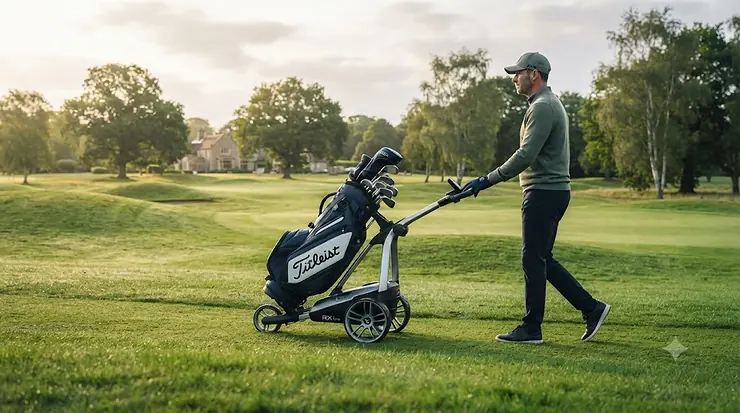
There’s a particular kind of golfer who discovers the remote control golf trolley at exactly the wrong moment — usually somewhere around the fourteenth hole, arms aching, still pushing a trolley uphill while their playing partner’s cart glides along beside them at the press of a thumb. If that sounds familiar, you’re not alone, and you’re also not choosing between one obvious winner and a pile of also-rans. This is a genuinely crowded, genuinely competitive corner of golf equipment, and the differences between models matter more than the marketing photos suggest.

A remote control golf trolley is an electric golf trolley steered from a handheld unit rather than pushed or pulled, letting you send it ahead down the fairway while you walk unencumbered to your ball. Some models go further still, using GPS or sensor-based follow-me technology to trail behind you automatically without any button-pressing at all.
This guide works through seven real, currently available models spanning true budget buys through to the kind of hand-built British engineering that costs more than some second-hand cars. We’ll cover the difference between a basic directional remote and full app-controlled steering, dig into what “follow-me” actually means in practice versus marketing copy, and look honestly at where household names like Stewart Golf and MGI sit against newer, cheaper challengers. For balanced third-party testing methodology, Golf Monthly’s independent trolley reviews are worth cross-referencing against anything you read here.
Quick Comparison Table
| Product | Control Type | Remote Range | Best For |
|---|---|---|---|
| GoKart Automatic | Auto pace-match (no directional remote) | N/A | Simplest budget option |
| Navee Birdie 3 | App + remote | Standard | Budget app-controlled steering |
| Motocaddy ME Remote | Handheld remote | 100m+ | Best value directional remote |
| PowaKaddy RX XL Plus Remote | Handheld remote | 50m+ | Longest battery warranty |
| MGI Zip Navigator AT | Handheld remote | Standard | All-terrain stability |
| Motocaddy M7 GPS Remote | Handheld remote + GPS | 100m+ | Best overall touchscreen GPS |
| Stewart Golf Q Follow | Remote + hands-free follow | 75m | True follow-me technology |
Looking at this table, the split that matters most isn’t price — it’s control philosophy. The GoKart Automatic technically isn’t a directional remote trolley at all; it automatically matches your walking pace rather than being steered from a handset, which is worth flagging honestly before you buy expecting to send it off down the fairway. Everything else on this list genuinely lets you steer or follow hands-free, with the Stewart Golf Q Follow the only model here offering true sensor-based follow-me technology rather than button-operated remote steering.
💬 Just one click — help others make better buying decisions too!😊
Top 7 Remote Control Golf Trolleys: Expert Analysis
1. GoKart Automatic — British-made, simplest auto-pace design
The GoKart Automatic sits apart from the rest of this list in an important way we should address immediately: it isn’t steered by a handheld directional remote. Instead, its patented control system automatically adjusts motor speed to match how hard you push or pull the handle, meaning you simply hold on and walk rather than pressing buttons to send it ahead.
Specs-wise, you’re looking at a lightweight lithium battery option weighing around 2.1kg for the 18-hole version, a five-year limited warranty on that battery, and genuinely compact folding dimensions. In practice, what that means is a trolley that requires almost no learning curve — there’s no remote to master, no app to pair, just a handle that reads your walking pace.
Aggregated review sentiment is notably strong on longevity specifically: independent testing gave it a 4 out of 5 rating, while long-term forum discussion among UK golfers repeatedly describes GoKart units still running reliably after a decade of regular use. The one recurring gripe, echoed across owner forums, is the trolley’s unusual folded shape, which some owners say doesn’t sit neatly in a car boot regardless of orientation.
Pros:
- ✅ Genuinely simple auto pace-matching, no remote to learn
- ✅ Lightweight lithium battery with five-year warranty
- ✅ Strong long-term reliability reported by UK owners
Cons:
- ❌ Not a directional remote — can’t be sent ahead independently
- ❌ Unusual folded shape awkward in some car boots
Price range: £399-579. Best for golfers who want the lowest hassle possible and don’t specifically need to send the trolley ahead down the fairway.
2. Navee Birdie 3 — best budget app-controlled remote
If genuine app-controlled golf trolley functionality at a budget price is what you’re after, the Navee Birdie 3 is currently undercutting most premium remote trolleys by a meaningful margin while still offering full remote and mobile app integration.
The core proposition here is straightforward: proper directional remote control plus smartphone app integration, at a price point that’s hundreds of pounds below flagship remote trolleys from the established UK brands. What that means in practice is you’re not sacrificing the core “send it ahead while I walk to the green” experience — you’re sacrificing some of the premium build refinement and brand heritage that adds cost elsewhere on this list.
Based on the spec comparison with pricier rivals, the Birdie 3’s core appeal is genuinely changing the conversation for golfers who’d previously felt priced out of remote trolleys altogether. As a newer entrant to the UK market compared to decades-old names like Motocaddy and Stewart Golf, independently verified long-term reliability data is still building, which is worth noting honestly rather than glossing over.
Pros:
- ✅ Full remote and app control at a genuinely budget price
- ✅ Undercuts premium remote trolleys by hundreds of pounds
- ✅ Straightforward app pairing for smartphone-based control
Cons:
- ❌ Newer brand with less long-term UK reliability history
- ❌ Fewer premium build touches than flagship rivals
Price range: under £850. Best for golfers who want genuine app-controlled steering without paying flagship prices.
3. Motocaddy ME Remote — best value directional remote under £1,000
Motocaddy’s 2026 update to the ME Remote addressed the small gripes testers had with the previous generation while holding the same accessible price point, and independent review coverage now calls it the best entry-level remote electric trolley on the market for exactly that reason.
Key specs include a 100-metre-plus remote range, compact folding, and all-terrain DHC tyres shared with the pricier M7 model above it — meaning you’re not sacrificing much on the wheels and chassis even at this price tier. What that means practically is confident handling on rough ground without needing to spend the extra few hundred pounds the M7 commands.
The main trade-off against its stablemate is warranty length: the ME Remote carries a three-year battery warranty against the M7’s five years, and it skips GPS entirely. Reviewers consistently frame it as the pragmatic choice for golfers who want remote convenience without paying for screen-based features they may not use every round.
Pros:
- ✅ Joint cheapest remote trolley from a major UK brand
- ✅ 100m+ remote range matches pricier premium models
- ✅ Same all-terrain DHC tyres as the flagship M7
Cons:
- ❌ Three-year battery warranty, shorter than premium rivals
- ❌ No GPS functionality at this price point
Price range: £950-1,050 range. Best for golfers who want proven remote convenience without paying for a screen they might not use.
4. PowaKaddy RX XL Plus Remote — longest battery warranty in its class
Sitting at almost exactly the same price as the Motocaddy ME Remote, the PowaKaddy RX XL Plus Remote takes a different approach to justifying its position: a five-year battery warranty that beats most rivals in this price bracket outright.
On the spec sheet, that translates to genuine long-term value reasoning rather than headline horsepower — a longer warranty period means a lower effective cost-per-year if the battery performs as expected, even before considering the trolley’s day-to-day handling. The remote range here sits at 50 metres plus, noticeably shorter than the Motocaddy ME’s 100-metre-plus figure, which matters more on wide-open courses than tighter parkland layouts.
Honestly, the choice between this and the Motocaddy ME Remote at a near-identical price comes down to what you value more: PowaKaddy’s warranty confidence or Motocaddy’s longer remote range. Neither is objectively wrong, and both represent the same “value tier” of the market rather than one clearly beating the other.
Pros:
- ✅ Five-year battery warranty, longest in this price bracket
- ✅ Competitive pricing matching the Motocaddy ME Remote
- ✅ Established brand with strong UK after-sales network
Cons:
- ❌ Shorter 50m remote range versus Motocaddy’s 100m+
- ❌ No GPS at this tier, same as its direct rival
Price range: £950-1,050 range. Best for golfers who prioritise long-term battery confidence over maximum remote range.
5. MGI Zip Navigator AT — all-terrain stability with gyroscope tracking
The MGI Zip Navigator AT brings something genuinely distinctive to this list: patented gyroscope straight-tracker technology designed to keep the trolley tracking true across uneven ground, backed by independent dual front wheels for added stability and twin 230-watt motors for power.
What that gyroscope system means in practice is less time correcting a wandering trolley on sloped or rutted fairways — a common frustration with simpler remote systems that rely purely on motor speed matching rather than active course correction. The all-terrain tread on the rear wheels and downhill speed control add up to a trolley genuinely built for golfers who play courses with real elevation change rather than flat parkland.
As an Australian-engineered brand sold into the UK market primarily through specialist importers rather than a dedicated UK retail network, buyers should factor in slightly less straightforward after-sales support than UK-based Motocaddy, PowaKaddy or Stewart Golf — a genuine consideration Amazon UK listings and specialist golf retailers alike are upfront about when stocking MGI’s range.
Pros:
- ✅ Patented gyroscope tech keeps tracking straight on slopes
- ✅ Twin 230W motors offer strong power for hilly courses
- ✅ Independent dual front wheels add genuine stability
Cons:
- ❌ UK after-sales support less established than domestic brands
- ❌ Premium import pricing versus UK-built equivalents
Price range: £1,200-1,400 range (imported UK pricing). Best for golfers on genuinely hilly, uneven courses who need active tracking, not just power.

6. Motocaddy M7 GPS Remote — best overall touchscreen GPS remote
The Motocaddy M7 GPS Remote has held the “best overall” title in independent testing for several consecutive years running, and the reasoning holds up under scrutiny: a genuinely premium 3.5-inch full-colour touchscreen combined with GPS coverage of over 40,000 courses worldwide, layered on top of the same reliable remote steering found on the cheaper ME Remote.
Beyond the screen, the personalisable shortcuts to frequently used features are the kind of detail that only becomes obvious after a few rounds — being able to jump straight to your most-used function rather than navigating menus mid-round genuinely speeds up play. On paper this is a trolley trying to do everything at once; in practice, testers consistently rate it as succeeding at that ambition rather than spreading itself thin.
The trade-off is straightforward: you’re paying a meaningful premium over the ME Remote specifically for the GPS and touchscreen layer, and if you already track your rounds on a dedicated GPS watch or rangefinder, that premium buys you convenience rather than a capability you were otherwise missing.
Pros:
- ✅ Independently rated best overall trolley for consecutive years
- ✅ 3.5-inch GPS touchscreen covering 40,000+ courses
- ✅ Personalisable shortcuts speed up mid-round navigation
Cons:
- ❌ Meaningful price premium over the non-GPS ME Remote
- ❌ Redundant if you already use a separate GPS device
Price range: £1,280-1,400 range. Best for golfers who want GPS and remote steering combined in one premium package.
7. Stewart Golf Q Follow — true follow-me technology, hand-built in Britain
At the summit of this list sits the Stewart Golf Q Follow, and it’s the only trolley here offering genuine sensor-based follow-me technology rather than button-operated remote steering — meaning it trails behind you automatically, hands entirely free, rather than requiring you to steer it via a handset.
An independent reviewer’s verdict on the current generation was direct: the follow function “works wonderfully,” paired with a remote control described as easy to use and intuitive for the moments you do want manual steering. Key specs back this up — 3D distance control on the follow function, a remote with roughly 75 metres of range, and a new SmartPower battery system aimed at improving efficiency across a round. Genuinely, over 90% of components are sourced from within the UK, reflecting Stewart Golf’s positioning as a hand-built, Gloucestershire-engineered product rather than a mass-imported one.
Honesty compels a caveat here too: while professional reviewers rate the build quality and engineering highly, at least one long-term owner review flagged disappointing reliability after three years of ownership — a genuine data point worth weighing against the otherwise glowing professional test coverage, particularly given the trolley’s substantial price tag.
Pros:
- ✅ Genuine hands-free follow-me technology, not just remote steering
- ✅ Hand-built in Britain with over 90% UK-sourced components
- ✅ Intuitive 75m-range remote for manual control when needed
Cons:
- ❌ Significant investment compared to every other trolley on this list
- ❌ At least one long-term owner reported reliability concerns after years of use
Price range: £1,749-1,899 range. Best for golfers who specifically want true hands-free follow function and can justify the investment.
Setting Up Your Remote Trolley for the First Round
Before your first outing, spend ten minutes pairing the remote and understanding its range limits on an open field rather than discovering them mid-round on a blind fairway. Most handheld remotes operate reliably between 50 and 100 metres, but trees, buildings and even other golfers’ bodies can shorten effective range — test it somewhere with obstacles similar to your home course.
Charge the battery fully before the first round regardless of what the display shows out of the box; lithium batteries in transit sometimes read a partial charge that isn’t accurate until a full charge cycle completes. For app-controlled models like the Navee Birdie 3, pair the app at home over your own WiFi first, since some Bluetooth pairing processes behave inconsistently on a first attempt in an unfamiliar car park.
The most common first-round mistake is testing the remote’s stop function at genuinely inconvenient moments — a trolley heading toward a bunker or water hazard at speed is a bad place to discover a laggy stop button. Test stop response on flat, open ground first, at a distance well within the stated range, before trusting it anywhere near a hazard.
Real-World Scenarios: Matching the Trolley to Your Game
Consider David, a 68-year-old golfer managing a knee condition who plays three times weekly and values simplicity above all else. The auto-pace GoKart Automatic suits him well — no remote to fumble with, no app to troubleshoot, just a trolley that reads his walking pace and eases the physical load without adding complexity.
Then there’s Amara, a 34-year-old weekend golfer on a tight budget who still wants genuine remote convenience on longer courses. The Navee Birdie 3 hits her sweet spot — real app-controlled steering without the flagship price tag, acceptable given she plays perhaps twice a month rather than needing years of proven reliability data.
Finally, picture Tom, a low-handicap golfer who plays competitively and walks every round, valuing hands-free convenience enough to justify serious investment. The Stewart Golf Q Follow‘s genuine follow-me technology suits his game specifically — freeing both hands for practice swings and rangefinder use between shots in a way no remote-steered trolley, however good, quite matches.
Common Problems With Remote Trolleys and How to Fix Them
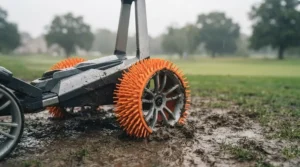
Problem: the trolley loses connection or drifts off course on hilly ground. This is precisely the scenario the MGI Zip Navigator AT‘s gyroscope tracking is built to solve — if you’re on genuinely undulating terrain, a trolley without active straight-line correction will need more manual intervention.
Problem: battery doesn’t last a full round. Check your trolley’s stated hole-count rating against your actual round length including any extra holes for lessons or practice; upgrading to a higher-capacity lithium battery, where offered, usually resolves this more cheaply than replacing the whole unit.
Problem: remote range feels shorter than advertised. Course terrain, tree cover and interference from other electronics all reduce effective range below the stated maximum — this is normal, not necessarily a fault, though it’s worth testing on open ground to rule out a genuine hardware issue.
Problem: trolley doesn’t fold compactly enough for your car boot. This varies significantly between models — the GoKart Automatic‘s unusual folded shape is a known trade-off, while models like the Motocaddy range are specifically designed around compact folding as a headline feature.
How to Choose the Right Remote Control Golf Trolley
- Decide between directional remote and true follow-me. Follow-me tech like Stewart’s Q Follow costs considerably more but frees both hands entirely; a directional remote is cheaper and still solves the core “send it ahead” need.
- Check remote range against your typical course width. Wider, more open courses benefit more from a 100m+ range than tighter parkland layouts.
- Match battery warranty length to how long you plan to keep it. A five-year warranty effectively lowers your cost-per-year if you’re a long-term owner.
- Consider whether GPS adds genuine value. If you already use a GPS watch or rangefinder, a non-GPS remote trolley likely saves you money without losing functionality you need.
- Factor in terrain type honestly. Hilly, uneven courses benefit more from active tracking tech than flat parkland does.
- Weigh brand support against import pricing. UK-based brands generally offer more straightforward servicing than imported alternatives.
- Read aggregated review sentiment, not just star averages. A single glowing professional review alongside a flagged long-term reliability concern tells you more than either alone.
Common Mistakes When Buying a Remote Control Golf Trolley
The most frequent error is buying based on remote range alone without considering whether your home course’s tree cover and layout will actually let you use that full range in practice. A second common mistake is assuming GPS functionality justifies its price premium without first checking whether you already own a GPS watch or rangefinder that does the same job. Buyers also regularly underestimate how much folded dimensions matter until they’re wrestling a trolley into a smaller hatchback boot for the first time. Finally, it’s easy to focus entirely on the trolley’s steering technology while overlooking battery warranty length, which has a much larger impact on long-term ownership cost than most buyers initially assume.
Remote Steering vs Follow-Me Technology: Which Wins?
This isn’t really a competition so much as two different solutions to the same problem. A directional remote, found on the Motocaddy, PowaKaddy, MGI and Navee models here, requires you to actively steer the trolley via buttons — simple, reliable, and generally cheaper, but it does still require your attention and one hand free to operate the handset.
Follow-me technology, as found on the Stewart Golf Q Follow, uses sensors to trail the trolley behind you automatically, freeing both hands completely for practice swings, scorekeeping or simply carrying a coffee. The trade-off is cost and a genuine learning curve — reviewers note that follow mode takes practice to use effectively, and it performs less predictably in tightly wooded or crowded fairway situations than straightforward remote steering does.
For most golfers, a good directional remote trolley solves the actual problem — not pushing a trolley — at a fraction of the cost. Follow-me technology earns its premium specifically for golfers who walk very regularly and genuinely value both hands free throughout the round, rather than as a blanket upgrade everyone should chase.
Long-Term Cost and Maintenance: What Ownership Really Costs
Battery replacement is the single biggest recurring cost across every trolley on this list, and warranty length directly affects when that cost lands. A five-year warranty, like PowaKaddy’s or Motocaddy M7’s, effectively defers that expense years longer than a three-year equivalent, which matters more the longer you intend to keep the trolley.
Servicing costs vary by brand approach: GoKart’s UK-based factory service model, where owners can send trolleys back for refurbishment, contrasts with the less centralised support structure typical of imported brands like MGI. Based on the spec comparison across this list, UK-manufactured or UK-distributed trolleys generally offer more predictable long-term servicing costs than imported alternatives, simply due to parts availability and technician familiarity.
Cost-per-round is worth calculating properly rather than guessing: divide the trolley’s total price plus one battery replacement over a realistic five-year ownership period by your typical rounds played annually, and the gap between a £450 GoKart and a £1,800 Stewart Golf narrows considerably once you’re talking pence per round rather than upfront pounds.
Wear parts beyond the battery are worth budgeting for too, even though they rarely make it into the initial spec sheet comparison. Tyres, particularly on trolleys used regularly on abrasive or gravelled paths, typically need replacing every few seasons, and remote handsets themselves — being handled, dropped, and left in bags — are a more common failure point than the trolley’s main drive system across most brands’ aggregated warranty claims. Buying a trolley from a brand with readily available spare parts, rather than one requiring a full unit replacement for a single broken component, meaningfully affects real-world ownership cost over a five-to-ten-year span, which is roughly the realistic lifespan of a well-maintained electric trolley on this list.
Safety and Practical Considerations on the Course
Remote-controlled trolleys moving unattended, even briefly, raise genuine etiquette and safety considerations most marketing material skips entirely. Always maintain a clear line of sight to your trolley when using remote steering, and never send it toward areas where other golfers, spectators or course staff might be working. Course-specific rules on trolley use, particularly around greens and tee boxes, generally apply identically to remote models as to manually pushed ones — check with your club rather than assuming remote convenience overrides local etiquette. For broader context on golf equipment regulations and course conduct, Which?’s consumer buying guides offer independently researched purchasing advice worth reading alongside brand-specific marketing.
Weather adds another practical layer worth planning for honestly. UK courses regularly serve up wet grass, standing water and muddy paths outside of high summer, and any remote trolley’s electronics are only as reliable as its waterproofing — check the IP rating where manufacturers publish one, and store the remote handset itself somewhere dry between uses rather than leaving it clipped to the trolley in persistent rain. Battery performance also drops in cold weather, which matters more in the UK than sunnier golfing destinations; expect a modest reduction in hole coverage on frosty winter mornings compared to the same battery’s summer performance, and factor that into how confidently you rely on the stated hole-count rating outside the warmer months.
Frequently Asked Questions
❓ How far can a remote control golf trolley travel from the handset?
❓ Is a follow-me golf trolley better than a remote-controlled one?
❓ Can you control a golf trolley with a smartphone app?
❓ How long do remote control golf trolley batteries last?
❓ Are premium brands like Stewart Golf worth the extra cost?
Conclusion
Choosing between these seven trolleys really comes down to being honest with yourself about what problem you’re actually solving. If it’s simply “I don’t want to push this uphill anymore,” the GoKart Automatic or Navee Birdie 3 solves that for a few hundred pounds. If you want proven, mid-range remote convenience with strong UK brand support, the Motocaddy ME Remote and PowaKaddy RX XL Plus Remote sit neatly in that space. Golfers on properly hilly terrain should look hard at the MGI Zip Navigator AT‘s tracking tech, while anyone wanting the full premium package lands on the Motocaddy M7 GPS Remote.
And then there’s the Stewart Golf Q Follow, sitting apart from everything else here — not because it’s simply more expensive, but because it’s solving a genuinely different problem: freeing your hands entirely rather than just your arms from pushing. Whether that’s worth the considerable premium depends entirely on how much you value that specific freedom, round after round, for years to come.
Recommended for You
- Motocaddy vs Powakaddy Electric Trolley: 7 Best Picks (2026)
- Electric Golf Trolley Under £500: 7 Brilliant Picks for 2026
- 7 Best Electric Golf Trolley Picks for 2026 (Top-Rated; Compared)
Disclaimer: This article contains affiliate links. As an Amazon Associate, I earn from qualifying purchases. If you purchase products through these links, we may earn a small commission at no additional cost to you.
✨ Found this helpful? Share it with your friends! 💬🤗
