
In This Article
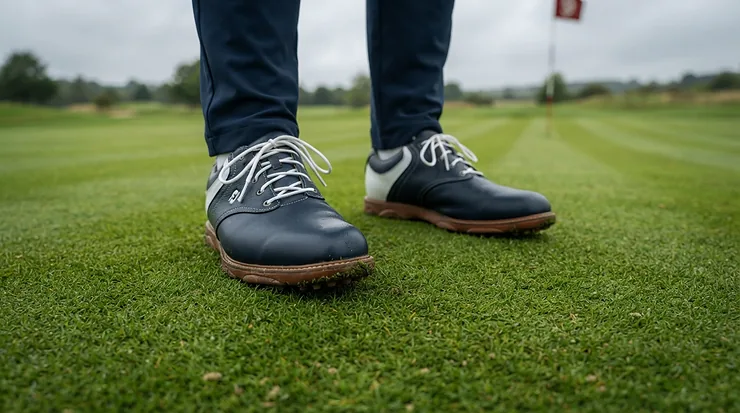
Picture the scene. You’ve just holed a nervy four-footer to win the match, the sun is sliding behind the eighteenth, and the club secretary appears at the clubhouse door. Politely, in that voice, he explains that your shoes will not be crossing the threshold. It happens more often than golfers admit.
That’s the quiet case for leather golf shoes for traditional clubs with dress codes. Plenty of modern models look like trainers that have wandered onto a fairway. Traditional clubs still expect something smarter: brogue detailing, a leather upper that takes a polish, and a sole that won’t chew up the carpet. The UK has no single fixed golf dress code, so every club writes its own rulebook. Some insist on soft spikes, and others keep golf shoes out of the dining room altogether.
This guide does three things. First, it compares seven real options, from wingtip brogues to hybrid leather, and explains what the specs mean on the course and in the bar. Second, it digs into the five details that separate a shoe that merely looks smart from one that lasts: full grain leather brogue golf shoes, classic wingtip golf shoes with soft spikes, Goodyear welt construction, leather upper care and formal clubhouse footwear. Third, it gives you a practical way to decide.
A word on method. I haven’t worn these shoes, and I won’t pretend otherwise. Everything below is built from manufacturer specifications, retailer and editorial coverage, and published club dress-code policies. Prices are given as ranges because they shift constantly, so check the current price before you buy.
Quick Comparison: Leather Golf Shoes for Traditional Clubs with Dress Codes at a Glance
Here’s the whole field on one screen. Use it to shortlist, then read the detailed write-ups below.
| Shoe | Style | Traction | Standout build detail | Price range | Best For |
|---|---|---|---|---|---|
| FootJoy Premiere Series Packard | Classic full-grain leather | Multi-cleat | Waterproof guarantee, padded collar | £130–£160 | Traditionalists who want grip |
| Royal Albartross The Tailor | Wingtip brogue | Spikeless | Italian leather, handcrafted in Portugal | Low-£200s | Style-first golfers |
| Crockett & Jones Birkdale | Country brogue with kiltie | Removable studs, leather sole | Goodyear welted, fully leather lined | Premium tier (check current price) | Heirloom buyers, strict clubs |
| ECCO Classic Hybrid | Traditional silhouette | Hybrid outsole | Gore-Tex lining | £130–£170 | All-weather everyday play |
| Lambda Roma | Classic brogue | Check sole spec | Handmade Italian leather, cork footbed | Roughly £180–£220 | Golfers who want something distinctive |
| Cole Haan Original Grand Tour | Longwing oxford | Check spec | Dress-shoe profile | Mid-range (check current price) | Smart-casual clubs |
| Adidas MC80 | Retro leather | Spikeless | Cushioned, roomy toe box | £110–£140 | Value-minded golfers at relaxed clubs |
Notice the pattern. The shoes that look most formal tend to give up either waterproofing or traction, and the grippiest options often look sportier. The FootJoy Premiere Series Packard and ECCO Classic Hybrid sit in the sensible middle at £130–£170. The Crockett & Jones Birkdale is the only one here with verified Goodyear welted construction, and it prices accordingly. Budget buyers should note that the adidas MC80 trades brogue styling for comfort and a lower price.
💬 Just one click — help others make better buying decisions too!😊
Top 7 Leather Golf Shoes for Traditional Clubs with Dress Codes: Expert Analysis
Each pick below follows the same logic: what the specs mean in practice, who the shoe suits, what reviewers and editors say, and whether the price range makes sense. Where I couldn’t verify a detail, I say so rather than guess.
1. FootJoy Premiere Series Packard — classic profile with real multi-cleat grip
The FootJoy Premiere Series Packard is built for golfers who want a traditional leather look without surrendering traction. The upper is full-grain leather with reinforced overlays at the toe and heel. Those are the two spots where leather golf shoes scuff and crack first, so the reinforcement earns its keep. The multi-cleat outsole spreads load through the swing, which on wet slopes means less foot drift on the downswing.
Based on the spec comparison, this is the safest all-rounder for a club that allows soft spikes in the locker room and bar. Confirm the cleat type in the listing, because metal spikes are banned in many clubhouses. Retailer coverage notes it runs slightly narrow, so wide-footed players should consider a wider fitting. An editorial roundup from Hole19 describes it as comfortable once the leather has relaxed and pitches it at traditionalists who still want maximum grip. That’s editorial opinion rather than a large buyer sample, so read current customer reviews before purchasing.
Pros:
- ✅ Full-grain leather with reinforced toe and heel
- ✅ Multi-cleat outsole for wet-turf stability
- ✅ Waterproof guarantee and padded collar
Cons:
- ❌ Runs slightly narrow for wide feet
- ❌ Needs a break-in period before it feels relaxed
Expect the FootJoy Premiere Series Packard to sit in the £130–£160 range. For full-grain leather with waterproofing, that’s strong value. Check current price and availability.
2. Royal Albartross The Tailor — spikeless Italian leather wingtip brogue
If clubhouse appearance is your priority, Royal Albartross The Tailor is the most overtly stylish option here. It’s described as an Italian leather wingtip brogue with a spikeless sole, handcrafted in Portugal. The brand’s wider range is built from full-grain Italian calf leather with hand-stitched construction. That produces an upper that develops a patina rather than simply wearing out.
Spikeless is the key word for dress-code purposes. A flat or lightly lugged sole is accepted in more clubhouses than any spiked shoe. The trade-off is that retailer coverage says Royal Albartross models lean on the leather’s natural water resistance rather than a synthetic membrane. Plan on regular waxing, and think twice before wearing them on a sodden January fairway. Coverage also describes a considered break-in period, so don’t debut these on a competition day.
I couldn’t verify a large pool of independent buyer reviews for this specific model, so treat the style claims as the brand’s own and read current feedback first.
Pros:
- ✅ Genuine wingtip brogue styling in Italian leather
- ✅ Spikeless sole suits many clubhouses
- ✅ Looks equally smart in the bar
Cons:
- ❌ Relies on leather’s natural water resistance
- ❌ Break-in period needs patience
Royal Albartross The Tailor sits in the low-£200s range. That’s a premium for style over athletic technology, so it’s worth it if the dress code is your main concern. Check current price.
3. Crockett & Jones Birkdale — the Goodyear welted heirloom
The Crockett & Jones Birkdale is the one shoe here that is documented as Goodyear welted. It has the silhouette of a country brogue with a kiltie. The calf leather uppers are fully leather lined, the sole is leather, and the studs are removable, with a removal tool and spare studs supplied. It’s made in the United Kingdom.
On paper this is the most “correct” shoe for a strict club. Leather lining breathes better than synthetic linings, and a welted leather sole can be resoled rather than binned. The compromise is practical: no waterproof membrane is listed, so keep these for drier rounds or treat the leather diligently. Leather soles with studs also demand more care on wet clubhouse steps.
One caveat. The only UK stockist listing I found showed the style as out of stock, so availability is uncertain. I also couldn’t verify enough independent reviews to summarise them honestly.
Pros:
- ✅ Goodyear welted construction allows resoling
- ✅ Calf leather uppers, fully leather lined
- ✅ Removable studs with tool and spares included
Cons:
- ❌ No waterproof membrane listed
- ❌ Availability uncertain
Treat the Crockett & Jones Birkdale as a heritage purchase in the several-hundred-pound bracket, though I couldn’t verify a live price. Over many seasons the resoleable build can justify it. Check current price and stock.
4. ECCO Classic Hybrid — leather elegance with Gore-Tex dryness
The ECCO Classic Hybrid answers the question most UK golfers eventually ask: can I have a smart leather shoe that survives drizzle? ECCO uses full-grain leather from its in-house tanneries. A Gore-Tex waterproof lining sits inside it, and the hybrid outsole mixes structure with strategically placed grip lugs.
That hybrid sole is the clever part. It gives you purchase on firm and lightly soft fairways, while the low-profile design is quieter and kinder to clubhouse floors than a conventional spiked shoe. The anatomical last follows the natural contour of the foot, which should reduce pressure points. The cushioned PU midsole helps on hilly layouts.
The ECCO Classic Hybrid suits golfers who play year-round and need one pair to do everything. It’s less formal than a full brogue, so check the dress code first. Retailer coverage is positive on comfort and build, but I couldn’t verify a robust independent review sample. Check current reviews.
Pros:
- ✅ Gore-Tex waterproof lining
- ✅ Full-grain leather from ECCO’s own tanneries
- ✅ Hybrid sole works across varied conditions
Cons:
- ❌ Less formal than a true wingtip
- ❌ Hybrid grip is lighter than full cleats
Expect the ECCO Classic Hybrid in the £130–£170 range, which is fair value given the waterproofing. Check current price.
5. Lambda Roma — handmade Portuguese brogue with a cork footbed
The Lambda Roma is the independent-maker option: a Portuguese handmade classic brogue in Italian leather with a cork footbed. Handmade small-batch construction tends to mean more individual character and less uniformity than factory output.
The cork footbed is a thoughtful detail. It moulds to your foot over time and adds underfoot comfort. A waterproof membrane is part of the build, which is welcome for a brogue. What I couldn’t confirm is the exact sole specification, and that matters hugely for dress codes. A spikeless sole and a spiked one face very different clubhouse rules, so check the current product page before ordering.
The Lambda Roma suits the golfer who wants something nobody else at the club owns. It’s less proven than the big-brand options, and I couldn’t verify a meaningful pool of independent buyer reviews. Read current feedback and the size guide carefully.
Pros:
- ✅ Handmade Italian leather brogue styling
- ✅ Cork footbed for comfort
- ✅ Waterproof membrane included
Cons:
- ❌ Sole specification needs checking
- ❌ Smaller review base than big brands
The brand lists the Lambda Roma from around €210 direct, which translates to roughly the £180–£220 range depending on colourway and exchange rate. That’s fair for handmade construction. Check current price.

6. Cole Haan Original Grand Tour — longwing oxford that blends with the blazer
The Cole Haan Original Grand Tour is the “dress shoe that happens to golf” option. Editorial coverage describes it as a timeless longwing oxford that looks equally good on and off the course. GolferHive’s roundup names it its best classic style pick.
The longwing oxford is a smart choice for a strict clubhouse. The wing runs the full length of the shoe, and the lace-up oxford form reads as formal. Most of its appeal is visual, which is precisely what a dress-code-driven buyer needs. What I couldn’t verify is the full sole and waterproofing specification, and availability in the UK varies, so confirm both before buying.
Because the Cole Haan Original Grand Tour leans toward dress-shoe styling, treat it as a better fit for players who walk fewer wet rounds. Independent buyer-review data was thin in my research, so check current reviews.
Pros:
- ✅ Longwing oxford profile suits formal clubs
- ✅ Equally at home off the course
- ✅ Strong editorial praise for classic style
Cons:
- ❌ Full spec details need verifying
- ❌ UK availability can vary
I’d place the Cole Haan Original Grand Tour in the mid-range bracket, though I couldn’t verify a live UK price. Value depends on your dress-code needs. Check current price.
7. adidas MC80 — retro leather that keeps costs sensible
The adidas MC80 is the value pick. Retailer coverage describes a full-grain leather upper, a spikeless rubber outsole, a waterproof upper, a cushioned midsole and a roomy toe box. It’s the shoe for a club whose dress code says “smart casual” rather than “jacket required”.
Be realistic about what it is. It’s a retro-inspired leather golf shoe rather than a brogue, so a very strict committee may see it as sporty. The low-profile spikeless sole provides good ground contact on firm UK turf and keeps clubhouse floors safe. The roomy toe box suits wider feet.
If you want an affordable entry into leather and your club accepts spikeless shoes, the adidas MC80 makes sense. If your dress code specifically mentions “traditional golf shoes”, look higher up this list. I couldn’t verify a large independent review sample, so check current reviews.
Pros:
- ✅ Lowest price of the seven
- ✅ Spikeless sole is clubhouse-friendly
- ✅ Roomy toe box and cushioned midsole
Cons:
- ❌ Not a brogue or wingtip
- ❌ May look sporty at the strictest clubs
Expect the adidas MC80 in the £110–£140 range, which is excellent value for leather. Check current price.
What Are Leather Golf Shoes for Traditional Clubs with Dress Codes?
Leather golf shoes for traditional clubs with dress codes are smart golf shoes made from full-grain or calf leather, usually styled as brogues, wingtips or longwings. They use soft spikes or spikeless soles, avoid sporty design cues, and stay polished enough for the clubhouse, so they satisfy both the course rules and the dress code.
Why the distinction? A performance golf shoe is judged only on the course. A shoe for a traditional club is judged twice: once on the tee and again at the bar. That second audience is the secretary, the committee, and the member who has strong views on footwear. The shoes that pass both tests share a few traits: leather uppers that can be polished, restrained colours (black, brown, tan, white with leather trim), classic toe-cap shapes, and soles that won’t scar the floor.
The next sections break down each of those traits, starting with how to choose.
How to Choose Leather Golf Shoes for Traditional Clubs with Dress Codes
Follow these six steps in order. Each one narrows the field before you spend a penny.
- Read the club’s dress code first. Look for the exact wording on spikes, clubhouse access and dining areas. Some clubs allow clean soft spikes in the bar; others ban golf shoes from the dining room entirely.
- Decide between spiked, spikeless or hybrid. Spiked soles grip best on wet turf. Spikeless and hybrid soles are accepted in more clubhouses and are more comfortable to walk in.
- Check the leather grade. “Full-grain” means the top layer hasn’t been sanded away, so it ages better. “Genuine leather” is a looser term and can mean lower-grade material.
- Pick the styling to match the club’s formality. Wingtips and longwings read as traditional. Plain-toe or sporty shapes read as casual.
- Prioritise waterproofing for UK conditions. A membrane like Gore-Tex or a waterproof guarantee matters more than extra leather detail on a wet November round.
- Get width and size right. Leather moulds to your foot, but it can’t fix a shoe that’s too narrow from day one.
Further analysis: if you can only get one thing right, make it step one. A beautiful shoe that is barred from the bar is an expensive mistake.
Full Grain Leather Brogue Golf Shoes: Why the Leather and the Perforations Matter
The brogue earned its place on the golf course honestly. According to Wikipedia’s entry on the brogue shoe, the style traces back to a rudimentary Scottish and Irish shoe of untanned hide, perforated so water could drain when crossing boggy ground. Brogues appeared on golf courses in the early twentieth century and were even considered a kind of sports shoe.
Today the perforations are decorative, but the heritage still shapes the dress-code hierarchy. A fuller brogue (with perforations and serrations along the toe cap and wing) is considered more country and less formal, while quarter and semi brogues are more understated. For a very strict club, a quarter or semi brogue is the safer bet. A full wingtip suits clubs that embrace the country-sporting look.
Now the leather itself. Full grain leather brogue golf shoes keep the strongest, most breathable layer of the hide intact, which is why they mould to your foot and take a patina rather than peeling. Corrected or “genuine” leather can look identical on day one but tends to crack sooner under repeated flexing and soaking. If a listing is vague about the grade, assume it isn’t full-grain.
In this round-up, the FootJoy Premiere Series Packard, ECCO Classic Hybrid and adidas MC80 are described as full-grain. The Royal Albartross The Tailor is described as Italian leather, and the Crockett & Jones Birkdale uses calf leather. These are strong signals, but confirm the exact grade on the current listing.
Classic Wingtip Golf Shoes with Soft Spikes: Where Tradition Meets the Turf
Pair a classic wingtip with soft spikes and you get the combination most traditional clubs quietly prefer. The shoe looks right, and the sole protects the greens and the clubhouse floor.
Here’s why it matters. Published guidance from England Golf’s iGolf site says soft spikes are generally preferred over metal, which can damage the turf. Individual club policies bear this out: The Rolls of Monmouth permits clean soft-spike shoes in its clubhouse but bans metal spikes there and on the patio, and Ashford Golf Club says metal spikes are not permitted. Metal spikes are the first thing to rule out.
Soft spikes themselves are worth understanding. They’re plastic cleats that replace worn ones, so keeping a spare set and the right tool in your bag is cheap insurance. A worn soft spike can slip on wet grass, which defeats the point of a spiked shoe. The Crockett & Jones Birkdale ships with a removal tool and spare studs, which is the traditional approach. The FootJoy Premiere Series Packard uses a multi-cleat outsole, and you should confirm the cleat type in the listing.
One more trap: even soft spikes aren’t welcome everywhere. Leeds Golf Club lists golf shoes, even with soft spikes, among items not acceptable in the clubhouse. At that kind of club, a spikeless wingtip like the Royal Albartross The Tailor is still a tight fit, so bring a change of shoes.
Goodyear Welt Construction in Golf Shoes: Is It Worth Paying For?
Goodyear welt construction is the benchmark for traditional dress shoes, and it’s worth understanding why. As Wikipedia’s explanation of the Goodyear welt puts it, a welt is stitched to the upper and insole, a cavity is filled with cork, and the outsole is then attached to the welt. The result is relatively waterproof, and it can be resoled as long as the upper remains viable. It’s also more expensive to manufacture than machine-moulded alternatives.
Loake, one of Northampton’s best-known makers, says Goodyear welted shoes offer a near-perfect balance of weather resistance, durability, breathability and comfort, and can be dismantled and rebuilt when resoling is needed. Northamptonshire makers like Barker, Grenson, Loake and Tricker’s have built their reputations on the technique.
In golf, though, welted shoes are rare. Among the seven picks here, only the Crockett & Jones Birkdale is documented as Goodyear welted. For the others, manufacturers don’t highlight welt construction in the listings I reviewed, so assume it isn’t welted unless the product page says so.
Is it worth paying for? If you play often and want one pair for a decade, probably yes, because resoling turns a purchase into an investment. If you play occasionally or want waterproof technology, a modern membrane shoe like the ECCO Classic Hybrid may serve you better. A practical middle route is a modern golf shoe for the course and a welted brogue from a Northampton maker for the clubhouse.
Formal Clubhouse Footwear: What Traditional Dress Codes Actually Allow
Clubhouse footwear is where dress codes bite hardest, and the rules vary wildly even within a few miles. These published examples show the spread (policies may change, so always check with the club):
- Leeds Golf Club lists trainers and golf shoes, even with soft spikes, as unacceptable in the clubhouse.
- Easingwold Golf Club keeps spiked shoes out of the main lounge and dining area but welcomes them in its spike bar.
- Ashford Golf Club allows clean, dry soft-spike or dimple shoes but no golf shoes in the dining area during sit-down meals, and no metal spikes at all.
- Sandbach Golf Club bars metal spikes from the lounge and dining room, but clean pimples and soft spikes are allowed.
| Footwear type | Typical clubhouse stance | Risk at strict clubs | Best For |
|---|---|---|---|
| Metal spikes | Almost universally banned | Very high | Nobody at a traditional club |
| Soft-spike leather | Often allowed in bar if clean | Medium | FootJoy Premiere Series Packard |
| Spikeless or hybrid leather | Widely accepted | Low | ECCO Classic Hybrid, adidas MC80 |
| Wingtip brogue, spikeless | Widely accepted, looks formal | Very low | Royal Albartross The Tailor |
| Change shoes (welted brogue) | Always accepted | None | Crockett & Jones Birkdale as a heritage option |
The table shows a clear pattern: the less aggressive the sole, the safer the clubhouse. Metal spikes are out everywhere, soft spikes are a coin-toss at stricter clubs, and spikeless brogues like the Royal Albartross The Tailor are the lowest-risk golf shoes. If your club is Leeds-style strict, the real solution is a change of shoes, not a cleverer golf shoe.
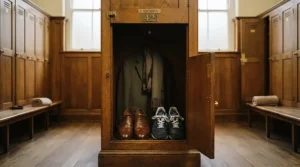
Leather Upper Care: A 30-Day Practical Guide
Good leather rewards routine and punishes neglect. Here’s a simple 30-day plan that works for any of the shoes above.
Days 1–7: the gentle break-in. Wear the shoes around the house in short sessions with golf socks before you take them out on the course. Leather needs time to mould, and a blister on the fourth hole ruins a round. This matters most for the Royal Albartross The Tailor and the Lambda Roma, where handmade leather benefits from a considered break-in.
After every round: knock off mud with a soft brush, wipe the uppers with a damp cloth, remove the insoles, and let the shoes dry naturally. Never use a radiator or hairdryer, because heat bakes the leather and makes it crack.
Every few weeks: apply a quality leather cream or conditioner to keep the upper supple. FootJoy-focused retailer guidance recommends exactly this cadence for wet UK seasons. If a shoe relies on the leather’s natural water resistance (as the Royal Albartross The Tailor does), add a wax coat for protection.
Rotation and storage: alternate between two pairs if you play more than twice a week, and use cedar shoe trees to hold the shape and absorb moisture. Leather needs a day or two to dry fully.
Common first-month mistakes: over-conditioning (which can soften leather too much), skipping the brush before cream (which grinds grit into the leather), and drying on a heater. Treat the leather upper as a long-term asset, and it will return the favour.
Real-World Scenarios: Matching Leather Golf Shoes to Real Golfers
These three hypothetical profiles show how the analysis above turns into a decision.
The twice-a-week member at a strict club. Budget £150–£250, plays all year, wants one pair for course and bar. The ECCO Classic Hybrid covers wet weather and hybrid grip, and a pair of Northampton welted brogues covers the clubhouse if the rules are tight. If the club is relaxed about soft spikes, the FootJoy Premiere Series Packard is a strong alternative.
The occasional society golfer. Budget under £150, plays perhaps six rounds a year at links and parkland courses, often on dry summer days. The adidas MC80 is the sensible choice, because a spikeless sole is accepted widely and a lower price makes sense for low usage.
The heritage buyer. Budget is flexible, plays 60 or more rounds a year, and values repairable products. The Crockett & Jones Birkdale fits, since the Goodyear welted construction can be resoled and the removable studs are replaceable. For a more modern-looking alternative, the Royal Albartross The Tailor gives the same smart look with a spikeless sole.
The decision framework is simple. If the club is strict about golf shoes in the clubhouse, choose spikeless or plan a change of shoes. If you play a lot in the wet, prioritise waterproofing. If you want longevity, prioritise leather quality and repairability.
✨ Don’t Miss These Exclusive Deals!
🔍 Take your clubhouse confidence to the next level with these carefully selected leather golf shoes. Click on any highlighted product to check current pricing and availability. These picks will help you walk into the bar looking the part and walk off the eighteenth with dry feet!
Leather vs Modern Spikeless and Synthetic: Which Wins at a Traditional Club?
Traditional leather isn’t the only option, so here’s how it compares to the alternatives.
| Option | Clubhouse acceptance | Wet-weather performance | Longevity | Best For |
|---|---|---|---|---|
| Traditional leather brogue | Excellent | Depends on membrane or care | Long with care | Royal Albartross The Tailor |
| Leather hybrid with membrane | Very good | Excellent | Long | ECCO Classic Hybrid |
| Spikeless leather | Very good | Good | Good | adidas MC80 |
| Synthetic performance shoe | Variable, often poor at strict clubs | Excellent | Medium | Players at relaxed clubs |
In plain terms, leather wins on acceptance and ageing, while synthetic wins on lightweight comfort and often on waterproofing. The hybrid leather route (the ECCO Classic Hybrid) captures most of the benefit of both, which is why it’s such a popular compromise.
Here’s the deeper point. A synthetic performance shoe can be brilliant for the game and still fail the dress code. A traditional brogue can be perfect for the dress code and mediocre in a downpour. The right choice depends on which constraint bites harder at your club. If the dress code is the constraint, buy leather. If wet-weather grip is the constraint, buy a leather hybrid with a membrane, and carry a change of shoes for the bar.
Long-Term Cost & Maintenance: What Leather Golf Shoes Really Cost per Round
Sticker price is a poor guide to value. Cost per round tells the real story.
Take a pair in the £130–£160 range, like the FootJoy Premiere Series Packard. If you play 40 rounds a year and the shoes last three seasons, that’s 120 rounds, working out at roughly £1.10–£1.35 per round. Add a few pounds a year for leather cream and replacement soft spikes, and the number barely moves.
Now consider a premium welted pair. If a hypothetical £450 shoe like the Crockett & Jones Birkdale lasts 10 seasons at 40 rounds a year, that’s 400 rounds, or about £1.10 per round before resoling costs. The ability to resole is what makes the premium arithmetic work, though resoling itself costs extra and I haven’t verified current prices.
| Tier | Typical range | Example | Value logic |
|---|---|---|---|
| Entry leather | £110–£140 | adidas MC80 | Cheapest way into leather |
| Core leather | £130–£170 | FootJoy Premiere Series Packard, ECCO Classic Hybrid | Best balance of waterproofing and price |
| Style and craft | Low-£200s | Royal Albartross The Tailor | Pays for styling and craftsmanship |
| Heritage | Several hundred pounds | Crockett & Jones Birkdale | Pays off through longevity and resoling |
This table makes the trade-off visible. Core leather offers the best price-to-protection ratio, entry leather is the best way to dip a toe in, and heritage shoes only make sense if you’ll genuinely use them for years. Add to the shoe cost a decent pair of cedar shoe trees and a tin of cream, and you’ve covered most of the upkeep.
Common Mistakes When Buying Leather Golf Shoes for Traditional Clubs with Dress Codes
These are the pitfalls that cost people money and embarrassment.
Assuming “golf shoe” means “clubhouse shoe.” England Golf’s iGolf guidance notes that traditional clubs typically expect smart attire and soft-spike golf shoes, but individual clubs vary widely. England Golf’s what-to-wear guide recommends checking the dress code before you go to avoid being turned away. Always ring ahead.
Buying on looks alone. A gorgeous brogue with a leather sole can be treacherous on wet grass. Match the sole to your typical conditions.
Trusting the word “leather.” “Genuine leather” and “full-grain leather” are not the same thing. If the listing doesn’t specify, ask or look elsewhere.
Ignoring width. Leather moulds, but it can’t turn a narrow shoe into a wide one. The FootJoy Premiere Series Packard runs slightly narrow, so wide-footed players should check fittings.
Skipping waterproofing. Wet feet ruin rounds. If a shoe has no membrane, like the Royal Albartross The Tailor, commit to waxing.
Relying on one pair. Rotating two pairs lets each dry fully and extends life considerably.
Forgetting spikes need maintenance. Worn soft spikes lose grip and can scuff floors. Keep spares and a tool in your bag.

FAQ
❓ Can I wear soft-spike leather golf shoes in a traditional clubhouse?
❓ Are Goodyear welted golf shoes worth the extra money?
❓ How long do full grain leather brogue golf shoes usually last?
❓ Are classic wingtip golf shoes with soft spikes waterproof?
❓ How do I break in leather golf shoes without blisters?
Conclusion
The right pair of leather golf shoes for traditional clubs with dress codes does two jobs: it keeps you steady on the tee, and it keeps the committee happy at the bar. In this round-up, the FootJoy Premiere Series Packard offers the best blend of classic styling and grip, and the ECCO Classic Hybrid is the sensible all-weather choice. The Royal Albartross The Tailor leads on pure style, the Crockett & Jones Birkdale is the heritage option with Goodyear welted construction, and the Lambda Roma and Cole Haan Original Grand Tour suit golfers who want something less common or more dress-shoe in feel. The adidas MC80 is the budget way into leather.
Remember the order of operations. Read your club’s dress code first, decide between spiked, spikeless and hybrid, check the leather grade, and look after the upper once you own it. Where I couldn’t verify a detail, such as sole specifications, live prices or large review samples, check the current listing rather than assume.
Recommended for You
- Golf Trainers For The Driving Range And Clubhouse: 7 Best Buys (2026)
- Waterproof Golf Shoes For Wet British Winters: 7 Proven Picks (2026)
- Spikeless Golf Shoes For Walking Hilly Courses: 7 Proven Picks 2026
Disclaimer: This article contains affiliate links. As an Amazon Associate, I earn from qualifying purchases. If you purchase products through these links, we may earn a small commission at no additional cost to you.
✨ Found this helpful? Share it with your friends! 💬🤗
