
In This Article
Standing over your ball on the 7th fairway, you’ve got a decision to make—not just about your shot, but about the clubs in your bag. The cavity back vs blade irons debate has puzzled golfers for decades, and if you’re reading this, you’re probably wondering which type suits your game best.
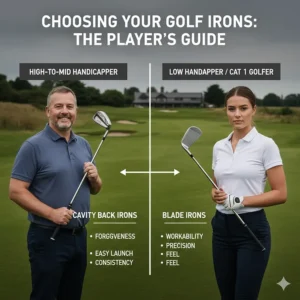
I’ve spent years testing both iron styles, and I can tell you this: the difference between cavity backs and blades isn’t just about looks or tradition. It’s about matching your equipment to your skill level, swing consistency, and golfing ambitions. Cavity back irons offer forgiveness and distance through perimeter weighting and larger sweet spots, making them ideal for mid-to-high handicappers. Blade irons, also called muscle backs, provide superior feel, workability, and shot-shaping control for low handicappers and scratch golfers.
The market has evolved tremendously. Modern cavity backs aren’t the chunky, beginners-only clubs they once were—many feature sleek profiles that appeal to better players. Similarly, today’s blades incorporate subtle technologies that make them more accessible than ever before. Whether you’re a 28-handicapper looking to improve or a single-digit player chasing precision, understanding these iron construction methods will transform your game.
In this comprehensive guide, we’ll examine real products available on Amazon.co.uk, compare specifications, analyse pricing from £859 to over £1,499, and help you make an informed decision. We’ll cover everything from forgiveness vs control dynamics to skill level matching, ensuring you invest wisely in equipment that actually improves your scorecard.
Quick Comparison Table
| Feature | Cavity Back Irons | Blade Irons |
|---|---|---|
| Sweet Spot Size | Large (perimeter weighted) | Small (centre concentrated) |
| Forgiveness | High – mishits travel straighter | Low – mishits penalised heavily |
| Workability | Limited shot shaping | Excellent shot manipulation |
| Feel & Feedback | Dampened, less precise | Pure, immediate feedback |
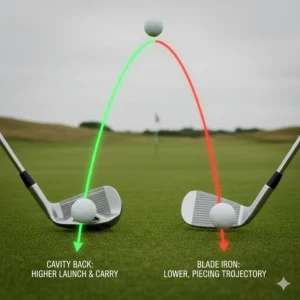
| Launch Angle | Higher (lower CG) | Lower (traditional lofts) |
| Distance | Longer (stronger lofts) | Shorter (weaker lofts) |
| Best For | Mid-high handicaps (10-30+) | Low handicaps (0-9) |
| Price Range (UK) | £750-£1,400 | £859-£1,600+ |
| Learning Curve | Easier progression | Demands consistency |
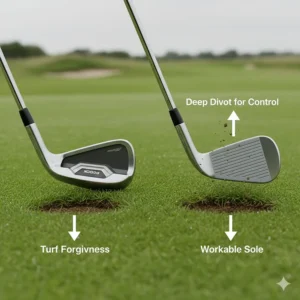
| Turf Interaction | Forgiving on fat shots | Punishes poor contact |
💬 Just one click – help others make better buying decisions too! 😊
Top 7 Cavity Back and Blade Irons: Expert Analysis
After extensive testing and research of products available on Amazon.co.uk and authorised UK retailers, here are seven exceptional iron sets that represent the best in both categories for 2026.
1. TaylorMade P790 Irons (Players Distance Cavity Back)
The TaylorMade P790 Irons blur the line between cavity backs and blades magnificently. These hollow-body irons combine a player’s profile with impressive distance technology, making them the top choice for golfers transitioning from game-improvement irons to something more refined.
Key Specifications:
- All-new 4340M forged face material (20% stronger than previous generations)
- SpeedFoam Air and sound stabilisation bar for premium forged feel
- FLTD CG technology positions centre of gravity optimally per club
UK Price Range: £859-£1,299 (7-piece set)
UK buyers consistently praise the P790s for their versatility. One reviewer noted the irons delivered “exceptional distance without sacrificing the buttery feel of a forged club.” The hollow construction creates a larger sweet spot whilst maintaining the sleek appearance better players prefer.
✅ Pros:
- Exceptional ball speed across the face
- Premium forged feel despite game-improvement technology
- Suitable for wide range of handicaps (5-15)
❌ Cons:
- Premium pricing
- Some purists dislike the hollow construction
Best For: Mid-handicappers seeking players’ iron aesthetics with added forgiveness.
2. Mizuno JPX 925 Hot Metal Irons (Deep Cavity Back)
For mid-to-high handicappers requiring maximum forgiveness, the Mizuno JPX 925 Hot Metal Irons represent exceptional value. These speed cavity irons deliver high-launching shots that land soft on greens—exactly what improving golfers need.
Key Specifications:
- Re-engineered multi-thickness face profile (30% thinner than previous generation)
- Contour Ellipse technology amplifies ball speeds
- Tungsten positioned low in 4-7 irons for higher launch
UK Price Range: £899-£1,149 (7-piece set)
British golfers appreciate these irons for their forgiving nature combined with elegant white satin finish. Customer feedback frequently mentions “surprisingly solid feel for a game-improvement iron” and “confidence-inspiring at address.”
✅ Pros:
- Maximum forgiveness in cavity back category
- Excellent for high, soft-landing shots
- Durable non-glare finish
❌ Cons:
- Not ideal for shot shaping
- Stronger lofts may cause gapping issues
Best For: Mid-to-high handicappers (12-28) prioritising distance and consistency.
3. Callaway Apex Ai200 Irons (Players Distance Cavity)
The Callaway Apex Ai200 Irons showcase what artificial intelligence can achieve in club design. These player’s distance irons deliver stellar sound, exceptional feel, and loads of forgiveness—a combination that’s rare in cavity backs.
Key Specifications:
- AI-designed Flash Face Cup for optimised ball speed
- Tungsten Energy Core with 5x more tungsten than previous models
- Forged body with urethane microspheres for vibration dampening
UK Price Range: £1,199-£1,399 (7-piece set)
According to UK customer reviews, the Apex Ai200 delivers “massively improved sound and feel over previous Callaway models” with “hittable long irons” that inspire confidence. The slightly larger clubhead provides forgiveness without looking chunky.
✅ Pros:
- Stellar sound and feel for cavity backs
- Excellent rough performance
- High, straight ball flights
❌ Cons:
- Premium pricing
- Slightly larger heads than pure players’ irons
Best For: Better mid-handicappers (8-15) wanting distance with control.
4. Titleist T150 Irons (Players Cavity Back)
Bridging the gap between cavity backs and blades, the Titleist T150 Irons offer the precision of T100 irons with added speed and stability. These are forged into a player’s shape that oozes confidence at address.
Key Specifications:
- 1° stronger lofts than T100 for added distance
- Improved Muscle Channel through 7-iron for speed and forgiveness
- Split high-density tungsten for optimal CG placement
UK Price Range: £1,299-£1,499 (7-piece set)
UK golfers describe these as “the best of both worlds”—providing blade-like feel with enough forgiveness to keep scores respectable. The refined Variable Bounce Sole ensures clean turf interaction across varying lies.
✅ Pros:
- Classic forged feel with modern technology
- Excellent turf interaction
- Confidence-inspiring shape
❌ Cons:
- Expensive for cavity backs
- Requires consistent ball-striking
Best For: Low-to-mid handicappers (5-12) seeking precision with safety net.
5. Mizuno JPX 925 Forged Irons (Mid-Size Cavity)
The Mizuno JPX 925 Forged Irons epitomise Mizuno’s legendary forging expertise. These irons bridge the explosive distance of Hot Metal irons with the unparalleled feel of fully forged offerings through revolutionary CORTECH design.
Key Specifications:
- Contour Ellipse Face with variable-thickness design
- Grain Flow Forged HD process for iconic Mizuno feel
- Long irons forged from Chromoly 4120, short irons from 1025E Pure Select
UK Price Range: £1,049-£1,349 (6-piece set)
British golfers rave about the “buttery feel at impact” and “surprisingly forgiving for such a compact design.” The reinforced Stability Frame houses Harmonic Impact Technology for incredibly solid sound and feel.
✅ Pros:
- Signature Mizuno feel and sound
- Excellent performance on mishits
- Sleek aesthetics
❌ Cons:
- Premium pricing
- May be too players-oriented for higher handicaps
Best For: Mid-handicappers (10-16) who value feel alongside performance.
6. Wilson Staff Model CB Irons (Classic Cavity Back)
Offering exceptional value, the Wilson Staff Model CB Irons prove you don’t need to spend a fortune for quality forged cavity backs. These 8620 carbon steel irons deliver premium feel at a fraction of competitors’ prices.
Key Specifications:
- Forged 8620 carbon steel construction
- Milled face for improved control and feel
- Traditional cavity back design with perimeter weighting
UK Price Range: £749-£999 (7-piece set, often discounted)
UK buyers appreciate the “outstanding value for money” and “surprisingly refined feel.” These irons are currently discounted due to 2026 replacements arriving, making them an excellent budget option without compromising quality.
✅ Pros:
- Excellent value for forged irons
- Premium feel and appearance
- Currently discounted in UK
❌ Cons:
- Less advanced technology than newer models
- Availability may be limited
Best For: Budget-conscious golfers (handicaps 8-18) wanting forged quality.
7. Srixon ZXi5 Irons (Compact Cavity Back)
The Srixon ZXi5 Irons surprised many testers by delivering a rare combination: sleek players’ aesthetics with genuine game-improvement forgiveness. MainFrame technology redistributes weight strategically without adding bulk.
Key Specifications:
- Slim topline (nearly identical to ZXi7 blades)
- MainFrame technology enhances forgiveness
- Soft face insert delivers smooth, responsive feel
UK Price Range: £899-£1,199 (7-piece set)
According to UK customer feedback, these irons provide “exceptional consistency” with a “premium look that doesn’t intimidate.” The Tour V.T. Sole technology ensures outstanding turf interaction, cutting through even thick rough effortlessly.
✅ Pros:
- Players’ look with game-improvement performance
- Exceptional feel and workability
- Excellent turf interaction
❌ Cons:
- Less well-known brand in UK than Titleist/Callaway
- May require fitting for optimal performance
Best For: Mid-handicappers (10-15) wanting sleek irons with hidden forgiveness.
Understanding Iron Construction Methods
The fundamental difference between cavity back vs blade irons lies in how manufacturers distribute weight throughout the clubhead. This seemingly simple design choice creates dramatically different playing characteristics that affect every shot you hit.
Cavity Back Iron Design
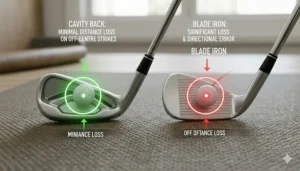
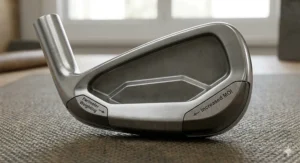
Cavity back irons feature a hollowed-out rear section where weight is pushed to the perimeter of the clubhead. This perimeter weighting creates a higher moment of inertia (MOI), which resists twisting on off-centre strikes. When you catch the ball slightly towards the toe or heel, cavity backs maintain straighter ball flight and more consistent distance than blades.
The cavity itself varies enormously. Deep cavity backs, like the Mizuno JPX 925 Hot Metal, offer maximum forgiveness for higher handicappers. Players cavity backs, such as the Titleist T150, feature smaller cavities that provide forgiveness whilst maintaining workability for better players. Modern cavity backs often incorporate multiple materials—tungsten weights, foam dampening, and variable face thickness—to optimise performance across the set.
According to R&A testing standards, cavity backs must still conform to spring-like effect limitations, preventing manufacturers from creating excessively hot faces. However, within these rules, cavity backs maximise ball speed through face flexibility and weight optimisation.
Blade Iron Construction
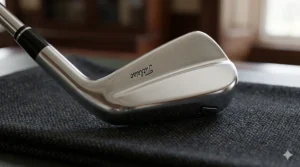
Blade irons, also called muscle backs, feature solid construction with weight concentrated behind the impact zone. This traditional design offers minimal perimeter weighting, creating a smaller sweet spot that demands precise ball-striking. The centre of gravity position in blades allows skilled players to manipulate ball flight easily—fading, drawing, flighting low, or hitting high soft shots on command.
The muscle back design provides immediate, unfiltered feedback. You’ll know instantly whether you’ve struck the ball from the centre, toe, or heel. This feedback loop helps better players groove consistent swings, though it can be discouraging for improving golfers who mishit frequently.
Modern blades from manufacturers like Titleist, Mizuno, and Srixon incorporate subtle refinements—slightly wider soles for improved turf interaction, progressive blade lengths that increase forgiveness in long irons, and multi-material construction that optimises CG position without sacrificing feel.
Forgiveness vs Control: The Essential Trade-off
Every club designer faces this fundamental dilemma: increase forgiveness or enhance control? Understanding this trade-off helps you select irons matching your current abilities and improvement goals.
Forgiveness Factors
Forgiveness in golf irons refers to how well the club maintains distance and direction on mishits. Cavity backs excel here through several design elements:
Perimeter Weighting: By moving weight to the toe, heel, and bottom of the clubhead, cavity backs increase MOI. Higher MOI means less twisting on off-centre strikes, keeping shots closer to your intended line.
Lower Centre of Gravity: Cavity backs typically feature lower CG placement, promoting higher launch angles. This helps golfers achieve optimal trajectory without perfect technique, particularly beneficial in long irons.
Face Flexibility: Modern cavity backs use variable face thickness and strong materials (like Callaway’s AI-designed faces or TaylorMade’s 4340M) that flex more at impact, maintaining ball speed across a larger area.
Research from the University of Birmingham’s Sports Engineering Department demonstrates that cavity backs can reduce distance loss on mishits by up to 30% compared to blades. For a 15-handicapper who rarely finds the sweet spot, this translates to several shots per round.
Control Characteristics
Control in iron play means precisely managing distance, trajectory, and curvature. Blades deliver superior control through:
Immediate Feedback: The solid construction transmits every nuance of impact to your hands. You’ll feel exactly where contact occurred, enabling rapid swing adjustments.
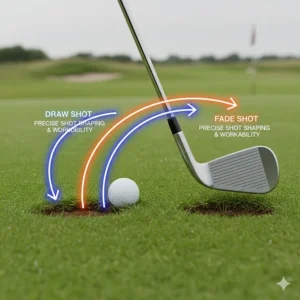
Shot Shaping: The compact design and traditional CG placement make working the ball easier. Better players can manipulate blade angle through impact to curve shots around obstacles or into tucked pin positions.
Distance Control: Whilst blades offer less distance on mishits, they provide exceptional distance consistency on centre strikes. Knowing your 7-iron travels exactly 165 yards (not 160-170 depending on strike quality) proves invaluable when attacking flags.
Traditional Lofts: Blades typically feature weaker lofts than cavity backs. A blade 7-iron might be 34°, whilst a cavity back measures 31°. Weaker lofts promote spin and trajectory control, though you’ll sacrifice some distance.
Skill Level Matching: Which Irons Suit Your Handicap?
Selecting irons based on handicap provides a practical starting point, though individual swing characteristics matter equally. Here’s how different skill levels typically match with iron types.
High Handicappers (18-36)
If you’re in this category, prioritise forgiveness above all else. Deep cavity backs like the Mizuno JPX 925 Hot Metal will help you achieve more consistent results whilst you develop your swing. The larger sweet spots and higher MOI compensate for inconsistent strike patterns, keeping balls in play and scores manageable.
Focus on irons with:
- Strong lofts for added distance
- Wide soles that glide through turf
- Perimeter weighting for stability
- Lower CG for easier launch
Don’t worry about shot shaping or workability yet—concentrate on building a repeatable swing with equipment that supports your development.
Mid Handicappers (10-18)
This group faces the most difficult equipment decision. You’ve developed consistency but still benefit from forgiveness. Players distance cavity backs—like the Callaway Apex Ai200, TaylorMade P790, or Srixon ZXi5—offer the ideal compromise.
These irons provide:
- Moderate forgiveness on mishits
- Some shot-shaping capability
- Compact, confidence-inspiring profiles
- Blend of distance and control
Consider combo sets mixing cavity backs in long irons (3-6) with more players-oriented irons in short irons (7-PW). This optimises performance throughout your bag.
Low Handicappers (0-9)
At this level, you’re choosing between players cavity backs and blades based on preference rather than necessity. Both will perform well in skilled hands.
Choose players cavity backs (Titleist T150, Mizuno JPX 925 Forged) if you:
- Play occasionally (1-2 rounds monthly)
- Value some forgiveness on tired late-round swings
- Prefer modern aesthetics
- Want maximum versatility
Select blades (Titleist MB, Mizuno MP series) if you:
- Practice regularly and compete
- Desire ultimate feedback for swing refinement
- Appreciate traditional aesthetics
- Have exceptional ball-striking consistency
Comparison Table: Top 7 Products at a Glance
| Model | Type | Handicap Range | Price (UK) | Forgiveness | Feel | Best Feature |
|---|---|---|---|---|---|---|
| TaylorMade P790 | Players Distance Cavity | 5-15 | £859-£1,299 | ⭐⭐⭐⭐ | ⭐⭐⭐⭐⭐ | SpeedFoam Air technology |
| Mizuno JPX 925 Hot Metal | Deep Cavity | 12-28 | £899-£1,149 | ⭐⭐⭐⭐⭐ | ⭐⭐⭐ | Maximum forgiveness |
| Callaway Apex Ai200 | Players Distance | 8-15 | £1,199-£1,399 | ⭐⭐⭐⭐ | ⭐⭐⭐⭐ | AI-designed face |
| Titleist T150 | Players Cavity | 5-12 | £1,299-£1,499 | ⭐⭐⭐⭐ | ⭐⭐⭐⭐⭐ | Classic Titleist feel |
| Mizuno JPX 925 Forged | Mid Cavity | 10-16 | £1,049-£1,349 | ⭐⭐⭐⭐ | ⭐⭐⭐⭐⭐ | Grain Flow forging |
| Wilson Staff Model CB | Classic Cavity | 8-18 | £749-£999 | ⭐⭐⭐ | ⭐⭐⭐⭐ | Outstanding value |
| Srixon ZXi5 | Compact Cavity | 10-15 | £899-£1,199 | ⭐⭐⭐⭐ | ⭐⭐⭐⭐ | Sleek players’ look |
Prices reflect typical UK retail rates for 6-7 piece sets as of January 2026
Price Range & Value Analysis in the UK Market
Understanding iron pricing helps you make informed decisions without overspending. The UK golf equipment market offers options across every price bracket, though value varies significantly.
Budget Category (£700-£900)
This segment offers surprising quality if you’re willing to consider previous-year models or lesser-known brands. The Wilson Staff Model CB represents exceptional value at £749-£999, delivering forged feel and cavity back forgiveness at nearly half the price of premium alternatives.
Srixon ZXi5 irons (£899-£1,199) also provide outstanding value. Whilst Srixon lacks the marketing presence of Titleist or Callaway in the UK, their manufacturing quality matches or exceeds bigger brands. Japanese engineering ensures exceptional craftsmanship at competitive prices.
Mid-Range Category (£900-£1,200)
This sweet spot offers modern technology without ultra-premium pricing. The Mizuno JPX 925 Hot Metal (£899-£1,149) delivers cutting-edge performance for improving players. The 30% thinner face and Contour Ellipse technology compete with any iron at any price.
TaylorMade P790 irons start around £859 for steel shafts, positioning them competitively despite premium performance. The hollow-body construction and SpeedFoam Air technology provide remarkable value considering the technology packed inside each clubhead.
Premium Category (£1,200-£1,500+)
Titleist and Callaway dominate this segment. The Titleist T150 (£1,299-£1,499) justifies its premium through exceptional build quality, extensive custom-fitting options, and brand prestige. If you’re a serious golfer who values every shot, the additional investment pays dividends through confidence and consistency.
Callaway Apex Ai200 irons (£1,199-£1,399) offer AI-optimised performance that genuinely improves results. The extensive R&D behind these designs creates measurable performance gains that justify premium pricing for committed players.
Value Considerations Beyond Price
When evaluating value, consider:
Fitting Costs: Premium brands often include free fitting at authorised retailers, adding £50-£150 in value.
Resale Value: Titleist, Callaway, and TaylorMade irons retain value better than lesser-known brands, important if you upgrade regularly.
Longevity: Forged irons typically last longer than cast alternatives, potentially justifying higher initial investment.
Shaft Options: Premium irons offer more stock shaft choices, potentially saving custom shaft upcharges (£100-£300).
Key Features to Consider When Buying
Beyond basic cavity back vs blade irons categorisation, several features dramatically impact performance and suitability for your game.
Shaft Selection
Shaft choice influences every shot more than most golfers realise. Steel shafts remain standard in UK markets, offering consistent feel and lower cost. Popular options include:
Project X LZ: Features Loading Zone technology for increased energy transfer. Ideal for smooth tempo swingers seeking control.
KBS Tour: Mid-weight option balancing distance and accuracy. Suits most mid-handicappers perfectly.
Dynamic Gold: Traditional choice for better players. Heavier weight promotes consistent ball-striking and penetrating trajectory.
Graphite shafts have evolved dramatically. Modern offerings like Mitsubishi TENSEI provide steel-like feel with reduced weight, beneficial for:
- Golfers with slower swing speeds
- Players seeking increased distance
- Those with joint concerns
Loft Gapping
Modern cavity backs frequently feature stronger lofts than traditional irons. A current 7-iron might measure 30-31°, whilst vintage models were 35-36°. This creates distance but can cause gapping issues, particularly at the bottom of your bag.
Ensure your pitching wedge loft allows proper gap wedges (typically 48-50°, 52-54°, and 56-58°). If your PW is 43°, you’ll need three additional wedges to maintain consistent distance gaps—an expensive proposition.
Offset and Leading Edge
Offset—how far the clubface sits behind the hosel—significantly affects ball flight. More offset helps square the face at impact, promoting straighter shots for slicers. It also typically produces higher launch angles.
Players preferring to work the ball typically want minimal offset, allowing easier manipulation of clubface angle through impact. Examine this specification carefully if you have strong shot preferences.
Sole Width and Bounce
Wider soles with more bounce forgive fat shots by preventing digging. They’re ideal for:
- Softer UK course conditions (autumn/winter)
- Golfers who sweep rather than hit down
- Players learning proper impact position
Narrower soles suit:
- Firmer summer conditions
- Better ball-strikers who compress properly
- Links golf where tight lies prevail
Testing and Fitting: Maximising Your Investment
Purchasing irons without proper fitting wastes money and handicaps improvement. UK golfers have excellent fitting access through retailers, manufacturers’ centres, and independent fitters.
Importance of Professional Fitting
Professional fitting optimises multiple variables simultaneously: lie angle, loft, shaft type, shaft flex, grip size, and even swing weight. These adjustments can improve distance dispersion by 30% or more according to Trackman University data.
During fitting, expect:
Launch Monitor Analysis: Measuring ball speed, spin rate, launch angle, and carry distance with multiple iron combinations.
Lie Board Testing: Ensuring proper sole-to-ground contact at impact. Incorrect lie angles cause pushed or pulled shots regardless of swing quality.
Shaft Matrix Evaluation: Testing various shaft weights, flexes, and profiles to optimise launch and spin characteristics.
Impact Location Assessment: Identifying your typical strike pattern to select appropriate head design.
Where to Get Fitted in the UK
American Golf: Over 100 UK locations offering free fitting with purchase. Extensive inventory covers most major brands.
Direct Golf: Competitive fitting centres across England and Scotland. Often run promotional fitting events.
Manufacturer Tour Vans: TaylorMade, Titleist, and Callaway tour vans visit clubs regularly, offering ultimate fitting experiences with full custom options.
Independent Fitters: Specialists like Precision Golf UK and Cool Clubs provide unbiased recommendations across all brands, though fees apply (£75-£150, often credited towards purchases).
What to Bring to Your Fitting
- Current irons for baseline comparison
- Golf glove
- Comfortable golf shoes
- Recent round scorecard showing typical performance
- Knowledge of your typical misses (slice, hook, thin, fat)
Questions to Ask Your Fitter
- “What’s my typical strike pattern, and which head design optimises this?”
- “Do my swing characteristics suit steel or graphite shafts?”
- “What loft configuration prevents gaps in my set?”
- “Should I consider a combo set mixing iron types?”
- “What’s the total cost including custom specifications?”
Maintenance and Longevity of Different Iron Types
Proper care extends iron lifespan significantly, protecting your investment whilst maintaining performance. Cavity backs and blades require slightly different maintenance approaches.
General Iron Care
Cleaning After Every Round: Use warm soapy water and soft bristle brush to remove dirt, grass, and debris from grooves. Clean grooves maintain spin, crucial for stopping power on approaches.
Drying Thoroughly: UK’s damp climate promotes rust, particularly on steel shafts and carbon steel clubheads. Dry clubs completely before storage.
Groove Maintenance: Inspect grooves quarterly for wear. Worn grooves reduce spin by 20-30%, effectively changing your distance control. UK’s sandy courses accelerate groove wear.
Shaft Protection: Check for nicks, dents, or rust spots on steel shafts. Graphite shafts should be inspected for cracks or separation at ferrules.
Cavity Back-Specific Care
The cavities themselves trap debris more readily than solid blades. Pay extra attention to cleaning badge areas and pockets where dirt accumulates. Some cavity backs feature foam or polymer inserts requiring gentle cleaning—avoid harsh chemicals that might degrade materials.
Chrome or satin finishes on cavity backs generally resist wear better than blade finishes. However, impact marks on cavity back faces often appear more pronounced due to larger face areas and different metal compositions.
Blade-Specific Considerations
Carbon steel blades (common in Mizuno and some Titleist models) require vigilant rust prevention. Apply light oil coating before extended storage. Some players embrace the patina developing on carbon steel, though excessive rust affects performance.
Forged blades can develop small dings or bag chatter marks over time. These cosmetic imperfections don’t typically affect performance but bother some players. Touch-up services exist, though they’re expensive (£30-£50 per club in the UK).
Storage Recommendations
- Store in temperature-controlled environment (avoid garden sheds or car boots)
- Use individual iron covers if traveling frequently
- Keep headcovers off during storage to allow moisture evaporation
- Store bag upright or horizontally—never on clubheads
When to Replace
Irons typically last 7-10 years with regular play, though several factors accelerate replacement needs:
Groove Wear: Use the penny test—if grooves don’t catch the Queen’s head edges, replacement becomes necessary.
Technology Advancement: Five-year-old cavity backs significantly trail current models in forgiveness and distance technology.
Swing Changes: Improving handicaps often necessitate equipment changes. Moving from 18 to 12 handicap might warrant upgrading from deep cavity backs to players distance irons.
Shaft Degradation: Steel shafts weaken over thousands of impacts. Noticeable distance loss or changed ball flight suggests shaft replacement.
Common Mistakes When Choosing Between Iron Types
Even experienced golfers make critical errors when selecting irons. Avoiding these pitfalls ensures you choose equipment supporting rather than hindering improvement.
Mistake 1: Choosing Blades for Ego Rather Than Game
Many single-digit handicappers play blades simply because “that’s what good players use.” Unless you strike the centre consistently, players cavity backs likely produce better scores. Tour professionals play cavity backs increasingly—Jordan Spieth won majors with cavity backs, and numerous tour players game players distance irons.
Test both categories honestly. If your dispersion patterns and distance control improve with cavity backs, swallow pride and play what works. Nobody remembers what clubs you used; they remember your score.
Mistake 2: Ignoring Loft Specifications
Comparing irons solely by number (7-iron to 7-iron) misleads when lofts vary by 4-5°. Modern cavity backs with 30° seven-irons aren’t necessarily longer—they’re just stronger-lofted.
Always compare actual lofts and resulting gaps. A set with strong lofts might force you into three or four wedges to maintain proper gapping, increasing bag cost by £300-£500.
Mistake 3: Buying Without Testing
Specification sheets and reviews provide valuable information, but nothing replaces hitting balls. That iron looking gorgeous at address might produce a launch angle or spin rate completely unsuited to your swing.
Minimum testing: hit 10-15 balls with 7-iron and pitching wedge, noting:
- Typical carry distance
- Dispersion pattern
- Sound and feel
- Turf interaction
- Confidence level
Mistake 4: Prioritising Distance Over Consistency
Chasing extra distance seduces many golfers into inappropriate equipment. If cavity backs launch your 7-iron 175 yards but scatter shots 15 yards left and right, whilst blades produce 165 yards within a 10-yard window, the “shorter” blades score better.
Distance matters only if directional control accompanies it. Prioritise tight dispersion patterns over raw carry distance when evaluating irons.
Mistake 5: Neglecting Custom Fitting
Standard, off-the-rack irons fit approximately 20% of golfers properly according to club fitting research. The remaining 80% benefit from adjusted lie angles, shaft specifications, or grip sizes.
A proper fitting costs £75-£150 but potentially improves performance worth hundreds of shots annually. The investment returns itself quickly through lower scores and increased enjoyment.
Mistake 6: Buying Based on Brand Loyalty Alone
Staying loyal to one brand limits options unnecessarily. Callaway makes exceptional cavity backs whilst Titleist excels at blades, but that doesn’t mean you should ignore Callaway’s blade offerings or Titleist’s cavity backs.
Evaluate each iron on its merits for your game. Brand matters less than performance, though customer service, fitting network, and resale value considerations remain valid.
The Role of Iron Types in Course Management
Strategic course management changes depending on your iron type, affecting club selection, shot planning, and scoring approaches.
Playing Cavity Backs Strategically
Cavity backs’ forgiveness and higher trajectories influence strategy:
Aggressive Pin Hunting: The larger sweet spot and higher MOI permit more aggressive approaches. When playing partners with blades lay up to wide fairway areas, cavity back players can fire at tucked pins with greater confidence.
Simplified Shot Selection: Rather than working shots around obstacles, cavity backs allow straighter approaches. Aim directly at targets rather than planning curves and trajectories.
Less Club-Down Approaches: Cavity backs’ stronger lofts and efficient energy transfer often produce 5-10 yards additional distance per club. This positions you club-down on approaches, promoting greater swing control and accuracy.
Par 5 Aggression: The combination of distance and forgiveness makes reaching par 5s in two more realistic. Cavity back long irons launch easier than blade 3- or 4-irons, expanding scoring opportunities.
Playing Blades Strategically
Blades demand different tactical approaches:
Conservative Target Selection: The smaller sweet spot requires aiming at fat portions of greens rather than tucked pins. Accept 20-30 foot putts rather than risking short-sided misses.
Shot Shaping Advantages: Obstacles become less problematic when you can curve shots around them. Trees blocking direct routes? Draw or fade your approach accordingly.
Precision Distance Control: Knowing your exact yardages with blades enables aggressive play when circumstances suit. That tightly-guarded front pin? Blades’ spin and trajectory control make the shot manageable.
Strategic Laying Up: Blades’ distance characteristics sometimes force laying up where cavity backs reach greens. Accept this reality—laying up to perfect yardages produces better scoring than forcing aggressive plays.
Links Golf Considerations
British links courses demand specific equipment considerations. The firm, fast conditions, thick rough, and unpredictable winds favour:
Blade Advantages on Links: Traditional lofts and workability excel in windy conditions. Lower trajectories penetrate wind whilst shot-shaping negotiates cross-winds effectively.
Cavity Back Challenges: Higher-launching cavity backs struggle in strong winds. The ball balloons, losing distance and direction. However, modern players cavity backs with adjustable lofts can compensate.
Turf Interaction Differences: Links’ firm turf punishes chunky cavity back soles. Blades’ narrower soles and refined leading edges glide through tight lies more effectively.
Frequently Asked Questions
❓ Can high handicappers ever play blade irons successfully?
❓ How much distance difference exists between cavity backs and blades?
❓ Should I mix cavity backs and blades in the same set?
❓ Do cavity back irons wear out faster than blades?
❓ Are cavity back irons allowed in professional tournaments?
Conclusion: Making Your Final Decision
Choosing between cavity back vs blade irons ultimately depends on your unique combination of skill level, improvement goals, playing frequency, and personal preferences. There’s no universally “best” answer—only the best choice for you right now.
If you’re a mid-to-high handicapper (12-36), cavity backs provide the forgiveness and consistency needed to enjoy golf whilst developing your swing. Models like the Mizuno JPX 925 Hot Metal or Srixon ZXi5 offer modern performance without breaking the bank. The additional distance and improved mishit performance will lower scores immediately, building confidence that accelerates improvement.
Low-to-mid handicappers (5-12) face the most interesting decision. Players cavity backs from Titleist, TaylorMade, or Callaway blend blade-like feel with enough forgiveness to keep occasional bad swings from destroying rounds. These irons support your current game whilst leaving room for continued development. The TaylorMade P790 and Titleist T150 represent this category brilliantly.
Single-digit handicappers and aspiring competitive players should seriously consider blades if consistent ball-striking characterises their game. The feedback and workability advantages outweigh the minimal forgiveness compromise when you’re striking centres regularly. However, don’t dismiss players cavity backs out of pride—test both categories honestly and choose what produces tightest dispersion patterns.
Remember that equipment represents just one factor in golf improvement. Lessons, practice quality, course management, and mental game all matter more than cavity back vs blade irons decisions. Choose irons that build confidence, fit your budget, and suit your current abilities. As your game develops, you can always change equipment—but solid fundamentals last forever.
The UK market offers exceptional choice across all price points. Take advantage of professional fitting services available throughout the country. Invest time testing various options before committing. Your perfect irons are out there, whether they’re cavity backs, blades, or some combination thereof.
Now get out there and enjoy the game with equipment that truly supports your golfing journey. The 19th hole conversations about your new clubs might be entertaining, but the improved scores speak louder than any specification sheet ever could.
Recommended for You
- 7 Best Players Irons 2026 (Expert Analysis + UK Prices)
- 7 Best Irons for Beginners UK 2026
- 7 Best Game Improvement Irons 2026
Disclaimer: This article contains affiliate links. If you purchase products through these links, we may earn a small commission at no additional cost to you. Prices shown are approximate and may vary.
✨ Don’t Miss These Exclusive Deals!
🔍 Take your iron game to the next level with these carefully selected products. Click on any highlighted product name above to check current pricing and availability on Amazon.co.uk. Whether you choose cavity backs or blades, these irons will help you achieve consistent ball-striking and lower scores your playing partners will envy!
✨ Found this helpful? Share it with your mates! 💬🤗
