
In This Article
Here’s a scenario every golfer with a supermini or a hatchback knows too well: you’ve just found the perfect electric trolley online, only to picture it wedged sideways in your boot with the parcel shelf popped out and your golf bag balanced precariously on the back seat. A compact electric golf trolley for small car boot use isn’t a luxury, it’s the difference between a trolley you actually take to the course and one that sulks in the garage because loading it up feels like a Sunday-morning wrestling match.

This guide skips the marketing fluff and goes straight to what matters: real folded dimensions, honest weight figures, and which trolleys genuinely shrink down small enough for a Fiesta, a Mini, or a compact SUV with a shallow boot floor. We’ve pulled together seven real, currently available electric trolleys spanning budget, mid-range, and premium price points, each one measured against the same yardstick — does it actually fit, and is it worth the money once it does? Whether you drive a two-door coupé or just refuse to give up boot space to a bulky frame, there’s a sensible option ahead.
What Is a Compact Electric Golf Trolley?
A compact electric golf trolley is a battery-powered cart designed to fold down to a notably smaller footprint than standard electric trolleys, typically under 55cm in height when collapsed, so it fits alongside a golf bag in tight boots, small hatchbacks, or narrow garage storage without needing the rear seats folded down.
Where a standard electric trolley might fold to something like 80cm long and 45cm wide, a genuinely compact model often shrinks to roughly half that footprint through clever engineering: inverting wheels, two-step folding frames, or hinge points that tuck the whole unit into a squarer, denser shape. The trade-off, as we’ll get into, is occasionally a slightly narrower stability base or a marginally smaller battery — though the best models on this list manage to avoid both compromises. Electric golf trolleys have UK roots going back to the 1980s, and the full history of the golf trolley on Wikipedia is worth a browse if you’re curious how a niche accessibility idea became a mainstream piece of golfing kit.
Quick Comparison Table: Compact Electric Golf Trolleys at a Glance
| Trolley | Folded Size (approx.) | Weight | Price Range | Best For |
|---|---|---|---|---|
| Ben Sayers Lithium 18-Hole | 82 x 56 x 33cm | 13.0kg | Budget (low £300s) | First-time buyers on a budget |
| GoKart Electric Trolley | 66 x 60 x 29cm | 11.9kg | Budget-mid (£350s-£500s) | Value seekers wanting a proper fold |
| PowaKaddy CT6 EBS | 51 x 43 x 38cm | 11.8kg | Mid (£700s-£800s) | All-round small-boot reliability |
| Motocaddy M1 DHC | 65 x 47 x 41cm | 10.6kg | Mid (£700s-£800s) | Easiest one-hand fold with braking |
| PowaKaddy CT8 GPS | 51 x 42 x 37cm | 11.7kg | Mid-premium (£800s-£900s) | Smallest footprint plus GPS |
| Stewart Golf Q Follow | 55 x 60 x 32cm | 14.1kg | Premium (£1,500s+) | Golfers who want hands-free follow tech |
| MGI Zip Navigator | 70 x 47 x 15cm | 15.9kg | Premium (£1,400s) | Flattest possible fold, remote control |
Looking at the spread above, the real story is height, not just overall bulk. The PowaKaddy CT8 GPS and PowaKaddy CT6 EBS win on sheer compactness because their two-step fold collapses the whole frame into something closer to a large holdall than a trolley. The MGI Zip Navigator, meanwhile, takes a different route entirely: it stays fairly long but flattens to just 15cm tall when the wheels invert, which suits a shallow, wide boot far better than a deep, narrow one. Budget buyers shouldn’t assume cheaper automatically means bulkier, either — the GoKart Electric Trolley proves a sub-£500 trolley can still fold reasonably tight if the frame geometry is sensible.
💬 Just one click — help others make better buying decisions too!😊
Top 7 Compact Electric Golf Trolleys: Expert Analysis
We’ve picked seven genuine, currently sold electric trolleys covering budget, mid-range, and premium buyers, plus a mix of two-wheel and three-wheel designs, standard folds and remote-control follow systems. Every one below has a folded footprint that a small-car owner should actually be able to live with.
1. Ben Sayers Lithium 18-Hole — best budget entry point with a proper lithium pack
Ben Sayers has quietly built a reputation for undercutting the big brands without resorting to the ageing lead-acid batteries that plague a lot of budget trolleys, and the Lithium 18-Hole is the clearest example of that approach. At around 13kg with the battery fitted and a folded footprint of roughly 82 x 56 x 33cm, it isn’t the smallest trolley on this list, but it’s noticeably more compact than the lead-acid alternatives cluttering the same price bracket. The lithium 18-hole battery means you’re carrying a third of the weight of an equivalent lead-acid unit, which matters as much for lifting it into a boot as it does for pushing it around. Based on the spec comparison with rival budget trolleys, this is one of the few sub-£400 electric options that doesn’t force a straight choice between “cheap” and “light.” It suits golfers buying their very first electric trolley who aren’t ready to commit to premium pricing, and reviewers on the major UK golf retailers consistently flag the motor as more than capable on moderately hilly courses, though a few note the plastic components feel less robust than pricier alternatives.
Pros:
- ✅ Genuine lithium battery at a genuinely low price point
- ✅ Noticeably lighter than lead-acid rivals in the same bracket
- ✅ Straightforward two-step fold with no fiddly clips
Cons:
- ❌ Folded footprint larger than the PowaKaddy CT range
- ❌ Build quality feels basic next to premium brands
Expect to pay in the low £300s, and at that price the value case is strong for anyone whose main goal is simply owning an electric trolley without a four-figure outlay.
2. GoKart Electric Trolley — compact fold on a genuinely modest budget
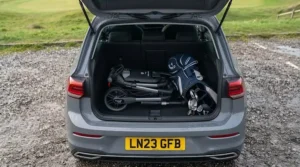
The GoKart Electric Trolley sits in an interesting gap: cheaper than most branded compact models, but with a folded size of roughly 66 x 60 x 29cm that’s meaningfully tighter than most trolleys under £500. What most buyers overlook about this one is the low folded height — at 29cm it slides under a parcel shelf far more easily than trolleys that fold to 35-40cm tall, even if the overall footprint is a touch wider. Weighing 11.9kg with the battery in place, it’s roughly on par with far pricier compact trolleys, which suggests GoKart has prioritised its engineering budget on the frame rather than on badge value. Reviewers on independent retailer pages tend to describe it as “does what it says” rather than exciting, which is a fair summary: no GPS, no remote control, just a trolley that folds down small and gets you round 18 or 36 holes depending on the battery you choose. It’s the pick for golfers who’ve measured their boot, know it’s tight, and don’t want to pay premium-brand prices for that reassurance.
Pros:
- ✅ Genuinely low folded height for the price bracket
- ✅ Choice of 18 or 36-hole lithium battery options
- ✅ Weight competitive with far pricier compact trolleys
Cons:
- ❌ Lacks the brand support network of PowaKaddy or Motocaddy
- ❌ No GPS or remote-control variants available
Pricing runs from the mid-£300s up to around £550 depending on battery capacity, making it one of the sharper value plays on this list.
3. PowaKaddy CT6 EBS — best all-round compact fold for everyday small-boot use
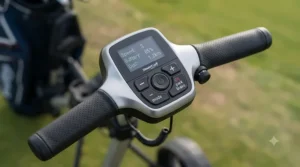
PowaKaddy built its CT range specifically to answer the small-boot problem, and the CT6 EBS is the version most golfers should look at first. Folded, it measures roughly 51 x 43 x 38cm, which PowaKaddy states is around 35 per cent smaller than many rival compact trolleys, and having seen the numbers laid out against the rest of this list, that claim holds up. The EBS designation refers to Electronic Braking System, which automatically slows the trolley on descents, a genuinely useful safety feature on any course with meaningful elevation change that budget trolleys almost never include. Here’s what to weigh: at 11.8kg it isn’t the lightest trolley here, but the two-step fold is quick enough that the extra kilo or two rarely bothers anyone in a car park. Owner feedback collected across PowaKaddy’s own site and major UK retailers repeatedly highlights how little space it takes up compared with the golfer’s previous trolley, alongside occasional comments that the colour display, while clear, is a step down from the full-colour screens on GPS models.
Pros:
- ✅ One of the smallest genuine folded footprints on the market
- ✅ Electronic braking adds real safety on hilly courses
- ✅ Simple two-step fold with no wheel removal required
Cons:
- ❌ No built-in GPS on this specific variant
- ❌ Sits at a noticeably higher price than budget alternatives
Expect to pay in the £700s to low £800s, which lands it firmly in mid-range territory but with a fold that punches above that price bracket.
4. Motocaddy M1 DHC — easiest one-hand fold with genuine downhill control
Motocaddy’s M1 DHC takes a slightly different approach to compactness: rather than the smallest possible footprint, it prioritises the fastest, simplest fold, using inverting wheels that flip inward to shrink the package to around 65 x 47 x 41cm. The standout feature here is genuinely the ease of use — Motocaddy’s “SlimFold” design means the whole process takes seconds and needs no wheel removal, no clips to align, and no instruction manual on your first attempt. Powered by a 230W motor running on a 28V system, the M1 DHC includes Automatic Downhill Control, which senses gradient and manages speed accordingly rather than relying on the golfer to adjust manually. Based on the spec comparison with the PowaKaddy CT6 EBS above, the M1 DHC folds to a slightly larger footprint but compensates with a genuinely quicker unfold-to-walking time, which matters more than a few centimetres for golfers squeezing in a round before work. Aggregated review sentiment across retailer sites consistently praises the display clarity and the nine-speed control, with the main recurring criticism being that the folded package, while quick to achieve, is bulkier than PowaKaddy’s CT range.
Pros:
- ✅ Fastest, simplest fold of any trolley on this list
- ✅ Automatic Downhill Control genuinely useful on undulating courses
- ✅ USB charging port and clear widescreen LCD display
Cons:
- ❌ Folded footprint larger than the PowaKaddy CT6 or CT8
- ❌ DHC braking function adds cost over the non-DHC version
Prices sit in the £700s to £800s range depending on retailer and bundled accessories, making it a close mid-range rival to the CT6 EBS with a different set of priorities.
5. PowaKaddy CT8 GPS — smallest footprint on this list, plus built-in GPS
If a single-digit reduction in folded size actually matters for your particular boot, the CT8 GPS is the trolley to measure against. At roughly 51 x 42 x 37cm folded and 11.7kg with the battery, it edges out even the CT6 EBS on raw compactness while adding a colour GPS display covering thousands of UK and international courses. The spec sheet won’t tell you this, but user reports suggest the GPS screen genuinely changes how people use the trolley on unfamiliar courses, reducing the temptation to carry a separate rangefinder or phone app. What most buyers overlook about GPS trolleys generally is battery drain from the screen; PowaKaddy has managed this well enough that the 18-hole battery option remains genuinely viable for a single round without anxiety. This is the trolley for golfers who drive smaller cars, play a variety of courses rather than one home club, and want yardage data without sacrificing the boot space they’ve worked hard to protect by choosing a compact model in the first place.
Pros:
- ✅ Marginally the smallest folded footprint of any trolley here
- ✅ Full-colour GPS covering a huge course database
- ✅ Same trusted two-step fold mechanism as the CT6
Cons:
- ❌ Noticeably pricier than the non-GPS CT6 EBS
- ❌ Slightly less stable on very steep slopes than wider-based rivals
Budget for the £850-£950 range, positioning it as one of the pricier compact folders but arguably the most complete package for golfers who value both boot space and on-course data.

6. Stewart Golf Q Follow — premium follow-technology trolley with a genuinely low, wide fold
The Stewart Golf Q Follow takes a completely different folded shape to everything else on this list: rather than a tall, narrow cube, it collapses to roughly 55 x 60 x 32cm, wider and lower rather than tall and boxy. Reviewers who’ve compared it directly to upright compact trolleys note this footprint can actually suit a shallow, broad boot far better than the vertical fold of a CT6 or CT8, even though the overall volume is similar. The headline feature is Stewart’s follow technology, which tracks a handset worn by the golfer so the trolley moves independently without a physical connection, something no other trolley in this price bracket offers convincingly. Here’s what to weigh: at 14.1kg it’s among the heavier trolleys on this list, and the premium positioning is obvious in the price, but for golfers with mobility considerations or those who simply want to walk unencumbered, the follow function changes the on-course experience in a way spec sheets struggle to convey. What most buyers overlook is that the wider fold, while low, does need a boot with reasonable width rather than depth, so it’s worth checking your specific car’s boot shape rather than assuming “compact” means universally compatible.
Pros:
- ✅ Genuine hands-free follow technology, not just a remote
- ✅ Low, wide fold suits shallow boots particularly well
- ✅ 36-hole battery as standard, no upgrade needed
Cons:
- ❌ Among the most expensive trolleys in this entire guide
- ❌ Heavier than every other model here bar the MGI
Expect premium pricing in the region of £1,500-£1,700, which puts it well above the rest of this list, but the follow technology is a genuinely different product category rather than a small step up.
7. MGI Zip Navigator — flattest fold on the market when the wheels invert
The MGI Zip Navigator’s party trick is height, or the lack of it: with the rear wheels inverted, the folded package measures a remarkable 70 x 47 x 15cm, which is dramatically flatter than anything else on this list even though it’s not the shortest overall. Reviewers consistently note that this shape is transformative for boots with a shallow, wide load area but limited vertical clearance under a parcel shelf, a boot shape common in hatchbacks and estate cars alike. Powered by twin 230W motors and a 24V 36-hole lithium battery, it’s engineered for genuine power rather than just compactness, with full directional remote control and a gyroscope-based straight-tracking system that keeps the trolley on line across cambered fairways. Based on the spec comparison with the Stewart Golf Q Follow, the MGI trades hands-free follow technology for direct remote steering, which some golfers prefer because it keeps the trolley fully under manual control at all times rather than relying on a tracked handset. At just under 16kg with the battery fitted, it’s the heaviest trolley here, so lifting it in and out of a boot is a two-handed job rather than a one-handed lift.
Pros:
- ✅ Dramatically flat 15cm folded height when wheels invert
- ✅ Twin motors and full directional remote control
- ✅ Standard 36-hole battery with no upgrade required
Cons:
- ❌ Heaviest trolley on this entire list at close to 16kg
- ❌ Premium price puts it well beyond casual buyers
Pricing sits around the £1,400 mark in the UK, positioning it alongside the Stewart Golf Q Follow as a premium remote-control option rather than a budget compact folder.
Benefits vs Traditional (Full-Size) Electric Trolleys
| Factor | Compact Electric Trolley | Full-Size Electric Trolley | Best For |
|---|---|---|---|
| Folded volume | Roughly 60-90 litres | Roughly 130-150 litres | PowaKaddy CT8 GPS wins on raw space saving |
| Boot compatibility | Fits alongside bag in small hatchbacks | Often needs rear seats folded | PowaKaddy CT6 EBS for everyday small cars |
| Battery range | Typically 18-36 holes depending on model | Often 27-36 holes as standard | Stewart Golf Q Follow for longest standard range |
| Setup speed | Two-step fold, seconds to deploy | Sometimes more steps, wheel removal | Motocaddy M1 DHC fastest to unfold |
| Typical price | £300-£1,700 depending on features | £400-£900 for most models | GoKart Electric Trolley for lowest entry cost |
The trade-off between compact and full-size trolleys isn’t really about performance on the course, since the motors, batteries and speed controls are broadly comparable across both categories. It’s almost entirely about what happens before and after the round: fitting the thing in your car without a fight, and finding somewhere to store it that isn’t the middle of the garage floor. Golfers who drive an estate car or an SUV with a genuinely deep boot may find a full-size trolley like the Motocaddy S1 DHC perfectly workable and often slightly cheaper for the same battery capacity, but anyone with a supermini, a coupé, or a boot already crowded with a pushchair and shopping should weigh the modest price premium of compact models against the daily frustration a bulky trolley creates.
Price Range & Value Analysis
| Budget Tier | Example Trolley | What You Get |
|---|---|---|
| Budget (under £500) | Ben Sayers Lithium 18-Hole, GoKart Electric Trolley | Lithium power, basic fold, no GPS or remote |
| Mid-range (£700-£950) | PowaKaddy CT6 EBS, Motocaddy M1 DHC, PowaKaddy CT8 GPS | Genuinely compact folds, braking or GPS features |
| Premium (£1,400+) | Stewart Golf Q Follow, MGI Zip Navigator | Remote or follow technology, twin motors, largest batteries |
Looking at value per pound rather than sticker price alone, the mid-range tier is where compactness and features intersect most sensibly for the average buyer. The PowaKaddy CT6 EBS in particular delivers a folded footprint close to the flagship CT8 GPS for meaningfully less money, and unless GPS yardage genuinely changes how you play, that saving is hard to argue against. At the premium end, buyers aren’t really paying for a smaller fold at all, since both the Stewart Golf Q Follow and MGI Zip Navigator are priced around remote and follow technology rather than boot-space savings specifically.
Practical Usage Guide: Folding, Charging and the First 30 Days
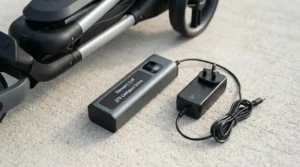
Getting the most from any easy-fold golf trolley starts before you’ve even played a hole. On day one, charge the battery fully before first use, even if it arrives showing partial charge, since lithium packs perform and report their remaining capacity more accurately after a complete cycle. Most manufacturers recommend an 8-14 hour initial charge, so plan to do this the evening before your first round rather than the morning of.
When folding for the first time, resist the temptation to force any hinge or wheel that feels stiff; compact frames rely on precise alignment, and a few practice folds in the driveway will save you an awkward moment in a busy car park. For inverting-wheel designs like the Motocaddy M1 DHC or MGI Zip Navigator, get into the habit of checking the wheels have fully clicked into their inverted position before closing the frame, since a half-locked wheel is the single most common cause of folding frustration reported by new owners.
A simple maintenance schedule pays off: wipe down the frame after wet rounds to prevent grit building up in the folding joints, check tyre pressure or tread monthly on models with pneumatic wheels, and store the battery at roughly 50 per cent charge if the trolley won’t be used for more than a few weeks, which protects lithium cell longevity far better than storing it fully charged or fully flat. Common first-30-days mistakes include leaving the trolley folded in a hot car boot for extended periods, which accelerates battery degradation, and skipping the manufacturer’s recommended break-in speed settings in favour of jumping straight to maximum power.
Real-World Scenarios: Which Golfer Are You?
The weekend commuter with a supermini. Playing twice a month at whichever course has a tee time, driving a Ford Fiesta or similar with a genuinely shallow boot. The PowaKaddy CT6 EBS or PowaKaddy CT8 GPS suit this profile best, since the vertical two-step fold slots neatly beside a golf bag without needing the rear seats down, and the EBS braking earns its keep on the hillier of the two local courses.
The frequent traveller playing away days. Someone who plays several different clubs a month, sometimes driving two hours each way, and values GPS yardage on unfamiliar layouts as much as boot space. The PowaKaddy CT8 GPS earns its higher price here through the course database alone, turning every new venue into familiar territory within a few holes.
The budget-conscious first-timer. Just switched from carrying or borrowing a trolley, wants to try electric assistance without a four-figure commitment, and has a reasonably flexible car with a mid-sized boot. The Ben Sayers Lithium 18-Hole or GoKart Electric Trolley make sense here, delivering genuine lithium power without the premium brand markup, accepting a slightly larger fold as a fair trade for the price saved.
✨ Don’t miss these exclusive deals!
🔍 Whichever profile fits you best, take your game to the next level with a trolley that actually earns its place in your boot. Click through to check current pricing and availability!
Car Boot Storage Tips: Problem → Solution
Problem: The trolley fits but blocks the bag. Solution: load the folded trolley against the wheel arch or side wall first, then slide the golf bag in lengthways along the opposite side rather than trying to fit both centrally.
Problem: The battery keeps sliding around in transit. Solution: most compact trolleys have the battery integrated or clipped into the frame; if yours is a separate unit, a simple non-slip boot mat prevents it rattling against other items on the drive to the course.
Problem: Wet trolleys soak the boot carpet. Solution: keep a fold-flat waterproof groundsheet or an old towel in the boot permanently, since a compact trolley folded straight off a rain-soaked course will otherwise leave the carpet damp for days.
Problem: The trolley won’t sit upright when folded. Solution: check whether your model has an auto-open stand feature like the Motocaddy M1 DHC; if not, position it against a flat vertical surface in the boot rather than trying to balance it freestanding.
Problem: Limited boot space when travelling with passengers. Solution: this is precisely where folded trolley size stops being a nice-to-have and becomes decisive — the MGI Zip Navigator‘s 15cm folded height slides under a parcel shelf even with rear seats occupied, something a taller compact trolley simply can’t manage.
How to Choose a Compact Electric Golf Trolley for a Small Boot
- Measure your boot before you shop. Note the depth, width, and height under any parcel shelf with the shelf in place, since folded dimensions on spec sheets are only useful once you know what you’re comparing them against.
- Prioritise folded height over folded length. A trolley that’s long but flat, like the MGI Zip Navigator, often clears parcel shelves that a taller, boxier fold cannot.
- Decide whether GPS earns its price premium. If you mainly play one home course, the extra cost of the PowaKaddy CT8 GPS over the standard CT6 EBS may not be justified.
- Weigh braking against your local terrain. Downhill control, as fitted to the PowaKaddy CT6 EBS and Motocaddy M1 DHC, matters far more on undulating courses than flat parkland layouts.
- Factor in weight, not just folded size. A compact trolley that’s awkward to lift, like the nearly 16kg MGI Zip Navigator, can be more frustrating day-to-day than a slightly larger but lighter alternative.
- Check battery type and reordering costs. Lithium batteries, standard on every trolley in this guide, hold charge longer and weigh less than the lead-acid packs still found on some budget rivals.
- Read genuine aggregated review sentiment, not just star ratings. Look for recurring themes across multiple retailer listings rather than trusting a single five-star review, since folding ease in particular varies by individual experience.
Common Mistakes When Buying a Compact Electric Golf Trolley
The single most common mistake is buying based on marketing terms like “compact” or “space-saving” without checking actual folded dimensions in centimetres against a boot that’s been physically measured. Manufacturers use “compact” relative to their own full-size range, not relative to every trolley on the market, so a model marketed as compact by one brand can still be larger than a genuinely small folder from another.
A second frequent error is underestimating weight in favour of folded size alone. A trolley that folds beautifully small but weighs close to 16kg, like the MGI Zip Navigator, can be genuinely difficult for some golfers to lift repeatedly, particularly over a high boot lip. The spec sheet won’t tell you this, but reviewers note that weight distribution matters as much as total mass; a trolley with the battery mounted low and centrally, as most compact models are designed, lifts more predictably than one where the weight sits awkwardly to one side.
Buyers also frequently skip checking battery range against their actual playing habits, paying for a 36-hole battery they’ll never fully use, or conversely buying an 18-hole model and finding it tight on longer rounds with extra practice on the range beforehand. Finally, many buyers overlook return policies entirely; UK consumer protection gives buyers meaningful rights if a trolley develops a fault, and it’s worth checking a retailer’s own returns window before assuming you’re stuck with a poor fit.
Compact Electric Trolley vs Manual Push Trolley
The comparison between electric and manual trolleys isn’t really about boot space at all, since manual push trolleys almost always fold smaller and lighter than any electric model, batteries included. It’s about effort versus convenience over the course of a full season. A manual trolley demands nothing from you beyond pushing, which some golfers genuinely prefer as part of the exercise benefit of walking a round; a peer-reviewed study on walking-based golf has linked regular walking rounds to a meaningfully reduced risk of cardiovascular disease and all-cause mortality among participants, alongside social and cognitive benefits that a ridden or fully motorised round doesn’t replicate in the same way.
That said, a compact electric golf trolley for small car boot use closes much of the practicality gap that historically favoured manual trolleys for space-conscious drivers. Where manual trolleys used to be the only sensible choice for a Mini or a small hatchback, models like the PowaKaddy CT8 GPS now fold small enough to make that argument far weaker than it once was. The remaining case for manual trolleys is largely financial and physical: they’re cheaper, lighter, and demand more from the body, which is either a drawback or a benefit depending entirely on what you’re looking for from your round. Golfers managing joint issues, recovering from injury, or simply wanting to conserve energy for their swing rather than the walk between shots will find the effort saved by an electric motor outweighs the modest extra bulk, especially once that bulk has been minimised by choosing genuinely compact models.
Folded Trolley Size and Boot Space Dimensions Explained
Boot space dimensions are usually quoted by car manufacturers in litres, which is a frustratingly abstract figure when you’re actually trying to picture whether a trolley will fit. A typical supermini offers somewhere between 260 and 350 litres of boot space, while a compact electric trolley folded down takes up roughly 60 to 90 litres depending on the model, which sounds generous until you account for the golf bag itself, which can easily claim another 40 to 60 litres of irregular, awkwardly shaped space.
The practical lesson is that folded trolley size matters far more in its exact shape than its total volume figure. A trolley folding to a tall, narrow cube like the PowaKaddy CT6 EBS at 51 x 43 x 38cm suits a boot with good vertical clearance but limited width, while a low, flat fold like the MGI Zip Navigator‘s 70 x 47 x 15cm suits the opposite: a wide, shallow load area with a parcel shelf that can’t be raised much. This squeeze has always shaped trolley design in the UK, where electric trolleys were introduced in the 1980s specifically as a compact alternative to the earlier, bulkier motorised carts developed for the wider American market, gradually folding down further with each generation as engineers chased exactly the small-boot problem this guide is solving. Before buying, it’s worth physically laying out the folded dimensions on your driveway using a tape measure and some string, since a genuine to-scale mock-up catches fitting problems that spec sheets on their own simply cannot.
Travel-Friendly Electric Golf Trolleys for Away Days
A travel-friendly electric golf trolley needs to satisfy two different requirements depending on how you’re travelling. For UK road trips, the priority is exactly the folded footprint we’ve covered throughout this guide, and the PowaKaddy CT8 GPS or MGI Zip Navigator both handle repeated loading and unloading with minimal fuss. For golfers flying to a destination course, the lithium battery inside every trolley on this list becomes the deciding factor, since airlines apply strict rules to lithium batteries carried in checked or hand luggage, and larger trolley batteries can exceed the thresholds airlines allow without prior approval.
Before flying with any electric trolley, check your airline’s specific policy and, where relevant, the UK Civil Aviation Authority’s official baggage safety advice on lithium batteries, since rules can differ between carriers and have tightened in recent years. In practice, many golfers travelling by air choose to hire a trolley at the destination course rather than navigate battery paperwork, reserving their own compact electric trolley for UK-based rounds where the only real constraint is boot space rather than aviation regulation.
Long-Term Cost & Maintenance
The purchase price is only the opening chapter of what a compact electric golf trolley actually costs over its lifetime. Replacement lithium batteries typically run to a meaningful fraction of the trolley’s original price, usually needed somewhere between three and six years into ownership depending on how often the trolley is used and how well it’s stored between rounds. Budget trolleys like the Ben Sayers Lithium 18-Hole carry a lower upfront cost but sometimes shorter manufacturer warranty periods on the battery specifically, so it’s worth checking warranty terms rather than assuming cheaper always means cheaper overall.
Total cost of ownership also includes the occasional wheel bearing, tyre, or charger replacement, none of which are expensive individually but which add up over several seasons of regular play. If a fault does develop within the first six months, UK buyers are protected under the Consumer Rights Act 2015, and Which?’s consumer rights guidance sets out clearly what a retailer is obliged to do about a repair, replacement, or refund. Premium trolleys such as the Stewart Golf Q Follow and MGI Zip Navigator generally carry longer standard warranties reflecting their higher build cost, which is worth weighing against the lower upfront price of budget alternatives when calculating genuine value over a five-year ownership period rather than just at the checkout.

Frequently Asked Questions
❓ What is the smallest folding electric golf trolley?
❓ How much does a compact electric golf trolley cost in the UK?
❓ Will an electric golf trolley fit in a small hatchback boot?
❓ Are compact electric golf trolleys as powerful as full-size models?
❓ How long do electric golf trolley batteries last?
Conclusion
Choosing a compact electric golf trolley for small car boot use ultimately comes down to matching folded shape, not just folded volume, to your specific vehicle. The PowaKaddy CT6 EBS and PowaKaddy CT8 GPS remain the benchmark for tall, narrow boots thanks to their genuinely small two-step fold, while the MGI Zip Navigator‘s remarkably flat profile suits wide, shallow load areas that other trolleys can’t clear. Budget buyers shouldn’t feel forced into a compromise either, since the Ben Sayers Lithium 18-Hole and GoKart Electric Trolley both deliver real lithium power at a fraction of premium pricing, accepting a modestly larger fold in exchange.
Whichever trolley you land on, the process outlined throughout this guide holds true regardless of budget: measure your actual boot, prioritise height over headline volume figures, and weigh genuine aggregated review sentiment against your own playing habits rather than chasing the single most talked-about model. A trolley that fits perfectly but sits unused because it doesn’t suit your course is no better value than one left in the garage because it never fit the car in the first place, so the best choice is always the one that solves both problems at once.
Recommended for You
- Lithium Battery Golf Trolley: 7 Best UK Picks for 2026
- Remote Control Golf Trolley: 7 Best Picks (2026)
- Motocaddy vs Powakaddy Electric Trolley: 7 Best Picks (2026)
Disclaimer: This article contains affiliate links. As an Amazon Associate, I earn from qualifying purchases. If you purchase products through these links, we may earn a small commission at no additional cost to you.
✨ Found this helpful? Share it with your friends! 💬🤗
