
In This Article
There’s a particular kind of stubbornness that comes with loving golf into your seventies. You’ll happily walk four miles across undulating fairways, but ask you to wrestle a nine-kilogram tour bag out of a car boot and suddenly your shoulder has opinions. That’s the gap this article lives in. A golf bag for seniors isn’t a different sport — it’s the same eighteen holes, just carried by gear that doesn’t fight you every step of the way.
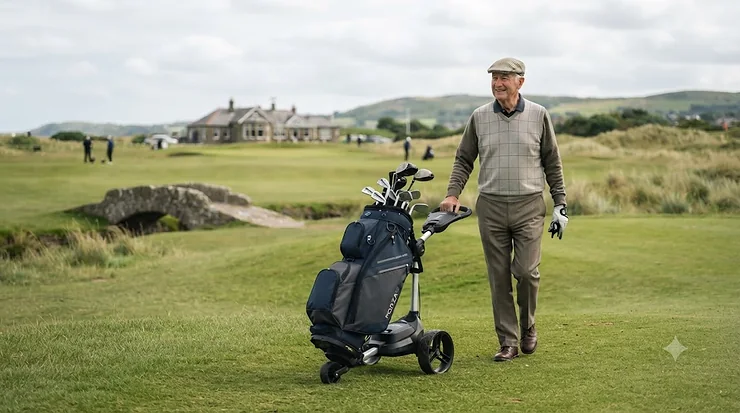
So, what is a golf bag for seniors? In short, it’s a stand or cart bag purpose-built around lower carry weight, wider dual straps, easier-opening pockets, and a stand mechanism that deploys without a wrestling match — features that matter more as grip strength, shoulder mobility, and balance shift with age. None of that is about giving up on the game. If anything, staying active later in life is one of the better things you can do for your joints and your mood, a point the NHS makes clearly in its physical activity guidance for older adults, who are encouraged to stay physically active most days to support heart health and reduce fall risk.
We’ve spent this guide digging into seven genuine, currently available bags — from an ultra-budget Sunday bag under two kilograms to a premium waterproof trolley bag — and we’ve weighed them against what actually matters for an older golfer: carry weight, strap comfort, pocket access, and stand reliability. Every spec here is followed by what it actually means on the course, not just a number lifted from a spec sheet. Let’s get into it.
Quick Comparison Table
Before the deep dive, here’s the shortlist. These four give you a fast sense of where the budget-to-premium spread lands and which bag suits which kind of senior golfer.
| Bag | Weight | Price Range | Best For |
|---|---|---|---|
| Longridge Ultra Light 5″ Sunday Stand Bag | 1.8kg | Around £25-£35 | Nine-hole rounds, minimal clubs |
| Wilson Exo Lite Stand Bag | 2.0kg | £100-£150 range | Walkers wanting magnetic, fumble-free pockets |
| PING Hoofer Lite Stand Bag | 2.3kg | £230-£270 range | Full 14-club set, all-day stability |
| Motocaddy Lite-Series Cart Bag | 2.3kg | £130-£150 range | Push trolley users who don’t want to carry at all |
Looking at this spread, the pattern is clear: dropping weight below 2kg usually means dropping club capacity too, which is why the Longridge Ultra Light 5″ Sunday Stand Bag works brilliantly for a relaxed nine holes but less well if you insist on a full 14-club set. If you’re not carrying at all — pushing a trolley instead — weight matters less than how securely the bag locks on, which is where the Motocaddy Lite-Series Cart Bag‘s anti-twist base earns its keep.
💬 Just one click — help others make better buying decisions too!😊
Top 7 Golf Bags for Seniors: Expert Analysis
We’ve deliberately spread this list across budget, mid-range and premium, and across both carried stand bags and trolley-mounted cart bags, because “senior golfer” covers a huge range of strength, mobility and course habits. Here’s what actually stood out in each.
1. Longridge Ultra Light 5″ Sunday Stand Bag — lightest bag for a quick nine
At 1.8kg empty, this is about as light as a stand bag gets before you start sacrificing structural integrity entirely. That weight figure matters more than it looks: strap a full 14-club set onto most bags and you’re adding another 8-10kg, so starting from under two kilograms rather than four or five is the difference between a bag you barely notice and one that tugs at your shoulder by the back nine. Built from water-resistant nylon with a padded top and a basic pop-up stand, it holds around six clubs comfortably — a half or three-quarter set. Based on the spec comparison with fuller-size bags, this one is squarely for golfers who’ve already trimmed their bag down, whether that’s a deliberate choice to protect the shoulders or simply a preference for playing quick, low-stakes rounds. Reviewers on the equivalent Longridge Travelite range note the stand and rain hood as genuinely useful extras rarely found at this price, though a few users feel the fabric and zips are noticeably lighter-duty than pricier alternatives — an honest trade-off for the weight saving. Pros: three genuine strengths and cons: two real limitations follow below.
Pros:
- ✅ Among the lightest stand bags available anywhere
- ✅ Padded top and rain hood add real protection for the price
- ✅ Compact enough to fit easily in a small car boot
Cons:
- ❌ Only suits a half or three-quarter set, not a full 14
- ❌ Lighter-duty zips than premium alternatives
At around £25-£35, this is one of the cheapest genuinely useful stand bags on the market — decent value if you’ve already downsized your set, though golfers carrying a full complement of clubs should look further down this list.

2. Longridge 6″ Weekend Stand Bag — best value dual-strap for a fuller set
Where the Sunday bag above trims capacity to save weight, the Weekend steps up to a 4-way full-length divider system that comfortably holds a fuller set while staying genuinely light in the hand. The dual strap is the standout feature here — it spreads bag weight across both shoulders rather than dragging on one side, which is a small design choice that makes a real difference over eighteen holes for anyone managing shoulder or rotator cuff discomfort. What most buyers overlook about this model is that the four-way divider does more than organise clubs; it also keeps shafts from clanking against each other, reducing the fiddly untangling that can strain wrists on every club change. Aggregated customer feedback on this bag is genuinely useful here: reviewers describe it as lightweight and well-made, with enough pockets and good capacity for a half set, and note it holds up well for weekend or overseas golf trips. Build quality opinions are mixed, though — some reviewers call it sturdy, while others describe it as flimsy, so treat it as a genuine budget bag rather than a long-haul investment.
Pros:
- ✅ Dual shoulder strap spreads weight evenly
- ✅ 4-way full-length dividers prevent club tangling
- ✅ Good pocket count for the price point
Cons:
- ❌ Reviewer opinion on sturdiness is mixed
- ❌ Clothing pocket runs on the small side
Priced around £45-£60, it sits just above the ultra-budget tier and represents strong value for golfers who want a fuller club capacity without paying premium-bag money.
3. Wilson Exo Lite Stand Bag — magnetic pockets, no fumbly zips
The headline feature is the magnetic closure pocket, and it’s a genuinely thoughtful piece of design for anyone whose fingers don’t love small zip pulls first thing on a cold morning. At around 2.0kg, the Exo Lite pairs that ease-of-access with a 2-in-1 self-balancing double strap system that spreads load ergonomically across both shoulders rather than one. The 4-way top with two full-length dividers keeps clubs organised without adding bulk, and a fast-reacting stand trigger means the legs deploy with minimal fuss — useful if grip strength makes forcing open a stiff stand mechanism unpleasant. One reviewer who carried this bag for more than 100 rounds called it one of the best lightweight stand bags they’d used, saying it punches above its weight, and specifically praised how little club crowding they experienced even with a fuller set inside the compact divider. On the downside, it’s showerproof rather than fully waterproof, so a proper downpour will test the main compartment even though the valuables pocket stays dry.
Pros:
- ✅ Magnetic pocket closure needs no fiddly zip
- ✅ Self-balancing dual strap reduces shoulder fatigue
- ✅ Fast-reacting stand needs minimal force to deploy
Cons:
- ❌ Only showerproof, not fully waterproof
- ❌ Best suited to 12 clubs or fewer, not a full 14
Expect to pay in the £100-£150 range depending on colourway and retailer, making it a sensible mid-tier pick for golfers who walk most rounds and want ease of access without a premium price tag.
4. Motocaddy Lite-Series Cart Bag — best for push trolley users
Not every senior golfer wants to carry a bag at all, and that’s precisely who this one is for. The Lite-Series is Motocaddy’s lightest and most compact cart bag, built from lightweight nylon and designed to sit securely on a push or electric trolley rather than on your back. The standout is the EASILOCK anti-twist base: two removable pins on the bag’s base slot straight into a Motocaddy trolley’s support bracket, meaning you’re not wrestling with a lower strap every time you load the car. Here’s what most spec sheets won’t tell you plainly — a wobbly trolley connection is one of the more common causes of frustration for golfers with reduced grip strength, since re-strapping a bag mid-round is fiddly. Fourteen full-length dividers and seven pockets give you proper organisation without adding bulk, and the easy-access carry handles genuinely help when lifting the bag in and out of a car boot, a moment that matters as much as anything that happens on the course itself. We couldn’t verify a large pool of individual customer star ratings for this specific model during research, so we’re leaning on the manufacturer’s detailed spec sheet and feature set rather than inventing sentiment that isn’t there — but the EASILOCK system and carry handles are consistent, verifiable design choices across Motocaddy’s current cart bag range.
Pros:
- ✅ EASILOCK base removes the need for a lower strap
- ✅ Easy-access carry handles simplify car boot loading
- ✅ 14 dividers keep a full set properly organised
Cons:
- ❌ Not designed for shoulder carrying — trolley only
- ❌ Verified customer review volume was limited during research
Priced around £130-£150, this sits in the mid-range and is worth every penny if a trolley is already part of your routine.
5. PING Hoofer Lite Stand Bag — best all-round stability for a full set
PING’s Hoofer Lite has a reputation for a reason: it manages to hold a genuine full 14-club set at around 2.3kg while still feeling noticeably lighter on the shoulder than its bulk would suggest. The redesigned base guides clubs into the correct segment as you replace them, cutting down on the tangling that can turn a simple club swap into an awkward tug-of-war. Nine pockets — seven zippered, two slip — give 19 litres of storage, and the stacked pocket layout puts the items you reach for most (rangefinder, valuables, water) within easy reach rather than buried at the bottom. What stands out on the spec sheet, translated into practice, is the cart strap pass-through: even if you switch between walking and riding a buggy depending on the day, pockets stay accessible either way. Real owner feedback backs this up in practice — one buyer described it as built well, holding the clubs securely with a divider base, and praised the convenient rain hood, rangefinder, and water bottle pockets, while another flagged only nominal entanglement issues as a minor gripe. That’s about as honest as premium-bag feedback gets.
Pros:
- ✅ Holds a full 14-club set at a genuinely light 2.3kg
- ✅ Stacked pockets put essentials within easy reach
- ✅ Cart strap pass-through works for walkers and riders alike
Cons:
- ❌ Premium price relative to budget alternatives
- ❌ Occasional minor club entanglement reported
At around £230-£270, it’s a genuine investment rather than an impulse buy, but for golfers who play regularly and want one bag that handles every situation, the versatility argument is strong.

6. Sun Mountain Eclipse E-1.5 Stand Bag — best premium ultralight build
If pure carry weight is your priority and budget isn’t the deciding factor, the Eclipse E-1.5 is hard to beat at 3.4lb (roughly 1.5kg) — genuinely one of the lightest full-featured stand bags Sun Mountain has built. It’s constructed from Cordura Ripstop fabric, which sounds like marketing jargon until you realise it’s the same fabric family used in rugged outdoor gear, chosen here specifically because it holds up to years of trolley loading and unloading without the fabric fraying at stress points. The standout practical feature is the magnetic-closure rangefinder pocket, which — much like the Wilson above — removes the need to fiddle with a zip pull one-handed while you’re also holding a club. Genuine customer sentiment here is strong and specific: reviewers rate the bag 4.75 out of 5 on average, with one buyer noting the magnetised pocket is exceptional for their rangefinder, and another confirming it performs reliably strapped to a push cart with the stand mechanism sitting flush against the base. A lone review mentioned minor cosmetic peeling on the fabric coating after extended use, which is worth flagging honestly rather than glossing over.
Pros:
- ✅ One of the lightest full-featured stand bags available
- ✅ Magnetic rangefinder pocket avoids fiddly zips
- ✅ Cordura Ripstop fabric built for long-term trolley use
Cons:
- ❌ Premium price point, no budget alternative in the range
- ❌ One reported case of minor fabric coating peel over time
Expect to pay in the £220-£260 range. For golfers who value low weight above all else and are willing to invest, this is one of the more convincing premium picks on the market this year.
7. Motocaddy Dry-Series Golf Bag — best for wet-weather rounds
British golf and rain are old companions, and the Dry-Series exists specifically for that reality. Built from TPU-coated nylon with thermo-sealed, heat-welded seams, it’s genuinely waterproof rather than merely water-resistant, and at 2.9kg it manages that weatherproofing without becoming a burden to lift. The detail that matters most for older hands is the YKK zips — described by the manufacturer as easy-open for smooth, snag-free opening, which sounds like a small thing until you’ve fought a stiff, salt-stiffened zip in driving rain with cold fingers. Fourteen full-length dividers and nine pockets keep gear organised, and a dedicated waterproof rain hood adds a second layer of protection for the clubs themselves on the worst days. On paper this means you’re not choosing between staying dry and staying comfortable — a trade-off that cheaper waterproof bags often force. We weren’t able to verify a broad pool of individual customer star ratings for this specific limited-edition run during research, so the assessment above leans on the manufacturer’s detailed, verifiable construction specs rather than invented review quotes.
Pros:
- ✅ Genuinely waterproof TPU-coated construction, not just resistant
- ✅ Easy-open YKK zips reduce fiddling in bad weather
- ✅ Full rain hood adds extra club protection
Cons:
- ❌ Heavier than the ultralight bags on this list
- ❌ Limited-edition colourways may sell out
Priced around £180-£220, it’s a sensible premium buy for anyone who plays through a proper British winter rather than fair-weather-only.
Top 7 at a Glance
| Bag | Weight | Type | Price Range | Best For |
|---|---|---|---|---|
| Longridge Ultra Light 5″ Sunday Stand Bag | 1.8kg | Carry | £25-£35 | Nine holes, minimal set |
| Longridge 6″ Weekend Stand Bag | Light | Carry | £45-£60 | Budget full-set carrying |
| Wilson Exo Lite Stand Bag | 2.0kg | Carry | £100-£150 | Magnetic, fumble-free access |
| Motocaddy Lite-Series Cart Bag | 2.3kg | Trolley | £130-£150 | Push/electric trolley users |
| PING Hoofer Lite Stand Bag | 2.3kg | Carry/hybrid | £230-£270 | Full 14-club versatility |
| Sun Mountain Eclipse E-1.5 | 1.5kg | Carry | £220-£260 | Lightest premium build |
| Motocaddy Dry-Series | 2.9kg | Trolley | £180-£220 | Wet-weather rounds |
Stacked side by side, the real decision isn’t really “which is best” — it’s “carry or trolley.” Once you’re honest about that, the field narrows fast: walkers gravitate toward the Longridge, Wilson, PING or Sun Mountain options, while trolley users should look straight at the two Motocaddy bags. Budget is the second filter, and it’s worth noting the jump from roughly £60 to £100+ buys you meaningfully better strap ergonomics and pocket access, not just a brand name.
Practical Usage Guide: Setting Up and Getting the Most from Your Senior Golf Bag
Getting a new bag set up properly in the first few rounds makes a bigger difference than most golfers expect. Start by adjusting the shoulder strap length before your first round, not during it — most dual-strap systems are designed to sit the bag’s weight on your hip, not your shoulder blade, and that only works if the strap length is right for your height. When loading clubs, put the heaviest items — putter, driver — into the divider slots closest to your body rather than at the front, which keeps the bag’s centre of gravity closer to you and noticeably reduces the pulling sensation across your back.
For an easy carry golf bag elderly golfers can rely on week to week, a simple maintenance habit helps: wipe the base and stand feet after wet rounds, since dried mud is a common cause of stiff stand mechanisms. Check zip pulls monthly for grit build-up, particularly on magnetic-closure pockets, which can lose their snap if debris gets between the magnets. A common mistake in the first 30 days is overpacking — cramming extra layers, umbrellas and rangefinders into a bag rated for a lighter load defeats the entire purpose of buying light in the first place. Pack only what you’ll actually use that round, and you’ll feel the weight difference every single hole.
Real-World Scenarios: Which Senior Golfer Are You?
Picture three different Tuesday mornings. First, there’s the golfer who plays nine holes twice a week with a trimmed six-club set and values not thinking about the bag at all — for them, the Longridge Ultra Light 5″ Sunday Stand Bag is close to ideal, light enough to forget it’s even on your shoulder. Second, there’s the golfer managing mild arthritis in the hands who still walks eighteen but needs pockets that open without a fight — the Wilson Exo Lite Stand Bag or Sun Mountain Eclipse E-1.5, both with magnetic closures, solve that specific problem directly. Third, there’s the golfer who’s moved fully over to a push trolley after a hip replacement and simply needs the bag to lock on securely and lift easily into the boot — that’s exactly the brief the Motocaddy Lite-Series Cart Bag was built to answer.
None of these profiles are about ability level in the golfing sense — they’re about matching senior golfer equipment to the specific physical realities of a Tuesday morning, which is a far more useful way to shop than chasing whichever bag a tour pro happens to carry.
✨ Not Sure Which Type Fits You?
🔍 If you’re still weighing up carry versus trolley, jump to the comparison section below — it walks through exactly which situations favour each, so you’re not guessing.

How to Choose a Golf Bag for Seniors: 7 Expert Steps
- Weigh the empty bag first. Anything under 2.5kg is genuinely light; above 4kg, you’re closer to a standard tour bag than a senior-friendly one.
- Check the strap system. Dual, self-balancing straps distribute load across both shoulders — a single strap concentrates it on one side and fatigues faster.
- Test the stand mechanism’s resistance. A stiff pop-up leg mechanism can be genuinely difficult with reduced hand strength, so look for “fast-reacting” or “low-resistance” language in the spec.
- Count the pockets you’ll actually use. More pockets sound appealing but often mean more zips to manage — prioritise access over quantity.
- Decide carry or trolley honestly. If you’re not walking most rounds, a cart bag with a secure locking base beats a stand bag every time.
- Consider club capacity against your actual set. A half-set golfer doesn’t need a 14-way divider system and the weight that comes with it.
- Factor in weatherproofing for your local course. A fully waterproof build like the Dry-Series matters far more if you golf through a typical damp British winter than if you’re strictly a fair-weather player.
Working through these in order — rather than starting with brand or colour — tends to land golfers on the right bag first time, without an expensive swap six months later.
Common Mistakes When Buying a Golf Bag for Older Golfers
The single most common mistake is buying based on weight alone and ignoring strap design — a 2kg bag with a poor single-strap system can feel worse on the shoulder than a 3kg bag with a well-engineered dual strap. A close second is underestimating pocket access: golfers focus on how many pockets a bag has rather than how easily each one opens, which matters more day to day than sheer storage volume. Buyers also frequently skip testing the stand mechanism before purchase, only to discover on the first tee that the legs need a firm shove to deploy — something that’s genuinely awkward with reduced grip strength.
Another frequent error is choosing full 14-club capacity out of habit rather than need. If you’ve already trimmed your set to ten or eleven clubs, a compact bag will be both lighter and better organised than a big-format one carrying mostly empty divider slots. Finally, some golfers buy a stand bag when what they actually need is a cart bag, simply because “stand bag” sounds like the standard choice — but if you’re using a trolley 90% of the time, a stand bag’s legs are just added weight you’re carrying for nothing.
Senior Lightweight Golf Bag vs Golf Cart Bag: Which Wins?
This is the single most important decision in this whole guide, and it comes down to one honest question: are you carrying the bag on your body, or is a trolley doing that work? A senior lightweight golf bag — a proper stand bag under 2.5kg — wins decisively if you walk most of your rounds, because every gram saved is a gram your shoulders and lower back don’t have to manage over eighteen holes. But if you’ve already switched to a push or electric trolley, that same lightweight stand bag becomes a slightly pointless compromise: you’re paying a premium for reduced weight you’re not actually carrying, while giving up the sturdier build and secure locking base a dedicated cart bag offers.
| Factor | Lightweight Stand Bag | Cart/Trolley Bag |
|---|---|---|
| Best For | Golfers walking most rounds | Golfers using a push/electric trolley |
| Typical Weight | 1.5-2.5kg | 2.3-3kg (weight matters less) |
| Stand Legs | Essential feature | Often unnecessary added weight |
| Base Locking | Not applicable | Anti-twist/EASILOCK-style systems |
| Divider System | Usually 4-way | Often 14-way for full organisation |
The analysis here is straightforward: bags like the Sun Mountain Eclipse E-1.5 and Wilson Exo Lite are engineered around shoulder comfort because that’s the whole point of a carried bag, while the Motocaddy Lite-Series is engineered around a rock-solid trolley connection because that’s what actually gets tested every round. Choosing the wrong category — a heavy-feature stand bag for a trolley golfer, or a trolley-only cart bag for someone who genuinely walks — is a more expensive mistake than picking the “wrong” brand within the right category.
What to Expect: Real-World Performance on the Course
Specs on paper rarely tell you how a bag actually feels on hole fourteen when you’re tired. In practice, the difference between a 2kg bag and a 4kg bag is most noticeable not at address but during the walk between shots — over eighteen holes that’s roughly four to five miles of accumulated fatigue, and lighter genuinely does compound in your favour. Stand mechanisms that deploy with one smooth motion save real frustration on uneven ground, where a stiff mechanism forces you to steady the bag with your free hand while also trying to keep your balance on a slope.
Pocket access matters most in the moments you’re least prepared for it — searching for a glove with cold fingers, or trying to stash a rangefinder quickly before your playing partner is ready to hit. Magnetic closures, as featured on the Wilson Exo Lite and Sun Mountain Eclipse E-1.5, genuinely change that experience for the better compared with small zip pulls. And on the subject of weather, a bag rated water-resistant rather than fully waterproof, like most of the lighter carry bags here, will hold up fine in a light shower but will let moisture through in sustained British rain — worth knowing before you’re caught out on the back nine.
Golf Bag Ergonomics for Elderly Golfers: What Actually Matters
Ergonomics in a golf bag comes down to three things: where the weight sits, how it’s distributed across your body, and how much force is needed to operate every moving part. A well-designed dual strap positions the bulk of the bag’s weight over the hip rather than the shoulder, using your body’s stronger, more stable joints to carry the load instead of the smaller muscles around the rotator cuff. This is genuinely relevant here, since the UK’s own manual handling guidance treats load position as a bigger safety factor than raw weight — the HSE’s official manual handling guidance notes that a load close to the body and at a comfortable height is considered far safer to lift than the same weight held away from the body or above shoulder height, which is essentially the same principle a well-engineered golf bag strap is applying to your round.
Golf bag ergonomics elderly golfers benefit from most obviously shows up in the lift-and-load moment — getting the bag in and out of a car boot. Bags with dedicated carry handles positioned at the balance point, like the Motocaddy models on this list, are noticeably easier to lift one-handed than bags where you’re grabbing an awkward strap. Reviewers and manufacturers repeatedly flag this as an underrated feature, and it’s one that Golf Monthly specifically highlights in its guide to bags for older golfers, noting that even a lightweight bag becomes a strain risk if it’s awkward to lift in and out of a car and on and off a trolley.

Arthritis-Friendly Golf Bag Features Explained
An arthritis-friendly golf bag isn’t a separate product category so much as a specific combination of design choices layered onto a good lightweight bag. The most important is closure type: magnetic pocket closures, as seen on the Wilson Exo Lite and Sun Mountain Eclipse E-1.5, remove the fine-motor demand of gripping and pulling a small zip tab, which can genuinely hurt on a cold, stiff-jointed morning. Wider, padded strap material also matters more than it sounds — a narrow strap concentrates pressure into a smaller area of shoulder tissue, which is exactly the kind of localised pressure that aggravates joint and soft-tissue discomfort over a long walk.
Stand mechanisms deserve specific attention too. Look for language like “fast-reacting” or “low-resistance trigger,” since a stiff, high-resistance stand leg mechanism can require a genuinely uncomfortable amount of hand and wrist force to deploy — precisely the kind of repetitive strain that’s worth avoiding. Staying active does carry real benefit for joint health, and golf specifically is often recommended as a low-impact option, but the right equipment removes unnecessary friction rather than adding to it, letting the round itself do the good work rather than the bag fighting you at every turn.
Golf Bags with Easy Access: Pocket and Zip Design That Matters
A golf bag with easy access is defined less by how many pockets it has and more by how each one behaves under real conditions — cold hands, one glove already on, playing partners waiting. Magnetic closures top this list for a reason already covered above, but zip quality matters almost as much for the pockets that don’t use magnets. YKK zips, as featured on the Motocaddy Dry-Series, are specifically engineered to glide smoothly rather than snag, which sounds like a minor detail until you’ve fought a cheap zip mid-round in the rain.
Pocket placement is the other half of the equation. A stacked pocket layout, like the one on the PING Hoofer Lite, puts frequently used items — rangefinder, valuables, water — within easy reach without bending or digging past other gear, while a full-length apparel pocket with a single long zip beats several small zipped compartments for anyone who’d rather open one thing than three. The best-designed bags on this list treat access as seriously as storage capacity, and it shows in daily use far more than it shows on a spec sheet.
Long-Term Cost & Maintenance for Senior Golfer Equipment
Thinking about total cost of ownership rather than sticker price changes the value picture considerably. A £30 Sunday bag that needs replacing every two seasons because the zips or stand mechanism wear out isn’t necessarily cheaper over five years than a £150 bag built to last a decade — the maths depends entirely on how many rounds you play and how hard you are on your gear. Waterproof, reinforced-seam construction, like the Motocaddy Dry-Series, costs more upfront but genuinely extends usable life if you play through wet UK winters rather than storing the bag away from October to March, a point echoed in Today’s Golfer’s testing of stand bags for walking golfers, which flags weatherproofing and strap comfort as the two factors that most affect long-term satisfaction.
| Tier | Typical Price Range | What You Get | Best For |
|---|---|---|---|
| Budget | £25-£60 | Basic stand, fewer pockets, lighter-duty fabric | Occasional or nine-hole golfers |
| Mid-Range | £100-£150 | Better straps, magnetic pockets, secure trolley locking | Regular golfers, weekly rounds |
| Premium | £180-£270 | Ultralight builds, waterproofing, reinforced construction | Frequent golfers, all-weather play |
Reading across this table, the value tips clearly toward mid-range for most senior golfer equipment purchases — you’re getting the ergonomic features that actually reduce strain (dual straps, magnetic closures, secure locking) without paying premium prices for marginal extra weight savings that matter more to competitive walkers than casual players. Maintenance itself is simple regardless of tier: rinse mud from the base after wet rounds, air-dry fully before storing to avoid mildew, and check strap stitching annually, since that’s the component under the most repeated stress.
Features That Actually Matter (And Those That Don’t)
Cutting through marketing language, a handful of features genuinely earn their place on a senior-friendly bag: dual balanced straps, magnetic or large-pull zips, a low-resistance stand mechanism, and dedicated carry handles positioned at the bag’s balance point. These directly address strength, grip and fatigue — the actual physical variables that change with age.
What matters less than the marketing suggests: exotic colourways, branded headcover matching sets, and maximum pocket count. An extra two or three pockets sound like added value, but each one is another zip to manage and another few grams of hardware — often working directly against the lightweight, easy-access goals that actually matter. Similarly, a 14-way divider system is genuinely useful if you carry a full set, but it’s simply added weight and cost if you’ve already trimmed down to ten or eleven clubs. The spec sheet won’t tell you this directly, but the most senior-friendly bags on this list succeed by deliberately leaving features out, not by piling them on.

Frequently Asked Questions
❓ What is the lightest golf bag for seniors?
❓ Is a stand bag or a cart bag better for elderly golfers?
❓ How much should a golf bag weigh for a senior golfer?
❓ What features help with arthritis when choosing a golf bag?
❓ Do lightweight golf bags hold a full set of 14 clubs?
Conclusion
There’s no single “best” golf bag for seniors, because there’s no single senior golfer — the right choice depends honestly on whether you walk or trolley, how many clubs you actually carry, and which physical limitations you’re working around. What every genuinely good option on this list shares, though, is a refusal to treat weight as the only variable that matters. Strap design, closure type and stand resistance shape how a round actually feels far more than the number on the spec sheet suggests.
If you take one thing from this guide, let it be this: try the stand mechanism and the strap system before you commit, not just the listed weight. A bag that’s technically lighter but fights you on every pocket and every stand deployment will feel heavier by the ninth hole than a slightly bulkier bag that simply works with you. Whichever of the seven you land on, the goal is the same — more rounds, less strain, and a bag that lets the golf be the hard part, not the equipment.
✨ Ready to Find Your Perfect Fit?
🔍 Take a closer look at whichever bag matched your walking style above. Click through to check current pricing and availability, and get back to enjoying more rounds with less strain on your shoulders.
Recommended for You
- Golf Bag For Beginners: 7 Best Picks; Buyer’s Guide 2026
- Cart Bag vs Stand Bag: 7 Best Golf Bags Compared (2026)
- Golf Shoe Bag: 7 Best UK Picks for 2026 (Waterproof; Ventilated)
Disclaimer: This article contains affiliate links. As an Amazon Associate, I earn from qualifying purchases. If you purchase products through these links, we may earn a small commission at no additional cost to you.
✨ Found this helpful? Share it with your friends! 💬🤗
