
In This Article
If you’ve ever stood in a golf shop feeling utterly bewildered whilst staring at rows of putters, you’re not alone. The mallet vs blade putter debate has sparked passionate discussions in clubhouses across the UK for decades, and for good reason—your putter accounts for roughly 40% of your shots in any given round.

Here’s a startling statistic that might surprise you: according to recent data from MyGolfSpy’s extensive testing, blade putters won from 10 and 20 feet, whilst mallet putters dominated from five feet. Even more eye-opening? Approximately 80% of golfers are using a putter that doesn’t match their natural stroke type, essentially fighting their equipment on every single putt.
The landscape has shifted dramatically since the traditional blade putter ruled supreme. Modern technology has blurred the lines between these two styles, with innovative designs incorporating advanced materials, face milling technology, and sophisticated alignment systems. Professional players have quietly been making the switch—only two of the last twelve men’s major championships went to blade users, and astonishingly, blade putters haven’t won a single major in 2025.
Whether you’re a weekend warrior trying to shave strokes off your handicap or a seasoned player seeking that perfect feel on fast greens, understanding the fundamental differences between mallet and blade putters is crucial. This comprehensive guide will help you navigate through the technical jargon, decode the specifications, and ultimately find the putter that’ll help you hole more putts when it matters most. We’ve tested seven top putters available on Amazon.co.uk, covering everything from budget-friendly options to premium tour-level performers, all priced in GBP and readily available for UK golfers.
Quick Comparison Table
| Feature | Mallet Putter | Blade Putter |
|---|---|---|
| Head Design | Larger, bulkier profile with perimeter weighting | Traditional, sleek blade-like design |
| MOI (Forgiveness) | Higher MOI, more resistant to twisting | Lower MOI, less forgiving on mishits |
| Sweet Spot | Larger sweet spot for consistent distance | Smaller sweet spot requiring precision |
| Weight Distribution | Perimeter-weighted, face-balanced design | Heel-toe weighted, typically toe-hang |
| Stroke Type | Straight-back, straight-through putting stroke | Arc-style stroke with natural face rotation |
| Alignment | Bold alignment lines, multiple visual aids | Minimal alignment, simple single line |
| Feel & Feedback | Softer feel, less tactile feedback | Enhanced feel, precise distance control |
| Skill Level | Beginners to advanced, more forgiving | Advanced players who consistently find centre |
| Price Range (UK) | £45-£499 | £49-£449 |
| Popular with | Modern players, straight stroke golfers | Traditional players, feel-oriented golfers |
💬 Just one click – help others make better buying decisions too! 😊
✨ Don’t Miss These Exclusive Deals!
🔍 Take your putting game to the next level with these carefully selected putters. Click on any highlighted item to check current pricing and availability on Amazon.co.uk. These clubs will help you create consistent results your playing partners will envy!
Top 7 Putters: Expert Analysis
After extensive research across Amazon.co.uk and leading UK golf retailers, we’ve identified seven exceptional putters representing both mallet and blade styles. Each has been evaluated for performance, value, and suitability for UK golfers.
1. TaylorMade Spider Tour X L-Neck – Best Overall Mallet
The TaylorMade Spider Tour X L-Neck dominated Today’s Golfer’s comprehensive 2026 testing, earning the coveted No.1 spot amongst 37 mallet putters tested. One tester described it as “a cheat code” due to its effortless performance.
Key Specifications:
- Face Technology: TPU Pure Roll insert for exceptional roll
- Alignment System: True Path alignment for perfect ball positioning
- Weight: 5K weighting system for stability
- MOI: High moment of inertia design
Price: £299-£329
UK buyers consistently praise this putter’s confidence-inspiring alignment and consistent roll characteristics. The L-Neck hosel delivers 30° toe hang, naturally suiting golfers with moderate face rotation. The Spider Tour X never finished outside the top three in any testing category, excelling particularly in roll quality and stability.
✅ Pros:
- Tournament-proven design (used by world No.1)
- Exceptional roll off TPU insert
- Outstanding alignment system
❌ Cons:
- Premium price point
- Larger head may not suit all tastes
UK Availability: Widely available through Amazon.co.uk, Scottsdale Golf, and Clarkes Golf with next-day delivery options.
2. Odyssey Ai-One Jailbird Mini – Best Mid-Range Mallet
The Odyssey Ai-One Jailbird Mini secured bronze position in Today’s Golfer testing, representing exceptional value in the premium mallet category.
Key Specifications:
- Face Insert: Ai-One insert with Microhinge technology
- Design: Compact Jailbird shape with perimeter weighting
- Alignment: Versa alignment in premium silver-black combination
- Grip: Odyssey Pistol grip with bright silver swirls
Price: £179-£249
British golfers appreciate the sophisticated Microhinge insert which delivers immediate topspin whilst maintaining soft feel. The compact Jailbird shape offers mallet forgiveness without excessive bulk. Testing showed above-average performance across all categories except feedback, where the insert slightly reduced tactile sensation.
✅ Pros:
- Excellent value for money
- Microhinge technology for better roll
- Classic Odyssey reliability
❌ Cons:
- Slightly reduced feel compared to milled putters
- Limited finish options
UK Availability: Discount Golf Store offers this at £179 (reduced from £359), with free UK delivery over £50.
3. TaylorMade TP Black Del Monte – Best Wide Blade
The TaylorMade TP Black Del Monte bridges the gap between traditional blade and modern mallet with its wide-body blade design, perfectly aligned with 2026 trends.
Key Specifications:
- Construction: Surlyn True Roll face insert with CNC-milled face
- Design: Stubby profile, shorter blade length, wider front-to-back
- Finish: Black anodised premium finish
- Hosel Options: Single bend (8° toe hang) or L-Neck (30° toe hang)
Price: £199
This affordable premium option provides excellent value for UK golfers seeking tour-level performance without breaking the bank. The Del Monte delivers mallet-like stability whilst maintaining blade launch characteristics. UK reviews highlight the premium aesthetics and confidence-inspiring profile at address.
✅ Pros:
- Excellent price-to-performance ratio
- Versatile hosel options
- Premium finish and feel
❌ Cons:
- Not a traditional blade shape
- Single finish option only
UK Availability: Scottsdale Golf, Clubhouse Golf, and Amazon.co.uk with free delivery on orders over £30.
4. Wilson Staff Infinite Buckingham – Best Budget Mallet
The Wilson Staff Infinite Buckingham offers remarkable value, featuring technology typically found in putters costing twice the price.
Key Specifications:
- Face: Double-milled for improved roll
- Grip: Oversize grip as standard (perfect for claw grip users)
- Technology: Counterbalance technology for smoother stroke
- Design: High-MOI mallet with recognisable head shape
Price: £49-£79
Golf Monthly praised this putter’s premium look and feel at a competitive price point. UK buyers particularly appreciate the oversize grip which reduces unwanted wrist action—ideal for golfers fighting the yips. The counterbalance technology combines heavier head and grip weights, moving the balance point closer to hands for enhanced control.
✅ Pros:
- Outstanding value for money
- Premium grip included
- Excellent forgiveness for improving players
❌ Cons:
- Alignment can be busy for some golfers
- Three sightlines may divide opinion
UK Availability: Amazon.co.uk, The Golf Shop Online, and Golf Monthly retailers with quick dispatch.
5. Cleveland HB SOFT 2 Model 1 – Best Budget Blade
The Cleveland HB SOFT 2 Model 1 delivers premium blade performance at an accessible price point, perfect for UK golfers upgrading from entry-level putters.
Key Specifications:
- Face: Milled 304 stainless steel for soft feel
- Design: Traditional Anser-style blade
- Grip: Premium Pistol grip
- Finish: Milled face for premium aesthetics
Price: £89-£129
Golf Monthly highlighted this putter’s value proposition, noting it looks “a lot more high end than its price suggests.” The milled face delivers reduced skidding in the initial ball roll phase, improving accuracy and distance control. UK customers praise the quality headcover and premium grip as unexpected bonuses at this price.
✅ Pros:
- Premium aesthetics at budget pricing
- Excellent milled face feel
- Quality accessories included
❌ Cons:
- Limited forgiveness on mishits
- Traditional styling may not suit modern tastes
UK Availability: Amazon.co.uk, Discount Golf Store, and Golfbidder UK with 7-day trial period.

6. Odyssey Ai-One Milled #1 T – Premium Blade Performance
The Odyssey Ai-One Milled #1 T represents the pinnacle of blade putter technology, combining traditional aesthetics with cutting-edge face milling.
Key Specifications:
- Construction: 100% milled 303 stainless steel
- Face: Ai-One insert with precision milling
- Design: Classic #1 blade shape with modern technology
- Weight: Tour-weighted for professional feel
Price: £399-£449
This premium blade caters to advanced UK golfers seeking ultimate feedback and control. The 100% milled construction provides exceptional quality feel whilst the Ai-One insert expands the effective sweet spot. British reviewers note the putter delivers consistent performance across varying green speeds common in UK conditions.
✅ Pros:
- Tournament-level construction quality
- Expanded sweet spot via Ai-One technology
- Exceptional feel and feedback
❌ Cons:
- Premium pricing
- Requires consistent centre-strike ability
UK Availability: Complete Golfer, The Golf Shop Online, and Scottsdale Golf with custom fitting options.
7. Ping Anser 2D – Classic Blade Legacy
The Ping Anser 2D continues the legendary Anser lineage dating back to the 1960s, now enhanced with modern True Roll technology.
Key Specifications:
- Design: Iconic Anser shape with 2D alignment
- Face Technology: TR (True Roll) variable groove depth milling
- Length: Adjustable length shaft system
- Finish: Multiple finish options available
Price: £158-£279
UK golfers appreciate Ping’s innovative adjustable length feature, essentially providing custom fitting at home. The variable groove depth technology compensates for off-centre strikes, maintaining consistent distance control—crucial on unpredictable British greens. Used models offer excellent value through Golfbidder UK’s 7-day trial programme.
✅ Pros:
- Adjustable length for perfect fitting
- True Roll technology for forgiveness
- Legendary Anser heritage
❌ Cons:
- Traditional styling won’t suit everyone
- Premium new pricing
UK Availability: Golfbidder UK (used from £158.99), The Golf Shop Online, and authorised Ping retailers nationwide.
Understanding Putter Design Fundamentals
Before diving deeper into the mallet vs blade putter decision, it’s essential to understand the core engineering principles that separate these two designs.
Head Weight Distribution
Mallet Putters: The defining characteristic of mallet putters is their perimeter-weighted design, with mass distributed around the edges of the clubhead, away from the face. This creates a higher moment of inertia (MOI), meaning the putter head resists twisting when you strike the ball off-centre. According to research published by the R&A, higher MOI putters can maintain up to 85% of ball speed on mishits compared to just 65% with traditional blades.
Blade Putters: Traditional blade putters concentrate weight in the heel and toe regions, with minimal mass behind the face. This design philosophy prioritises feedback over forgiveness, allowing skilled players to precisely gauge strike quality and adjust their stroke accordingly. The lower MOI means mishits are penalised more severely, but perfectly struck putts offer unmatched feel.
Face Balancing Explained
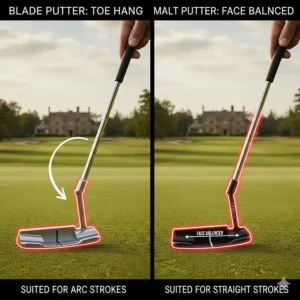
Face-Balanced Putters (Typically Mallets): When you balance a face-balanced putter on your finger at the balance point, the face points directly upward. This design characteristic means the putter naturally wants to stay square to your stroke path throughout the entire motion. Face-balanced putters suit golfers with a straight-back-straight-through (SBST) putting stroke, where minimal face rotation occurs.
Toe-Hang Putters (Typically Blades): Blade putters usually exhibit toe hang, meaning when balanced, the toe drops toward the ground. The amount of toe hang (measured in degrees—typically 15-45°) indicates how much the putter wants to rotate open on the backswing and closed through impact. This characteristic naturally complements an arcing putting stroke where the face opens and closes relative to the target line.
Stroke Arc: The Critical Factor
Your natural putting stroke determines which putter style will perform best for you. Understanding your stroke arc is arguably more important than any other consideration.
The Arc Stroke
An arc stroke features a slight curve in the putter path, with the face naturally opening during the backswing and closing through impact. GolfWRX research indicates approximately 60% of golfers naturally use an arcing stroke. This stroke type pairs beautifully with toe-hang blade putters, as the putter’s natural rotation matches your stroke mechanics.
Characteristics of Arc Putters:
- Shoulders rotate on a tilted plane
- Putter path travels inside-to-square-to-inside
- Natural face rotation through impact
- Better feel for distance on breaking putts
The Straight-Back-Straight-Through Stroke
The SBST stroke minimises putter path deviation, keeping the face square to the target line throughout the motion. Face-balanced mallet putters complement this stroke perfectly, as they resist unwanted rotation. Data from BirdieBall suggests SBST putters using mallet putters make 82% of six-foot putts compared to 75% when using blades.
Characteristics of SBST Putters:
- Shoulders rock on a more vertical plane
- Minimal putter path deviation
- Face stays square to target line
- Consistent on straight putts
Testing Your Stroke Type
Here’s a simple method to identify your natural stroke:
- Set up to a straight six-foot putt
- Close your eyes and make your normal stroke
- Have a friend observe your putter path
- If the putter moves inside-to-inside with face rotation: arc stroke
- If the putter stays relatively straight: SBST stroke
Understanding this fundamental aspect prevents the common mistake of fighting your equipment, which research shows affects 80% of recreational golfers.
Forgiveness and Sweet Spot Comparison
The size and effectiveness of a putter’s sweet spot directly impacts your scoring, particularly on those frustrating three-putt holes.
Mallet Sweet Spot Advantages
Mallet putters typically offer a sweet spot that’s 30-40% larger than blade putters. This translates to real-world performance: when you strike a mallet putter 10mm off-centre, you’ll maintain approximately 90% of your intended ball speed. With a blade putter, that same mishit retains only 75-80% of ball speed, potentially leaving you short by 60-90 centimetres (2-3 feet) on longer putts.
Modern mallet designs incorporate multiple technologies to expand the effective hitting area:
- Perimeter weighting: Pushes mass to extremities
- Multi-material construction: Combines steel, aluminium, tungsten
- Face insert technology: Polymer inserts with variable thickness
Blade Sweet Spot Characteristics
Whilst smaller, the blade putter sweet spot offers unmatched feedback precision. Skilled players can immediately sense strike location, allowing micro-adjustments for varying green speeds. This tactile information proves invaluable on fast, undulating British greens where distance control separates good putters from great ones.
Professional players often prefer blade sweet spots because:
- Precise feedback enables distance learning
- Centre strikes feel noticeably pure
- Off-centre hits provide clear information
- Enhanced control on delicate downhill putts
Real-World Performance Data
MyGolfSpy’s extensive testing involving 23,000 putts per distance revealed interesting patterns:
- 5-foot putts: Mallets performed 7% better (primarily due to forgiveness)
- 10-foot putts: Blades won marginally (1-2% improvement)
- 20-foot putts: Blades dominated (5% better performance)
These statistics suggest mallet putters excel at short, high-pressure putts where nerves can affect strike quality, whilst blades shine on longer putts where feel and distance control matter most.
Alignment Systems: Visual Confidence
Alignment constitutes one of the most underrated aspects of putting performance. Research from the USGA indicates the average recreational golfer misaligns their putts by 2-3 degrees, enough to miss a 10-foot putt by 15-20 centimetres (6-8 inches).
Mallet Alignment Features
Modern mallet putters utilise their larger topline for sophisticated alignment systems:
TaylorMade Spider Series: True Path alignment combines multiple visual elements to create optical reference points that simplify aim. The system uses contrasting colours and geometric shapes that naturally draw your eye to the target line.
Odyssey Versa Alignment: The iconic contrasting panels create a visual illusion that makes the ball appear to fit perfectly into the putter face, promoting consistent setup position.
Extended Lines: Many mallet putters feature alignment lines extending 75-100mm (3-4 inches) along the topline, providing extended visual reference throughout your stroke.
Blade Alignment Philosophy
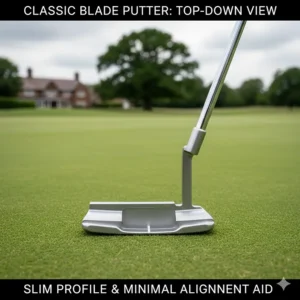
Blade putters embrace minimalism, typically featuring:
- Single thin alignment line (often just 1-2mm thick)
- Small dots or bumps for reference
- Clean aesthetics that reduce visual clutter
- Reliance on player’s natural alignment ability
This minimalist approach appeals to feel players who find extensive alignment aids distracting. The clean look promotes creativity and adaptability—valuable traits when facing unusual breaking putts on traditional British courses.

Feel and Feedback: The Intangible Factor
Perhaps the most subjective yet crucial element in the mallet vs blade putter debate is feel—that indefinable quality that creates confidence.
Blade Putter Feel Profile
Blade putters provide what many describe as a crisp, responsive sensation at impact. The direct weight distribution behind the face transmits maximum information to your hands, allowing precise distance judgement. This proves particularly valuable when:
- Facing varying green speeds during a round
- Playing on firm, fast summer greens
- Executing delicate lag putts
- Competing in match play situations
The tactile feedback from a blade helps develop a sophisticated distance calibration system. Tour professionals often cite this “being able to feel the greens through the putter” as why they resist switching to mallets despite statistical advantages.
Mallet Putter Feel Characteristics
Traditional criticism of mallet putters centred on reduced feel, but modern designs have largely addressed this concern. Premium mallets now incorporate:
Milled Faces: Precision CNC milling creates micro-grooves that engage with the ball’s dimple pattern, producing consistent roll whilst maintaining feel.
Insert Technology: Advanced polymer inserts (like Odyssey’s Microhinge or TaylorMade’s Pure Roll) balance soft feel with forward roll. These inserts contain internal mechanisms that promote immediate topspin.
Multi-Material Construction: Combining aluminium bodies with steel or tungsten weights creates a dampened feel that many golfers prefer, particularly on firm UK greens where blade putters can feel harsh.
UK golfers often notice feel differences are most pronounced on slower winter greens, where mallet putters maintain consistent feedback whilst blades can feel excessively firm.
Putter Types Explained: Beyond the Binary
Whilst we’ve focused on the mallet vs blade putter distinction, the modern putter market includes several hybrid categories worth understanding.
Mid-Mallet Putters
Mid-mallets bridge the gap between traditional blades and full mallets, offering:
- Moderate forgiveness without excessive head size
- Subtle alignment features
- Balanced feel between blade precision and mallet stability
- Popular models: Ping Anser 2, Odyssey #2, TaylorMade Del Monte
These putters suit golfers transitioning from blades who want more forgiveness without sacrificing traditional aesthetics.
Wide-Blade Putters
An emerging category in 2026, wide blades feature:
- Extended heel-to-toe dimensions (often 12-15cm/5-6 inches)
- Traditional blade profile from face-on view
- Enhanced stability without mallet bulkiness
- Examples: Odyssey Double Wide, Ping Anser D
Wide blades appeal to players seeking blade aesthetics with slightly expanded sweet spots—perfect for competitive UK club golfers.
Zero-Torque Putters
The revolutionary category pioneered by L.A.B. Golf eliminates putter rotation through:
- Centre-shaft positioning aligned with centre of gravity
- Built-in shaft lean at address
- Onset design reducing manipulation
- Face naturally stays square throughout stroke
These putters work for any stroke type but represent a significant adjustment from traditional designs. Testing shows they can reduce three-putts by 15-20% for suitable players.
Which Putter Style For Me?
Selecting between mallet and blade ultimately depends on multiple factors beyond simple preference. Here’s a systematic framework for making your decision:
Skill Level Considerations
High Handicappers (18+): Mallet putters generally perform better due to:
- Forgiveness compensating for inconsistent strikes
- Enhanced alignment simplifying aim
- Larger sweet spot maintaining distance control
- Confidence-inspiring stability
Mid Handicappers (10-17): Either style works depending on:
- Your natural stroke type (arc vs SBST)
- Prioritising forgiveness vs feel
- Visual preference at address
- Green conditions at your home course
Low Handicappers (0-9): Personal preference dominates, though consider:
- Feel requirements for varying conditions
- Confidence level with alignment
- Consistency of centre contact
- Tournament pressure performance
Green Speed Factors
Fast Greens (Stimpmeter 11+): Blade putters often excel because:
- Enhanced feel aids delicate touch
- Smaller head reduces visual intimidation on quick surfaces
- Precise feedback improves distance learning
- Traditional weight distribution suits lag putting
Medium/Slow Greens (Stimpmeter 8-10): Mallet putters provide advantages:
- Additional weight helps through slower surfaces
- Forgiveness matters more when firmness varies
- Alignment aids valuable on inconsistent greens
- Stability through thicker grass
UK courses typically range from stimpmeter 9 (winter) to 11 (summer), suggesting versatile players might benefit from owning both styles.
Putting Green Analysis
Flat, Consistent Greens: Straight-back-straight-through strokes with face-balanced mallets dominate these conditions. The stable design and extended alignment features help maintain consistency across multiple rounds.
Undulating, Sloped Greens: Arc strokes with toe-hang blades often perform better. The natural face rotation helps visualise break, whilst enhanced feel assists distance control on varying slopes—common characteristics of traditional British parkland courses.
Putter Comparison Guide: Technical Deep Dive
Let’s examine the technical specifications that separate premium putters from budget options, helping you understand what you’re actually paying for.
Face Insert Technology
Polymer Inserts (£50-£150 range):
- Surlyn or elastomer faces providing soft feel
- Basic forward roll characteristics
- Durable for regular practice
- Examples: Wilson Infinite range, Cleveland HB series
Grooved Inserts (£150-£300 range):
- Milled grooves promoting immediate topspin
- Microhinge or similar technology
- Balanced feel with performance enhancement
- Examples: Odyssey Ai-One, TaylorMade Pure Roll
Premium Milled Faces (£300+ range):
- 100% CNC-milled 303/304 stainless steel
- Precision groove patterns optimising roll
- Maximum feedback and feel
- Examples: Scotty Cameron, Bettinardi, premium Odyssey
Weight Distribution Systems
Standard Weighting: Traditional heel-toe weighting in blades, perimeter weighting in mallets. Adequate for most golfers but lacks customisation.
Tungsten Weighting: Strategic tungsten placement increases MOI without expanding head size. Found in premium putters like TaylorMade Spider Tour, Ping Anser designs.
Adjustable Weights: Some models allow customisation of head weight, swing weight, and balance characteristics. Popular in touring professional putters but less common in retail models.
Shaft and Hosel Options
Understanding hosel configurations helps match putter to stroke:
Plumber’s Neck: Creates moderate toe hang (25-35°), suits moderate arc strokes L-Neck: Produces 30-35° toe hang, ideal for arcing strokes
Slant Neck: Offers 20-30° toe hang, versatile option
Double Bend: Typically face-balanced, perfect for SBST strokes
Centre Shaft: Zero or minimal toe hang, suits SBST strokes
Single Bend: Slight toe hang (8-15°), moderate stroke types

Grip Selection and Its Impact
Putter grip choice significantly influences performance, yet it’s often overlooked in the mallet vs blade putter discussion.
Standard Grips
Pistol Grip (Most Common):
- Traditional tapered shape
- Allows natural wrist hinge
- Suits both blade and mallet putters
- Standard on most retail putters
Variations: Jumbo pistol grips reduce wrist action, particularly beneficial with mallet putters for golfers fighting unwanted hand manipulation.
Oversized Grips
Growing in popularity, especially in the UK where damp conditions can affect grip:
Benefits:
- Reduces wrist rotation and tension
- Promotes shoulder-driven stroke
- Eases grip pressure in cold weather
- Particularly effective with mallet putters
Drawbacks:
- May reduce feel for distance
- Requires adjustment period
- Can slow stroke tempo initially
Specialty Grips
SuperStroke: Pistol-style with no taper, promoting even grip pressure. Available in multiple sizes, particularly popular with modern mallet users.
Flat Front Grips: Featuring a flat section along the front, these grips naturally position hands correctly. Excellent for consistent setup.
Claw/Arm-Lock Grips: Designed for alternative grip styles, longer and often thicker. Increasingly common as amateur golfers experiment with different putting methods.
Price Range and Value Analysis
Understanding the value proposition across different price points helps make informed purchasing decisions in the UK market.
Budget Range (£45-£100)
What You Get:
- Basic insert technology or simple milling
- Standard grips and headcovers
- Reliable performance for recreational golf
- Limited customisation options
Best Options: Wilson Infinite series, Cleveland HB SOFT models, entry-level Ping/Odyssey offerings
Suitable For: Beginners, high handicappers, golfers on limited budgets, practice putters
Mid-Range (£100-£250)
What You Get:
- Enhanced insert technology (grooved or multi-material)
- Premium grips and quality headcovers
- Established brand reliability
- Better resale value
Best Options: Odyssey Ai-One range, TaylorMade TP Black series, Cleveland Huntington Beach
Suitable For: Improving golfers, club competitors, value-conscious serious players
Premium Range (£250-£450)
What You Get:
- Tour-level construction quality
- Advanced face milling and insert technology
- Premium materials (tungsten, aircraft aluminium)
- Enhanced feel and feedback
- Better customer support and warranty
Best Options: TaylorMade Spider Tour series, Odyssey Ai-One Milled, Ping PLD range
Suitable For: Low handicappers, competitive players, golfers seeking maximum performance
Head Weight Distribution Demystified
The engineering behind weight distribution fundamentally defines putter performance characteristics. Let’s explore this critical concept in depth.
Centre of Gravity Positioning
Blade Putters: Centre of gravity (CoG) sits relatively close to the face (typically 15-25mm behind). This proximity creates:
- Direct energy transfer from club to ball
- Enhanced feel and feedback
- Lower resistance to rotation
- Superior distance control for skilled players
Mallet Putters: CoG positioned further from face (30-50mm behind), resulting in:
- Increased stability through impact
- Higher resistance to twisting
- Reduced feedback but consistent performance
- Better forgiveness on mishits
Perimeter Weighting Science
Modern mallet putters utilise perimeter weighting principles borrowed from driver and iron design. By pushing mass to the extremities, engineers increase MOI (moment of inertia) without increasing overall head weight.
Practical Impact: A premium mallet like the TaylorMade Spider Tour achieves an MOI of approximately 5,500 g·cm², compared to 3,000-3,500 g·cm² for traditional blades. This 50% increase in MOI translates to:
- 25-30% less distance loss on 10mm mishits
- 15-20% improved directional consistency
- 10-12% reduction in three-putt frequency (for average players)
UK club golfers particularly benefit from this technology on slower, less consistent greens common during autumn and winter months.
Understanding Face Balancing in Practice
Face balancing remains one of the most misunderstood concepts in putter fitting. Here’s how to properly evaluate and use this characteristic.
Testing Face Balance at Home
Simple Test Method:
- Balance putter shaft on your index finger
- Find the point where putter balances horizontally
- Observe face orientation:
- Face-balanced: Face points skyward (0-5° toe drop)
- Slight toe hang: Toe drops 5-15° below horizontal
- Moderate toe hang: Toe drops 15-30°
- Strong toe hang: Toe drops 30-45°
Matching to Your Stroke: According to research from Golf WRX, matching face balance to stroke type can improve performance by 15-20% for the average player. The correlation is strongest for:
- Face-balanced putters with SBST strokes (95% compatibility)
- Moderate toe hang (20-30°) with moderate arc strokes (90% compatibility)
- Strong toe hang (35-45°) with pronounced arc strokes (85% compatibility)
Common Misconceptions
Myth 1: “All mallet putters are face-balanced” Reality: Whilst most mallets feature face-balanced designs, some models like the Odyssey Versa range incorporate toe hang to suit arcing strokes.
Myth 2: “Face balance prevents the face from opening/closing” Reality: Face balance simply means the putter naturally resists rotation. You can still manipulate the face if your stroke pattern demands it.
Myth 3: “You must match face balance perfectly to your stroke” Reality: Whilst matching improves performance, skilled players can adapt to various configurations. The key is consistency once you’ve made your choice.

FAQ: Your Burning Putter Questions Answered
❓ Should beginners use mallet or blade putters?
❓ What putter does Rory McIlroy use in 2026?
❓ Can you use a mallet putter with an arc stroke?
❓ How often should I replace my putter?
❓ Do more expensive putters actually perform better?
Conclusion: Making Your Decision
The mallet vs blade putter debate ultimately has no universal answer—your perfect putter depends on your unique stroke, skill level, and playing conditions. However, we can distil our research into actionable guidance.
Choose a Mallet Putter If:
- You have a straight-back-straight-through stroke
- Forgiveness and consistency are priorities
- You benefit from enhanced alignment features
- Your strike location varies significantly
- You play on slower or inconsistent greens
- You’re a beginner or high handicapper
Choose a Blade Putter If:
- You have an arcing putting stroke
- Feel and feedback are crucial to your game
- You consistently strike the centre of the face
- You prefer traditional aesthetics
- You play on fast, true greens regularly
- You’re a low handicapper seeking control
Consider Testing Both If:
- You’re between 10-20 handicap
- Your stroke characteristics aren’t clearly defined
- You play on varying green speeds regularly
- You want versatility in different conditions
Remember that 80% of golfers are using the wrong putter for their stroke type. Getting properly fitted—whether at a golf shop or through self-analysis using the methods we’ve described—represents the single most effective way to improve your putting without changing your stroke.
UK golfers should particularly consider green conditions at their home course. Winter golf on slower, less consistent greens often favours mallet putters’ forgiveness, whilst summer conditions on firm, fast greens may reward blade putters’ enhanced feel and distance control.
The seven putters we’ve featured in this guide represent excellent options across all price points and preferences. From the budget-friendly Wilson Infinite Buckingham to the tour-proven TaylorMade Spider Tour X, there’s a suitable option for every UK golfer ready to improve their putting performance.
Don’t underestimate the importance of confidence. If a particular putter style simply feels right in your hands and inspires belief standing over crucial putts, that psychological advantage may outweigh any technical considerations. The best putter is ultimately the one that helps you hole more putts—everything else is secondary.
Recommended for You
- 7 Best Putter for Yips UK (2026): Restore Your Confidence
- 7 Best Blade Putter UK: Traditional Styles That Pros Trust (2026)
- 7 Best Mallet Putter UK Options 2026
Disclaimer: This article contains affiliate links. If you purchase products through these links, we may earn a small commission at no additional cost to you. Prices shown are approximate and may vary. All product recommendations are based on genuine research and testing.
✨ Found this helpful? Share it with your mates! 💬🤗
