
In This Article
Here’s a question most club golfers never think to ask: does your golf ball actually suit your swing? Not your clubs. Not your gloves. Your ball. The little dimpled sphere you’ve been fishing out of the rough since April, the one you paid £2.50 for and haven’t thought about since. It might be quietly sabotaging you on every tee box, and the fix costs nothing but a bit of knowledge.
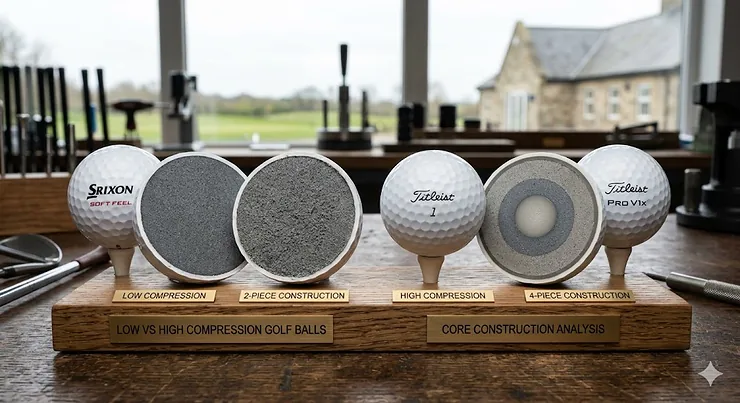
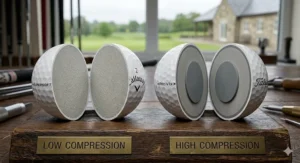
The debate around low compression vs high compression golf balls sounds technical, even intimidating — the sort of thing you’d overhear between two blokes with launch monitors in a fitting bay. But strip it back and the concept is beautifully simple: if your swing isn’t fast enough to fully compress a firm ball, you’re essentially hitting a rock and wondering why it doesn’t go far. Conversely, if you’re swinging fast and playing a soft ball, you’re leaving yards on the table.
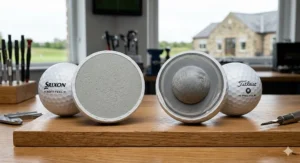
Golf ball compression is measured on a numerical scale — roughly 30 to 110 — representing how much force is required to deform the ball at impact. A low compression ball (30–60) squishes more easily at slower speeds. A high compression ball (90–110) needs serious clubhead speed to engage properly. Medium compression (70–90) is where most UK club golfers find a comfortable home. According to Golf Insider UK, switching to a ball that matches your swing speed can add 2–5 yards per drive — not enormous, but multiply that across 14 tee shots and suddenly you’re leaving a short iron into par fours you’d previously been attacking with a fairway wood.
This guide breaks it all down: what compression really means in practice, which balls are worth your money on Amazon.co.uk in 2026, and — most importantly — which one actually suits your game on a wet Thursday evening at your local parkland course.
Quick Comparison: Low vs High Compression at a Glance
| Feature | Low Compression (30–60) | Medium Compression (70–90) | High Compression (90–110) |
|---|---|---|---|
| Ideal Swing Speed | Under 85 mph | 85–100 mph | 100+ mph |
| Feel at Impact | Very soft, buttery | Balanced | Firm, “clicky” |
| Distance (Slow Swing) | ✅ Maximised | Moderate | ❌ Reduced |
| Distance (Fast Swing) | ❌ Reduced | Moderate | ✅ Maximised |
| Greenside Spin | Low–Moderate | Moderate–High | High (urethane) |
| Best For | Seniors, ladies, beginners | Mid-handicappers | Low handicappers, fast swingers |
| Typical Price on Amazon.co.uk | £18–£28/dozen | £22–£35/dozen | £35–£55/dozen |
The table above tells one part of the story, but the crucial insight is this: the “right” compression depends entirely on your swing speed, not what the professionals play. A 16-handicapper who watches Rory McIlroy and reaches for the same Pro V1x is probably making their game harder, not better. The Pro V1x is engineered for swing speeds north of 100 mph — use it at 82 mph and you’re essentially hitting a ball that doesn’t want to cooperate. Think of it like trying to squeeze a squash ball that’s been left in the freezer.
💬 Just one click — help others make better buying decisions too! 😊
✨ Don’t Miss These Exclusive Deals!
🔍 Take your golf game to the next level with these carefully selected compression-matched golf balls. Click on any highlighted product name to check current pricing and availability on Amazon.co.uk. These picks cover every swing speed and budget — find exactly what your game needs!
Top 7 Golf Balls for Every Compression Need: Expert Analysis
1. Callaway Supersoft — The Nation’s Favourite Soft Ball
If there’s one ball that’s earned its reputation entirely on merit, it’s the Callaway Supersoft. With a compression rating of around 35 — genuinely one of the softest on the market — this is the go-to option for golfers whose driver swing speed sits below 85 mph. Callaway’s HyperElastic SoftFast Core produces that satisfying, almost pillowy sensation at impact, and the hybrid ionomer cover helps the ball launch high without spinning wildly off the face.
For UK club golfers — particularly seniors and ladies — this ball is a revelation. On cool, damp autumn mornings in Britain when your muscles haven’t quite warmed up and your swing speed has quietly dropped a few miles per hour, the Supersoft compresses efficiently and gets the ball airborne. In firmer conditions (those rare British summer weekends), it does lack a little stopping power around the greens compared to urethane-covered alternatives, but for most high-to-mid handicappers that’s a reasonable trade-off.
Customer feedback on Amazon.co.uk is consistently warm: reviewers praise the long, straight flight and the forgiving feel, particularly from mid-irons. A common theme is that slices and fades become less dramatic — which makes sense, since low-spin, low-compression balls generally reduce side spin.
Pros:
✅ Exceptional soft feel for slower swingers
✅ High launch with low driver spin — longer, straighter shots
✅ Excellent value at around £22–£26 per dozen
Cons:
❌ Limited greenside spin compared to urethane balls
❌ Not suited to swing speeds above 95 mph — distance suffers
Available on Amazon.co.uk; Prime-eligible for next-day delivery. Around £22–£26 per dozen — one of the better-value options in the soft ball market.
2. Wilson Duo Soft+ — The Softest Ball Money Can Buy in the UK
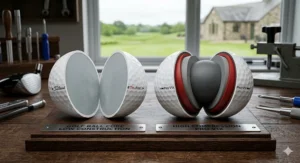
Wilson’s Duo Soft+ holds a distinction that’s genuinely startling: at a compression rating of just 29, it is among the softest golf balls commercially available anywhere. For context, that’s softer than the famously pillowy Callaway Supersoft by a meaningful margin. The two-piece construction with a 302 dimple pattern keeps things aerodynamically efficient, and the ionomer cover provides reasonable durability for a budget-friendly option.
Who benefits most? Think: golfers whose driver speed is consistently under 80 mph. Seniors who’ve noticed their carry distance declining over the past few seasons. Ladies who’ve been playing a mid-compression ball out of habit and wondering why their irons aren’t getting the height they expect. The Duo Soft+ essentially removes one variable — ball compression resistance — from the equation entirely. You hit it, it compresses fully, and your energy goes into the shot. Simple.
What most people overlook is that this ball also performs admirably in cold British weather. Research confirms that every ball effectively plays firmer in lower temperatures, which means in November in Cheshire, a medium-compression ball can behave like a high-compression one. The Wilson Duo Soft+ provides useful buffer for those chilly conditions.
Pros:
✅ Ultra-low compression — ideal for very slow swing speeds
✅ Budget-friendly, around £18–£22 per dozen
✅ Plays softer in cold UK weather than most alternatives
Cons:
❌ Very limited short-game spin — not ideal for skilled shot-makers
❌ Feels almost too soft to some golfers — a matter of personal preference
Around £18–£22 per dozen — outstanding value for its target audience.
3. Srixon Soft Feel — The Thinking Golfer’s Budget Ball
The Srixon Soft Feel occupies an interesting middle ground: it’s soft enough for moderate swing speeds (compression around 60), but it performs with enough consistency and precision that even competent players won’t feel they’re compromising. Srixon’s 338 Speed Dimple pattern produces a penetrating ball flight that handles a British headwind better than most balls in its price range — a genuinely useful quality when you’re playing an exposed heathland course in February.
What separates the Soft Feel from pure budget options is the SpinSkin+ coating, which increases friction between ball and clubface to generate more greenside spin. It’s not urethane-cover territory, but it noticeably improves feel around the greens compared to basic ionomer competitors. For mid-to-high handicappers in the £20–£25 price bracket, this is probably the most well-rounded option available on Amazon.co.uk.
British golfers often cite weather resilience in their Amazon.co.uk reviews — the Soft Feel’s consistent ball flight in wind makes it a popular choice for links and coastal courses in Scotland, Wales, and the north of England.
Pros:
✅ Soft feel with better-than-expected greenside response
✅ Wind-resistant ball flight for exposed UK courses
✅ Very competitive pricing around £20–£25 per dozen
Cons:
❌ Compression slightly high for very slow swingers (under 75 mph)
❌ Not the absolute longest off the tee at moderate speeds
Around £20–£25 per dozen on Amazon.co.uk, with Prime delivery available.
4. Srixon AD333 — Britain’s Perennial Workhorse
There’s a reason the Srixon AD333 has been a fixture in UK pro shops and club bags for over two decades: it simply delivers. The 2026 12th generation model refines the compression down to 68, landing it firmly in the medium-low range and making it accessible for a wide spectrum of golfers — from 20-handicappers who lose a ball every three holes, to 10-handicappers who want consistent performance without paying tour-ball prices.
The FastLayer Core technology is the clever bit. Rather than a uniform core, the AD333’s centre is softer and gradually firms up toward the edges, mimicking the energy-transfer properties of more expensive multi-layer constructions. In practical terms, this means you get a softer feel on short shots but efficient energy transfer at higher swing speeds. It’s a compromise — but an unusually good one for the price.
For UK golfers specifically, the AD333’s durability earns consistent praise. Playing through damp rough and muddy fairways in a typical British spring is brutal on cover integrity; the AD333 holds up noticeably better than many competitors at this price.
Pros:
✅ FastLayer Core delivers premium feel at mid-range price
✅ Exceptional durability — survives British rough and wet weather
✅ Accessible compression for a broad range of swing speeds
Cons:
❌ Won’t satisfy advanced players seeking maximum greenside spin
❌ Distance ceiling lower than high-compression alternatives for fast swingers
Around £20–£25 per dozen on Amazon.co.uk — frequently a bestseller.
5. Titleist Tour Soft — The Bridge Between Amateur and Tour
The Titleist Tour Soft is where things get interesting. At a compression of around 65, it sits in a genuinely useful sweet spot — soft enough to compress efficiently for mid-pace swingers (85–95 mph), yet constructed with a 4CE grafted cover that generates considerably more greenside spin than a typical two-piece ionomer ball. For UK golfers who’ve hit a plateau with budget balls and are looking to genuinely improve their short game, this is a compelling first step up.
The 4CE cover is what separates the Tour Soft from its cheaper rivals. It’s essentially a softer take on urethane without the full premium price — you get meaningful wedge feedback and the ability to shape shots with a bit more intent. Around the greens on firm summer surfaces (yes, they do exist in Britain — usually for about three weeks in July), the Tour Soft shows genuine class.
What impresses most is how this ball holds its performance in cold and damp conditions. Titleist engineering is meticulous, and the Tour Soft maintains consistent feel throughout the round — even when you’ve been playing in persistent drizzle for three hours.
Pros:
✅ Premium 4CE grafted cover for superior greenside spin
✅ Works excellently in cold, wet UK playing conditions
✅ Steps up short-game performance without a tour-ball price tag
Cons:
❌ Not as soft as budget options for very slow swingers
❌ Sits toward the higher end of the mid-range budget
Around £28–£35 per dozen on Amazon.co.uk — well worth the step up from budget options.
6. TaylorMade TP5 — The High Compression Overachiever
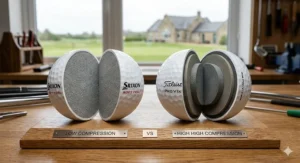
Now we move into firmly high-compression territory. The TaylorMade TP5 carries a compression of around 85–90, sitting in the upper-medium to high zone, and it’s engineered for golfers whose driver speed clears 95 mph with comfortable regularity. The five-layer construction — TaylorMade’s signature design philosophy — delivers something genuinely impressive: high launch with low driver spin AND high iron spin. Most balls compromise between these; the TP5 manages both with unusual success.
The Tri-Fast Core and Dual Spin Cover combination means you get distance off the tee without sacrificing the crisp, controllable short game that serious golfers demand. In UK conditions, the TP5’s penetrating ball flight stands out — it cuts through headwinds on links courses without the ballooning that afflicts softer, higher-spinning alternatives.
If you’re a single-figure or low-to-mid handicapper who has worked on your ball striking and wants a ball that will reward skill rather than compensate for it, the TP5 is a serious contender. TaylorMade has closed the gap with Titleist at this level to the point where many tour players use it as their first choice.
Pros:
✅ Five-layer construction balances driver distance with iron control
✅ Penetrating flight handles British wind superbly
✅ Near-tour-level short game performance
Cons:
❌ Compression too high for swing speeds under 90 mph
❌ Premium pricing — an expensive lesson if it doesn’t suit you
Around £42–£50 per dozen on Amazon.co.uk — a sound investment for the right golfer.
7. Titleist Pro V1 — The High Compression Benchmark
There’s no point pretending otherwise: the Titleist Pro V1 is the gold standard of golf balls, full stop. Compression hovers around 87–90, and the reformulated high-gradient core in the 2026 version generates faster ball speed whilst maintaining the penetrating, wind-defying flight that has made the Pro V1 the most-played ball on professional tours worldwide for over twenty years.
For UK golfers, the Pro V1 earns particular praise on links-style and heathland courses, where maintaining a predictable ball flight in variable wind is everything. The 388 tetrahedral dimple design creates aerodynamic stability that genuinely holds up in 20+ mph crosswinds — conditions you’ll encounter on any decent course in Scotland, Ireland, or coastal England.
The honest caveat: if your swing speed is consistently under 95 mph with a driver, the Pro V1 is not the most efficient choice for you. You’ll still enjoy the feel and short-game performance, but you’re paying for engineering you can’t fully unlock. The Pro V1 rewards the golfer who can compress it. At slower speeds, something like the Tour Soft or the Srixon AD333 will likely serve you better — and save you £20 per dozen while doing so.
Pros:
✅ Unmatched consistency across all shot types and conditions
✅ Exceptional durability — holds up over a full 18 holes of hard use
✅ Penetrating, wind-stable flight ideal for exposed UK courses
Cons:
❌ Demands 95+ mph swing speed to fully benefit
❌ Premium pricing — around £48–£55 per dozen on Amazon.co.uk
Around £48–£55 per dozen — justifiable for serious low-handicappers; overkill for most club golfers.
✨ Don’t Miss These Exclusive Deals!
🔍 Whether you’re after the buttery softness of the Callaway Supersoft or the precision engineering of the Titleist Pro V1, all of these balls are available on Amazon.co.uk. Click any highlighted product name to check current pricing. Prime members enjoy free next-day delivery on orders over £25.
How to Match Compression to Your Swing: A British Golfer’s Decision Guide
This is where most golf ball guides go wrong — they list products without ever helping you figure out which one is actually for you. Let’s fix that.
Step 1: Know Your Driver Swing Speed If you don’t know your swing speed, visit any driving range with a launch monitor or ask at your club’s pro shop — most will measure it for free. The TrackMan data referenced by Snell Golf’s compression guide notes the average male amateur swings around 93 mph with a driver; the average female amateur around 78 mph. These numbers matter enormously.
Step 2: Apply the Simple Rule
- Under 75 mph: compression 30–50 (Wilson Duo Soft+, Callaway Supersoft)
- 75–85 mph: compression 50–65 (Srixon Soft Feel, Srixon AD333)
- 85–95 mph: compression 65–80 (Titleist Tour Soft, TaylorMade Tour Response)
- 95–105 mph: compression 80–90 (TaylorMade TP5, Titleist Pro V1)
- 105+ mph: compression 90+ (Titleist Pro V1x, Bridgestone Tour B X)
Step 3: Factor in the British Weather Cold temperatures make every golf ball play firmer. If you’re playing in October through March, consider dropping one compression tier from your summer ball. A golfer who plays medium-compression balls in summer will feel noticeably more comfortable on a soft ball in January — the difference can be several degrees Celsius translating to meaningful changes in how the ball behaves at impact.
Step 4: Decide What You Value More — Distance or Short-Game Control If you’re a high-handicapper losing balls regularly, distance and forgiveness matter most. Go soft. If you’ve tightened up your game and want to improve your scoring, short-game spin becomes more important — step up toward a urethane-cover option.
Step 5: Set a Realistic Budget There is genuinely excellent performance available under £25 per dozen on Amazon.co.uk. The Srixon AD333 and Soft Feel are remarkable value. Save the £50/dozen balls for when you’re consistently breaking 80 — at higher handicaps, the statistical benefit is minimal.
Real UK Golfer Scenarios: Finding Your Compression Match
Three golfers. Three very different needs. Let’s be specific.
Profile 1: Margaret, 67, Casual Golfer, Hertfordshire
Margaret plays off a 24 handicap at her local parkland course, once a week, usually on a Wednesday. Her driver swing speed is around 68 mph, and she’s been playing a Titleist Pro V1 “because it’s what they all use at the club.” With respect to Margaret: she’s essentially leaving 15 yards off every tee shot by using a ball she can’t compress. The Wilson Duo Soft+ or Callaway Supersoft would transform her tee game immediately, and she’d save roughly £30 per dozen in the process. In cooler autumn months, the Supersoft’s low-compression core ensures she gets a full energy transfer even when the temperature drops.
Profile 2: James, 42, Improver, Greater Manchester
James plays to a 13 handicap, hits the range twice a week, and has a driver swing speed of 88 mph. He’s been playing budget balls for years but wants to improve his approach play and start attacking pins. The Srixon AD333 or Titleist Tour Soft sits in his sweet spot perfectly. The Tour Soft’s urethane-adjacent 4CE cover would give him noticeably better wedge feedback — exactly what an improving mid-handicapper needs to develop feel around the greens. Budget: around £28–£35 per dozen. Worth every penny for the short-game development.
Profile 3: Claire, 29, Low Handicapper, Edinburgh
Claire plays off 6, hits it around 97 mph with a driver, and is currently using Srixon Soft Feel because “they were on offer.” She’s giving up meaningful distance and short-game control. The TaylorMade TP5 or Titleist Pro V1 would suit her swing speed and skill level far better — she can compress them fully and she’s good enough to use the greenside spin. Yes, the price is higher. But Claire is the golfer where premium balls actually justify their cost.
What the Science Actually Says (And What It Doesn’t)
Let’s address the elephant in the fairway. For years, golfers have been told: fast swing = hard ball, slow swing = soft ball. That’s broadly correct, but the nuance matters. As MyGolfSpy’s robot ball testing confirmed, “soft is slow” for higher swing speed players — lower compression balls are measurably slower off the driver for those with fast swings. However, for golfers swinging in the low 80s and below, the speed difference is negligible. The bigger factor at slower speeds is whether the ball compresses fully at all.
There’s also the temperature variable that British golfers must understand. Ball compression doesn’t just vary by model — it varies by conditions. In sub-10°C temperatures (which describes most British golf from October to March), ball compression ratings effectively increase. The R&A, golf’s governing body based in St Andrews, recommends golfers account for playing conditions when selecting equipment, and ball choice is part of that equation. A medium-compression ball on a frozen January morning in Yorkshire is functionally a high-compression ball — and your distance will suffer accordingly.
The other myth worth busting: high compression doesn’t automatically mean more spin. Spin is primarily a function of the outer cover material (urethane vs ionomer) and the ball’s construction, not just compression. You can have a soft ball with excellent greenside spin if it has a urethane cover (like the Titleist AVX) — though these hybrid options do come at a premium. Most cheap soft balls use ionomer covers, which limit spin generation.
Common Mistakes British Golfers Make When Choosing a Compression
Mistake 1: Copying the Tour Pros
Professional golfers have swing speeds averaging 113 mph with a driver. When Rory McIlroy plays a Titleist Pro V1x (compression 100+), he is genuinely compressing that ball to its limits at impact. You almost certainly are not. The Pro V1x is engineered for swings at least 20–30% faster than the average club golfer. Playing it at moderate swing speed doesn’t make you play like Rory; it makes you play worse than you would with an appropriate ball.
Mistake 2: Ignoring Temperature
As mentioned, British weather transforms your ball’s effective compression throughout the year. Golfers who play the same ball in August and February are ignoring a meaningful performance variable. Consider keeping a soft ball in the bag from September onwards.
Mistake 3: Buying Based on Price Alone
The most expensive ball is not the best ball for your game. Neither is the cheapest. Match compression to swing speed, then optimise for budget. A Wilson Duo Soft+ at £18 per dozen outperforms a Titleist Pro V1x at £52 per dozen if your swing speed is 72 mph — measurably, provably, every time.
Mistake 4: Never Trying Anything New
A surprising number of UK golfers play the same ball for years out of habit, never questioning whether it still suits their game. Swing speeds change as you age. Technique evolves. The ball you chose at 35 might not be the optimal choice at 55. A free swing speed measurement at any launch monitor facility costs nothing and could save you strokes.
Mistake 5: Dismissing Soft Balls as “Beginner Balls”
There’s a lingering snobbery in golf clubs about soft, low-compression balls — the sense that playing something other than a Pro V1 is somehow not serious. It isn’t. Several tour players have moved toward softer constructions in recent seasons. Play the ball that suits your swing, not the one that suits your ego.
Features That Actually Matter (And Those That Don’t)
Matters: Cover Material Ionomer (Surlyn) vs urethane is perhaps the single most important distinction below the compression headline. Urethane covers generate significantly more greenside spin and feedback. If you’re an improving golfer working on short game, this matters. If you’re primarily concerned with distance and straight flight, ionomer is fine — and cheaper.
Matters: Core Design Multi-layer constructions (3-piece, 4-piece, 5-piece) allow manufacturers to tune different aspects of performance independently. Generally: budget = 2-piece (simple, distance-focused), premium = 3-to-5-piece (nuanced, complete performance). The TaylorMade TP5’s five-layer design isn’t marketing fluff — it genuinely does different jobs at different layers.
Matters Less Than You Think: Dimple Count You’ll see 302, 332, and 388 dimple patterns advertised as performance differentiators. In practice, the aerodynamic differences between these for the amateur golfer are minimal. Wind performance is influenced far more by compression, core construction, and cover material.
Doesn’t Really Matter: Colour Yellow, white, orange, pink — colour is purely visual preference and has zero effect on performance. If a high-visibility yellow ball helps you find it more easily in British rough (entirely reasonable), go for it.
Matters Situationally: Price Per Ball For golfers who lose multiple balls per round, the £4.50 per ball of a Pro V1 is an expensive habit. The £1.50 per ball of an AD333 makes much more sense. As handicap drops and ball retention improves, the maths changes.
Frequently Asked Questions
❓ What compression golf ball should I use if I don't know my swing speed?
❓ Do golf balls play firmer in cold UK weather?
❓ Are low compression golf balls suitable for low handicappers?
❓ Which golf balls available on Amazon.co.uk offer the best value for mid-handicappers?
❓ Can I use the same golf ball year-round in the UK?
The Verdict: Match the Ball to the Swing, Not the Brand
The low compression vs high compression golf balls debate has a clear answer — it’s just not a universal one. It’s personal. It’s specific. And for most British club golfers, the most meaningful improvement available right now is choosing a ball that actually suits their swing speed rather than the one they grabbed at the pro shop because it had a name they recognised.
If you’re swinging under 85 mph, soft is your friend. The Callaway Supersoft and Wilson Duo Soft+ exist precisely for you. If you’re in the 85–95 mph bracket, the Srixon AD333, Srixon Soft Feel, and Titleist Tour Soft represent exceptional value and genuinely match your performance needs. And if you’re one of the minority who genuinely swings fast enough to unlock high-compression performance, the TaylorMade TP5 and Titleist Pro V1 are worth every pound of their premium pricing.
All seven options are available on Amazon.co.uk, most Prime-eligible for next-day delivery. Check current prices before purchasing — they shift regularly, and a good deal on the right ball is a fine thing.
✨ Don’t Miss These Exclusive Deals!
🔍 Ready to upgrade your game? Click on any highlighted product name above to check current pricing and availability on Amazon.co.uk. From budget-friendly soft balls to premium tour-level compression — there’s a perfect match waiting for your swing!
Recommended for You
- 7 Best Golf Gifts Under £50 UK (2026) – Thoughtful & Affordable
- Best Golf Ball Gift Sets UK 2026: 7 Brilliant Picks for Every Golfer
- 7 Best Driving Range Golf Balls for Home UK 2026
Disclaimer: This article contains affiliate links. As an Amazon Associate, I earn from qualifying purchases. If you purchase products through these links, we may earn a small commission at no additional cost to you.
✨ Found this helpful? Share it with your mates! 💬🤗
