
In This Article
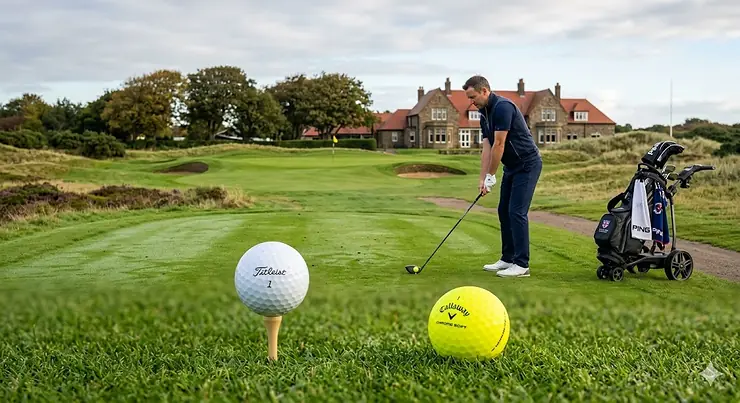
Picture this. It’s a damp Tuesday morning on a parkland course in Cheshire — mist hanging over the fairways, overcast sky the colour of old dishwater. You stripe a drive down the centre, follow the ball with your eyes, and then… it vanishes. Swallowed whole by that flat grey backdrop that British golfers know intimately for about nine months of the year.
That’s the moment the yellow vs white golf balls debate stops being a trivial aesthetic squabble and starts being a genuinely useful conversation.
Here’s the short answer, for the benefit of search engines and impatient golfers alike: yellow and white golf balls deliver identical performance in terms of distance, spin, feel, and flight. The colour pigment changes nothing inside the ball. What does change is how well you can track it, find it, and maintain confidence throughout the round — and in British playing conditions specifically, that distinction is far more significant than manufacturers let on.
Science confirms what most experienced golfers already suspect: yellow-green wavelengths sit in the most sensitive range of human colour perception, which is precisely why you’ll see fluorescent yellow on everything from tennis balls to hi-vis safety vests. Studies suggest yellow golf balls can be up to three times easier to track in flight compared to white — and when you’re playing through autumnal leaf cover in the Cotswolds or a grey November in the Peak District, those three times feel very real indeed.
In this guide, we’ll break down the science, cut through the snobbery that’s historically attached itself to coloured golf balls, and point you toward the seven best yellow golf balls currently available on Amazon.co.uk — from premium tour-level options to outstanding budget choices.
Quick Comparison: Yellow vs White Golf Balls at a Glance
| Feature | Yellow Golf Ball | White Golf Ball |
|---|---|---|
| Performance (distance, spin, feel) | Identical | Identical |
| Flight visibility | ⭐⭐⭐⭐⭐ Excellent | ⭐⭐⭐ Good |
| Visibility in rough | ⭐⭐⭐⭐⭐ Excellent | ⭐⭐ Fair |
| Overcast/UK weather visibility | ⭐⭐⭐⭐⭐ Superior | ⭐⭐ Poor |
| Visibility vs blue sky | ⭐⭐⭐⭐ Very Good | ⭐⭐⭐ Good |
| Social stigma on course | Fading rapidly | None |
| Price premium | None – identical pricing | Baseline |
| Best for | UK conditions, high handicappers, older golfers | Traditionalists, bright conditions |
The table above tells a clean story. On pure performance metrics, there is no winner — they are genuinely equal. The contest is fought entirely on visibility, and yellow wins comprehensively in the murky, overcast, leaf-strewn conditions that define British golf for most of the calendar year. That said, in bright sunshine against a deep blue sky, white holds its own; the contrast is still excellent in summer. The honest conclusion? For the majority of UK golfers playing the majority of UK courses in the majority of UK weather, yellow has a meaningful practical edge.
💬 Just one click — help others make better buying decisions too! 😊
✨ Don’t Miss These Exclusive Deals!
🔍 Take your golf to the next level with these carefully selected balls. Click any highlighted product to check current pricing and availability on Amazon.co.uk. Prime members enjoy free next-day delivery on eligible orders.
Top 7 Yellow Golf Balls: Expert Analysis
1. Titleist Pro V1 Yellow Golf Balls (2025)
The Pro V1 needs no introduction. It has been the most played ball on the professional tour for over two decades — and now in its 25th anniversary iteration, Titleist has equipped it with a new high-gradient core that delivers measurably more distance and lower long-game spin than the previous generation. The 388-dimple tetrahedral design keeps the flight penetrating and stable, which matters enormously on a seaside links when the wind is coming in from the north-west at 25 mph.
The yellow version is — and I cannot stress this enough — exactly the same ball. Same urethane elastomer cover, same multi-layer construction, same flight characteristics. You are paying for the Pro V1’s tour-grade performance with the added bonus of being able to actually see the thing against a November sky in Scotland. For the mid-to-low handicapper who already plays Pro V1 white but regularly loses balls in autumn rough, switching to yellow is quite possibly the most cost-effective “upgrade” available.
UK buyers will find the 2025 Pro V1 Yellow readily available on Amazon.co.uk, typically Prime-eligible for next-day delivery.
✅ Tour-proven performance across all club types
✅ Outstanding greenside spin and soft urethane feel
✅ Dramatically easier to track in overcast conditions
❌ Premium price point (in the mid-to-upper £40s per dozen)
❌ Lower-swing-speed players won’t fully exploit the construction
Value verdict: If you already play Pro V1 white and spend time searching for balls on autumn courses, the yellow version pays for itself in lost-ball prevention alone.
2. Callaway Chrome Soft Yellow Golf Balls (2024)
Callaway’s Chrome Soft has always been positioned as the “soft feel, no compromise on distance” option — and the 2024 version tightens that brief considerably. The new Hyper Fast Soft Core generates excellent ball speed with an impressively low compression rating, meaning golfers with moderate swing speeds get more out of it than they might with a Pro V1. The Seamless Tour Aero dimple pattern (a genuine aerodynamic innovation, not a marketing phrase) produces a consistent high flight that resists crosswinds better than many competitors.
What makes the yellow Chrome Soft particularly interesting for UK golfers is the TruTrack alignment technology on some variants — a visual cue that helps at address and on putts. In the fog-heavy mornings common on parkland courses in Wales and northern England, the yellow + TruTrack combination provides two layers of visual assistance where a plain white ball gives you none.
UK reviewers on Amazon.co.uk consistently highlight the visibility advantage, with several noting it’s their go-to ball for early morning winter rounds.
✅ Exceptional soft feel with genuine tour-level spin
✅ Strong performer for moderate swing speeds (under 95 mph)
✅ TruTrack alignment system adds practical value
❌ Some golfers find it slightly too soft off the driver for their preference
❌ Higher price in the premium tier
Value verdict: A superb all-rounder in the upper price bracket — particularly well-suited to the UK golfer who prioritises short game control and wants to stop hunting for balls in damp rough.
3. TaylorMade TP5 Yellow Golf Balls (2024)
TaylorMade’s five-piece construction is genuinely unusual in the golf ball market, and the TP5 Yellow makes a compelling case that more layers can mean more versatility. The key innovation is the speed layer system: four increasingly stiff layers working outward from the core create a progressive stiffness gradient that effectively “loads” more energy into the strike, regardless of whether you’re swinging at 85 or 105 mph. For the mid-handicapper who hits down sharply on irons but sweeps the driver, the TP5’s layered construction adapts in a way that simpler two- and three-piece balls cannot.
The yellow finish here is genuinely bright — not the slightly washed-out yellow you’ll find on certain budget balls, but a proper optic yellow that stands out dramatically against the grey-green fairways of a British autumn. UK buyers on Amazon.co.uk who’ve reviewed it specifically mention how visible it is in fading light during late-season twilight golf.
✅ Five-piece construction delivers genuine versatility
✅ Excellent all-round performance from tee to green
✅ Very bright optic yellow — superb in low-light conditions
❌ Premium price (mid-to-upper £40s per dozen)
❌ Some players find the feel fractionally firmer than Chrome Soft
Value verdict: Among the best-engineered five-piece balls available, and the yellow finish transforms it into a practical tool for serious UK golfers who play year-round.
4. TaylorMade TP5x Yellow Golf Balls (2024)
Think of the TP5x as the TP5’s more ambitious sibling — faster, higher-flying, and designed specifically for players with higher swing speeds and a preference for a penetrating ball flight rather than a high arc. The High Flex Material (HFM) in the speed layer rebounds with particular intensity on compression, which translates to extra yards for golfers who already swing above 95 mph. The 322 seamless dimple pattern is specifically engineered to maintain trajectory consistency in crosswinds — a point that’s more relevant on an exposed links in East Lothian than on most American courses.
The TP5x Yellow on Amazon.co.uk has garnered a strong following among single-figure handicap players who feel the standard TP5 gives them slightly too much spin off the driver. It’s a subtle but real distinction — and notably, UK reviewers specifically flag the yellow finish as excellent for evening roll-offs when the light turns flat.
✅ Faster ball speed than TP5 for higher swing speeds
✅ Consistent flight in wind — relevant on British links and coastal courses
✅ Piercing high trajectory suits players who want to flight the ball
❌ Not ideal for golfers with swing speeds below 90 mph
❌ Marginally less greenside feel than the softer TP5
Value verdict: The better choice between the two TP5 variants if you swing fast, flight your irons low, and want a ball that doesn’t balloon in British coastal winds.
5. Srixon Soft Feel Tour Yellow Golf Balls (2025)
Here’s where the value argument gets genuinely interesting. The Srixon Soft Feel Tour Yellow sits in the budget-to-mid tier — typically available on Amazon.co.uk in the £25–£35 range per dozen — yet it delivers a playing experience that vastly exceeds what the price might suggest. The low-compression core is specifically engineered for golfers with swing speeds below 95 mph, which, if we’re being honest, describes the majority of British club golfers who are approaching retirement and playing two or three times a week on a tree-lined parkland course.
The low compression means more of the clubhead’s energy actually transfers to the ball on impact, which translates to better distance for the moderate striker — and the soft feel off the putter face is genuinely pleasant. UK Amazon reviewers repeatedly note that the Tour Yellow finish is exactly as described: clean, bright, and easy to spot against rough, not a pale or faded alternative to white.
✅ Outstanding value — competitive performance at roughly half premium price
✅ Ideal for swing speeds under 95 mph
✅ One of the brightest yellows in the budget tier
❌ Short-game spin won’t match premium urethane-covered balls
❌ Slightly less durable than tour-grade options
Value verdict: The most sensible choice for the majority of UK club golfers — particularly anyone over 50 who plays regularly and doesn’t want premium pricing alongside a premium ball-losing habit.
6. Srixon Q-Star Tour Yellow Golf Balls (2025)
This is the one the club professional probably plays when the sponsor’s logo comes off — a ball that delivers performance distinctly closer to the premium tier than its mid-range price implies. The Q-Star Tour’s three-piece construction includes a urethane cover (genuinely rare at this price point), which generates noticeably more greenside spin than two-piece ionomer alternatives. Srixon’s 338 Speed Dimple pattern keeps the ball tracking under control in gusty conditions, and testing confirms it competes meaningfully with considerably more expensive options on approach shots.
The yellow finish on the Q-Star Tour is cleanly applied and maintains brightness through multiple rounds — important, given that some budget yellows fade to a slightly anaemic ochre after a few holes in wet grass. For the mid-handicapper who watches their spending but refuses to sacrifice short-game capability, this is arguably the sweet spot of the entire yellow golf ball market.
According to Golf Monthly’s 2026 testing, the Q-Star Tour Yellow is among the most underrated options at its price point — and it’s hard to argue.
✅ Urethane cover at mid-range pricing — exceptional value
✅ Strong performer in windy conditions
✅ Bright, durable yellow finish that holds up through wet rounds
❌ Slightly higher price than the Soft Feel entry level
❌ Not quite the premium feel of Z-Star or Pro V1
Value verdict: The best value proposition in the yellow golf ball market. A serious mid-handicapper buying this ball and spending the savings on a lesson would be making an excellent investment.
7. Volvik Vivid Yellow Golf Balls
Right — and now for something a bit different. Volvik’s Vivid Yellow breaks ranks from the traditional matte or gloss finishes and delivers what can only be described as a radioactive optic yellow that is, genuinely, impossible to miss. This Korean brand has made high-visibility colour its entire identity, and the results are striking: the Vivid Yellow is consistently cited in visibility testing as the brightest ball available in the consumer market. Against autumn leaf cover, it’s almost comically easy to find.
Performance-wise, the three-piece construction with a low-compression NANO core makes it particularly appealing to seniors and lady golfers, where soft feel and high launch are priorities. The Vivid Yellow has a dedicated following among UK golfers who’ve given up pretending that the social stigma of a coloured ball matters — and honestly, with several European Tour players now using yellow, that stigma is dissolving rapidly.
Available on Amazon.co.uk, typically Prime-eligible and sitting in a very reasonable price bracket for what it offers.
✅ The most visible yellow on the market — unmatched in rough and low light
✅ Soft feel and high launch suit moderate swing speeds
✅ Distinctive — you will never confuse your ball with anyone else’s
❌ Slightly softer feel may not suit players who prefer a firmer response
❌ Less recognised as a “serious” performance ball (though performance data says otherwise)
Value verdict: Perfect for the golfer who’s finally accepted that finding the ball matters more than what the bloke with the 5-handicap thinks of the colour.
📊 Top 7 Yellow Golf Balls: Full Comparison
| Ball | Construction | Cover | Best For | UK Price Range |
|---|---|---|---|---|
| Titleist Pro V1 Yellow | 3-piece | Urethane | Low handicappers | Mid-to-upper £40s/doz |
| Callaway Chrome Soft Yellow | 3-piece | Urethane | Mid-to-low, moderate speed | Mid £40s/doz |
| TaylorMade TP5 Yellow | 5-piece | Urethane | All-round mid-to-low | Mid-to-upper £40s/doz |
| TaylorMade TP5x Yellow | 5-piece | Urethane | Higher swing speed | Mid-to-upper £40s/doz |
| Srixon Soft Feel Tour Yellow | 2-piece | Ionomer | Seniors, slow swing speeds | £25–£35/doz |
| Srixon Q-Star Tour Yellow | 3-piece | Urethane | Mid-handicappers, value | £30–£38/doz |
| Volvik Vivid Yellow | 3-piece | Urethane | Maximum visibility | £25–£35/doz |
The premium tier (Pro V1, Chrome Soft, TP5/TP5x) clusters tightly in performance, and choosing between them is genuinely a matter of personal preference — feel, launch angle, and short-game spin hierarchy. The real story in this table is the Q-Star Tour: a urethane-covered, tour-adjacent ball at mid-range pricing that makes the premium tier difficult to justify for most club golfers. Budget buyers should note that the Soft Feel Tour Yellow sacrifices urethane cover spin for its lower price — a sensible trade for the majority of higher-handicappers whose wedge game isn’t yet at the level where cover material makes a noticeable difference.
✨ Don’t Miss These Exclusive Deals!
🔍 Ready to stop losing balls in the rough? Check current pricing and availability on Amazon.co.uk — many of these options are Prime-eligible for next-day delivery.
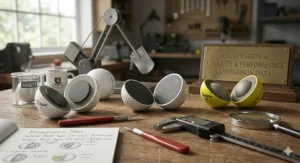
The Science Behind Why Yellow Wins in British Conditions
Let’s talk about why, rather than just that, yellow outperforms white in poor visibility. The human visual system is not neutral across the colour spectrum — it is dramatically more sensitive to yellow-green wavelengths, which peak around 555 nanometres and sit precisely at the centre of our photopic (daylight) vision response. Wikipedia’s article on the CIE 1931 colour space illustrates this spectral sensitivity curve clearly — and it explains why high-vis safety equipment, tennis balls, and softballs all migrated away from white decades ago.
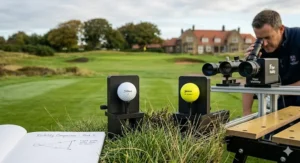
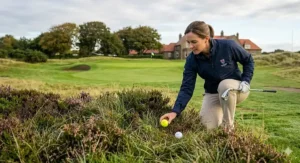
Against a grey-white overcast sky — which UK golfers experience for roughly 250 days a year — a white golf ball loses contrast almost entirely. Yellow, by contrast, maintains strong differentiation against grey backgrounds because it occupies an entirely separate region of the visual spectrum. This is not a small effect. Testing published across golf media suggests yellow can be up to three times easier to track in flight in overcast conditions, and the benefit compounds dramatically in low-light scenarios: dawn rounds, evening roll-offs in late October, and those particularly charming winter twilight rounds when you tee off at 3pm knowing you have approximately forty-five minutes of useful light remaining.
There is also an ageing factor worth acknowledging. From around the age of 50, the human eye’s lens begins to yellow slightly, subtly altering colour perception. This typically makes yellow balls more visible relative to white for older golfers — the opposite of what you might expect. The Royal National Institute of Blind People (RNIB) has documented how colour contrast profoundly affects visual performance in everyday activities, and the same principles apply directly to golf ball tracking. For golfers with mild colour vision deficiency, neon yellow is consistently the most accessible option, maintaining distinguishability across the widest range of colour perception profiles.
Practical Visibility Guide: When to Choose Yellow and When White Still Works
This is the section most guides skip, because the honest answer complicates the “always play yellow” narrative. Here is a realistic breakdown:
Yellow wins convincingly when:
- The sky is overcast (which in the UK means roughly 70% of your rounds)
- You’re playing through autumn leaf cover — yellow stands out against brown, orange, and gold foliage where white disappears
- It’s early morning or late afternoon, when light is low and flat
- You’re playing a course with light-coloured rough or pale sandy waste areas
- You’re 50+ and notice your ball tracking has deteriorated
White holds its own when:
- You’re playing under brilliant blue summer sky — the contrast is strong either way
- The course has very deep rough or heavily shaded tree lines, where yellow can blend with dappled yellow-green light on the floor
- You’re playing competitive golf and personal preference outweighs marginal visibility gains
- You simply prefer it. Which is, frankly, a perfectly valid reason.
The practical recommendation for most UK golfers? Keep a sleeve of each in the bag. Play yellow from October through March without a second thought. Switch to white in high summer if you prefer the look. The performance is identical either way — you are making purely a visibility decision.
UK Golfers: Three Real-World Scenarios
The Weekend Parkland Player in Yorkshire
Meet David, 54, plays off 18, Lytham area, weekend golfer who plays two rounds a month between September and April. His courses are tree-lined and heavily shaded, with autumn leaf cover from late September onwards. His current ball is Titleist Pro V1 white — excellent choice for his short game, but he loses three or four a round to autumn rough, which costs him around £12–15 per session in replacement balls.
Recommendation: Switch to Titleist Pro V1 Yellow. Identical performance he’s used to, meaningfully better visibility in the conditions he plays most. The premium cost is justified because he already plays the Pro V1 — it’s a direct swap, not a downgrade.
The Retired Couple at a Surrey Heathland
Margaret and John, both 68, both swing below 85 mph, play three times a week on a heathland course. They’ve both noticed in the last few years that tracking the ball in the air has become harder, particularly in flat grey light. White balls disappear on them regularly.
Recommendation: Srixon Soft Feel Tour Yellow for both. The low-compression core maximises distance for their swing speeds, the yellow is genuinely bright, and the price is sensible for the frequency they play. Budget-conscious and precisely engineered for their swing profile.
The Competitive Club Player in Edinburgh
Niamh, 34, plays off 6, practices seriously, competes in monthly medals. She’s been playing white Chrome Soft but is curious about yellow after watching several European Tour players switch.
Recommendation: Callaway Chrome Soft Yellow. Exactly the same ball she’s playing now. Zero performance adjustment. But on Muirfield-adjacent coastal courses in low coastal light, she gains meaningful flight tracking without giving up a single performance metric. It’s effectively a free upgrade.
Common Mistakes When Choosing a Golf Ball Colour
Assuming yellow means lower quality. This persisted as a received wisdom for decades and has no basis in fact. The 2025 Pro V1 Yellow is engineered to precisely the same specification as the white Pro V1. As the R&A’s equipment standards confirm, the Rules of Golf impose no performance restrictions based on ball colour — only conformance to standards of size, weight, and construction.
Choosing by price tier rather than swing speed. A premium five-piece tour ball is genuinely wasted on a golfer swinging below 85 mph — the construction is engineered to respond at higher compression levels. The Soft Feel Tour Yellow at £28–£35 per dozen may actually outperform a Pro V1 at £45 for a slower-swinging golfer, because the softer core engages more efficiently.
Overlooking yellows in bright sunlight. On a perfect summer day, against deep blue sky, white remains excellent. Some golfers find yellow slightly harder to track against high bright blue in peak summer — the contrast between neon yellow and deep blue sky is strong, but some eyes prefer the brightness of white. Know your visual preference.
Buying the cheapest yellow available. Budget yellows from unbranded manufacturers often use inferior pigments that fade to a dull ochre after a few holes in wet grass — precisely the conditions in which you wanted the visibility advantage. The balls listed in this guide all use quality pigment formulations that hold their brightness through wet British rounds.
How to Choose Yellow Golf Balls in the UK: A Practical Decision Framework
- Identify your swing speed. Below 85 mph: prioritise low-compression options (Soft Feel Tour Yellow, Volvik Vivid). 85–95 mph: mid-range shines (Q-Star Tour Yellow, Chrome Soft Yellow). Above 95 mph: premium five-piece construction rewards you (TP5x Yellow, Pro V1 Yellow).
- Assess your typical playing conditions. Autumn/winter parkland? Yellow is a clear choice. Summer links under blue skies? Either works; personal preference rules.
- Match your performance priorities. Short-game spinner: urethane cover is non-negotiable — Pro V1 Yellow, Chrome Soft Yellow, or Q-Star Tour Yellow. Maximum distance: TP5x Yellow or Soft Feel Tour Yellow depending on swing speed.
- Set a realistic budget. A mid-handicapper does not need a £45 dozen. The Q-Star Tour Yellow at around £32–£38 is the honest sweet spot for the vast majority of UK club golfers.
- Consider your playing frequency. Playing three times a week? Mid-range makes sense — you’ll lose balls regardless. Playing once a fortnight in precious conditions? The premium tier’s durability justifies the cost.
FAQ
❓ Do yellow golf balls perform the same as white?
❓ Are yellow golf balls easier to see in the UK's overcast weather?
❓ Are yellow golf balls allowed in UK competitive golf?
❓ Which yellow golf ball is best for beginners in the UK?
❓ Do yellow golf balls cost more than white golf balls?
Conclusion: Stop Fighting the Yellow Ball
The yellow vs white golf balls debate, when stripped of the snobbery that has historically surrounded it, resolves into a surprisingly simple conclusion: play yellow unless you have a specific reason not to. In British conditions — those grey, damp, leaf-strewn, low-light conditions that define most of the golfing year — yellow provides a practical, scientifically grounded advantage that costs you absolutely nothing in performance terms.
The best option for you from this list depends almost entirely on your swing speed and budget. Premium players already on Pro V1 or Chrome Soft white should switch to yellow without a second thought — it is a free upgrade. Mid-handicappers looking for value should start with the Q-Star Tour Yellow, where a urethane cover and tour-adjacent performance arrive at a genuinely sensible price. High-handicappers and seniors will find the Soft Feel Tour Yellow or the Volvik Vivid Yellow transforms their ability to find the ball — and finding the ball, after all, is rather the point.
The stigma is fading. The science is clear. The yellow ball is no longer the confession of a golfer who couldn’t hit fairways. It’s the choice of a golfer who’s decided to be practical about a sport that’s difficult enough without adding “find the white thing in the grey light” as an extra challenge.
✨ Don’t Miss These Exclusive Deals!
🔍 Check current pricing and availability on Amazon.co.uk for all seven options above. Prime members enjoy next-day delivery on eligible orders — you could be playing yellow by the weekend.
Recommended for You
- Low Compression vs High Compression Golf Balls: 7 Best UK Picks (2026)
- 7 Best Golf Gifts Under £50 UK (2026) – Thoughtful & Affordable
- Best Golf Ball Gift Sets UK 2026: 7 Brilliant Picks for Every Golfer
Disclaimer: This article contains affiliate links. As an Amazon Associate, I earn from qualifying purchases. If you purchase products through these links, we may earn a small commission at no additional cost to you.
✨ Found this helpful? Share it with your mates! 💬🤗
