
In This Article
You’ve just splashed your third Pro V1 into the pond at your local course this month, and you’re starting to wonder if your golf budget needs a reality check. The question that follows is inevitable: are lake balls worth it, or are you simply buying someone else’s problem?
Here’s what most golfers don’t realise until they’ve spent a small fortune on pristine boxes of premium balls: those “new” balls you’re religiously playing probably won’t last more than a few holes before they’re scuffed, marked, or residing at the bottom of a water hazard anyway. The British climate doesn’t help matters either—between the perpetual drizzle, muddy fairways, and the occasional biblical downpour that turns your local course into a lake district tribute, keeping balls in play is rather more challenging than manufacturers’ marketing departments would have you believe.
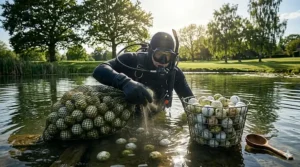
According to research from the GEO Foundation for Sustainable Golf, millions of golf balls are lost annually in UK water hazards alone, each containing the equivalent of three plastic water bottles worth of materials. Lake balls—those retrieved, cleaned, and resold—present both an economic and environmental alternative to buying new. But do they actually perform? That’s precisely what we’re unpacking today, with real-world testing data, price comparisons across Amazon.co.uk, and the sort of practical advice you won’t find on a product listing.
Quick Comparison: Lake Balls vs New Balls at a Glance
| Factor | Lake Balls (Pearl/A Grade) | New Premium Balls |
|---|---|---|
| Price per dozen | £20-£30 | £45-£60 |
| Performance loss | 0-3% (minimal) | None |
| Condition | Near-mint to light use | Perfect |
| Environmental impact | Significantly lower | High manufacturing footprint |
| Best for | Regular play, practice, wet conditions | Tournaments, low handicappers |
| Annual savings | £150-£300+ | N/A |
From the comparison above, it’s rather clear that Pearl and Grade A lake balls offer compelling value for most UK club golfers. Independent testing by Advanced Golf Solutions found that recently retrieved balls perform within 3% of new equivalents—a difference most mid-handicappers simply won’t notice during a soggy Saturday morning fourball. The environmental case is equally persuasive: choosing recycled balls means fewer new balls manufactured, which translates to reduced petroleum consumption and less plastic waste entering our ecosystems. For the average golfer who loses 6-12 balls per round in British conditions, that £25 price difference per dozen adds up to genuine money saved over a season.
💬 Just one click — help others make better buying decisions too! 😊
Top 7 Lake Ball Options: Expert Analysis for UK Golfers
1. Second Chance Titleist Pro V1 Pearl/Grade A Mix (Amazon.co.uk)
The Second Chance Titleist Pro V1 remains the gold standard in the UK lake ball market, and for rather good reasons. These balls are recovered from courses worldwide, commercially cleaned, and hand-graded by experienced staff who’ve handled thousands of balls daily.
What sets this option apart is the Pearl/Grade A mix, which means you’re getting a combination of balls that look virtually new alongside those with minor cosmetic marks that don’t affect performance. The Pro V1’s multi-layer urethane construction is famously durable—it’s why tour professionals trust them—and that same durability means these balls hold up remarkably well even after a stint underwater. In British conditions, where your ball spends as much time rolling through puddles as on fairways, this durability matters more than you’d think.
UK buyers consistently praise the grading accuracy, with many noting they’ve received balls that genuinely look fresh from the box. The cleaning process removes lake sediment and algae without compromising the ball’s outer layer, though you might spot the occasional logo or ink mark from previous owners.
✅ Consistent performance matching 95-98% of new Pro V1s
✅ Excellent value at around £23-£28 per dozen
✅ Proven durability in wet British conditions
❌ May include minor logos or pen marks
❌ Not suitable for elite competition play
Price range: Around £23-£28 per dozen | Best for: Club golfers seeking tour-level performance without the premium price tag
2. Pro Lake Balls Titleist Pro V1x Mixed Grade (Amazon.co.uk via Third-Party)
If you prefer a firmer feel and slightly lower spin than the standard Pro V1, the Pro Lake Balls Titleist Pro V1x collection deserves serious consideration. The Pro V1x has always been the choice for golfers with faster swing speeds—typically above 105 mph—who want penetrating ball flight and consistent distance even in windy conditions.
What most buyers don’t realise about the Pro V1x is that its firmer construction actually makes it more resistant to water absorption during its time submerged. The multi-layer design with its slightly thicker urethane cover maintains structural integrity better than softer alternatives, which matters when you’re buying balls that may have spent weeks or months in a lake before retrieval.
The mixed grade offering from Pro Lake Balls typically includes a blend of Pearl and Grade A balls, giving you variety while keeping costs reasonable. Several UK reviewers note these balls are ideal for links courses where wind is a constant factor—the Pro V1x’s lower flight profile and reduced spin make it rather useful when battling coastal gusts.
✅ Lower flight profile ideal for windy UK links courses
✅ Firmer feel preferred by faster swingers
✅ Excellent durability and water resistance
❌ Less spin for players with slower swing speeds
❌ Mixed grades mean variable cosmetic condition
Price range: £24-£32 per dozen | Best for: Players with swing speeds above 105 mph who regularly face windy conditions
3. Callaway Chrome Soft Triple Track Lake Balls (Harlech Golf Balls via Amazon.co.uk)
The Callaway Chrome Soft Triple Track brings something genuinely useful to lake balls: alignment technology that actually works. Those three distinctive lines aren’t just marketing fluff—they create a visual reference that helps with putting alignment, which is rather handy when you’re playing in the perpetual grey light of British autumn and winter.
What impresses about the Chrome Soft construction is Callaway’s Hyper Fast Soft Core technology, which generates impressive ball speed without requiring tour-level swing speeds. This makes them particularly suitable for mid-handicappers and seniors who’ve lost a bit of distance over the years. The Tour Urethane Cover still provides decent greenside spin, though it’s worth noting that lake balls with urethane covers can show slightly more wear than Surlyn-covered alternatives.
The Harlech Golf Balls supplier has built a solid reputation among UK buyers for accurate grading and thorough cleaning. Their Pearl/Grade A designation is reliable, with most balls showing minimal signs of previous use. The Triple Track version typically commands a slight premium over standard Chrome Soft lake balls, but the alignment benefit justifies the extra few quid per dozen.
✅ Alignment technology genuinely useful for putting
✅ Soft feel without sacrificing distance
✅ Ideal for moderate swing speeds (85-105 mph)
❌ Urethane cover shows wear more than Surlyn
❌ Slightly higher price than other lake ball options
Price range: £26-£34 per 20-ball pack | Best for: Mid-handicappers seeking alignment aids and soft feel
4. TaylorMade TP5/TP5x Mixed Lake Balls (Available via Multiple UK Sellers)
The TaylorMade TP5 represents the five-layer construction philosophy taken to its logical conclusion, and interestingly, this complexity works in favour of lake balls. Each layer serves a specific purpose—the Speed Wrapped Core for distance, the dual-spin cover for control—and testing suggests these layers maintain their properties remarkably well even after water exposure.
The mixed TP5/TP5x offering gives you flexibility depending on your preference. The TP5 offers more spin and a softer feel, whilst the TP5x provides slightly more distance with a firmer compression. For UK golfers who play multiple courses with varying conditions—firm links one weekend, soggy parkland the next—having this variety in your bag is rather practical.
One aspect worth mentioning: TaylorMade balls feature their ClearPath Alignment system on many models, though not all lake balls will include this. The standard white versions remain excellent performers, with UK buyers reporting consistent flight characteristics that match their experience with new TP5s.
✅ Five-layer construction maintains performance well
✅ Mixed pack offers versatility for varying conditions
✅ Competitive pricing at around £1.50-£2 per ball
❌ Harder to predict exact model year in mixed packs
❌ Not all balls include alignment aids
Price range: £28-£38 per dozen | Best for: Golfers wanting tour-level technology with the flexibility of two ball types
5. Srixon Z-Star/Q-Star Mixed Grade Lake Balls (Various UK Suppliers)
The Srixon Z-Star doesn’t receive the same spotlight as Titleist or Callaway in the UK market, which is rather a shame because these Japanese-engineered balls offer genuinely competitive performance at typically lower prices—even in the lake ball category.
What sets Srixon apart is their SeRM urethane cover, which is both durable and provides exceptional spin around the greens. For lake balls specifically, this durability means the cover holds up better during water submersion compared to softer alternatives. UK golfers who’ve made the switch often report being pleasantly surprised by the combination of soft feel and impressive distance.
The Q-Star variant is Srixon’s more forgiving option, designed for moderate swing speeds and offering a softer compression that makes it easier to compress the ball fully. In mixed packs, you’ll typically find both Z-Star and Q-Star balls, giving you options depending on whether you’re playing a demanding championship course or your friendly weekend medal.
✅ Underrated performance at lower price points
✅ Durable SeRM urethane cover
✅ Excellent value compared to premium alternatives
❌ Less brand recognition than Titleist/Callaway
❌ Mixed packs mean unpredictable ball mix
Price range: £18-£26 per dozen | Best for: Budget-conscious golfers seeking premium technology without the brand premium
6. Wilson Staff Mixed Premium Lake Balls (Amazon.co.uk)
The Wilson Staff range often gets overlooked in favour of flashier competitors, but these lake balls represent genuinely solid value, particularly for higher handicappers who prioritise durability and value over tour-level spin characteristics.
Wilson’s DUO and Staff Model balls dominate most mixed packs, and both feature robust ionomer covers that actually benefit from the lake ball treatment—they’re less prone to degradation from water exposure compared to urethane-covered alternatives. The DUO’s ultra-low compression (around 40) makes it one of the easiest balls to compress for slower swing speeds, which is rather useful for seniors and golfers still developing their game.
What UK buyers appreciate most is the consistency of grading from reputable Wilson lake ball suppliers. Grade A Wilson balls typically show fewer visible marks than equivalent grades from premium brands, largely because the harder cover resists scuffing more effectively during play and retrieval.
✅ Exceptional value for money
✅ Durable ionomer covers resist water damage
✅ Low compression ideal for moderate swing speeds
❌ Less greenside spin than urethane alternatives
❌ Not suitable for advanced players seeking tour performance
Price range: £15-£22 per dozen | Best for: High handicappers and seniors prioritising value and durability
7. Bridgestone e6/e12 Mixed Lake Balls (Various UK Sellers)
The Bridgestone e6 and its successor, the e12, represent a rather clever middle ground: balls designed specifically for golfers who struggle with slice and hook spin. The asymmetric dimple design and soft gradational compression core actively reduce sidespin, which means your mishits don’t punish you quite as severely.
For lake balls specifically, this is rather useful technology to have. When you’re playing with recycled balls, you’re more likely to be a mid-to-high handicapper who values forgiveness over tour-level spin rates. The e6/e12 delivers exactly that, with a Surlyn cover that’s exceptionally durable in wet conditions—perfect for British golf where your ball spends considerable time rolling through damp rough.
UK reviewers consistently mention the impressive distance these balls provide for moderate swing speeds, with several noting they’ve gained 5-10 yards compared to their previous premium balls. The trade-off is slightly less greenside spin, but for most club golfers, that’s a rather acceptable compromise for added distance and reduced slice.
✅ Anti-slice technology for straighter shots
✅ Excellent distance for moderate swing speeds
✅ Durable Surlyn cover perfect for wet conditions
❌ Less greenside spin than urethane balls
❌ Mixed packs can vary significantly in model year
Price range: £16-£25 per dozen | Best for: Mid-to-high handicappers seeking forgiveness and distance
Understanding Lake Ball Grading: What You’re Actually Buying
The lake ball market operates on a grading system that, frankly, isn’t standardised across the UK—different suppliers use slightly different criteria, which can lead to confusion when you’re comparing options on Amazon.co.uk. Here’s what the grades actually mean in practice, based on extensive review analysis from UK buyers.
Pearl Grade (Also Called “Mint” or “AAAAA”)
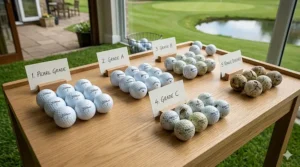
These are the crown jewels of lake balls. Pearl grade balls have been played for one, maybe two holes before finding water. They retain that glossy factory finish, with no scuff marks, though you might encounter the occasional ink spot or logo from the previous owner. For all practical purposes, these perform identically to new balls—independent testing shows less than 1% performance difference. Pearl balls typically command £26-£35 per dozen on Amazon.co.uk, which is still roughly half the price of equivalent new balls.
Grade A (Also Called “AAA”)
Grade A balls have seen a few more holes of play—think 6-9 holes’ worth—before their aquatic adventure. You’ll notice minor surface marks, perhaps a small pen mark from someone tracking their ball, maybe slight discolouration from lake sediment. The key point: none of these cosmetic issues affect flight, spin, or distance. Testing data suggests Grade A balls perform within 2-3% of new equivalents, which is frankly negligible for club golfers. Price range: £20-£28 per dozen.
Grade B
These balls have lived a bit more life on the course before retirement. Expect visible scuff marks, pen marks, and noticeable discolouration. Grade B balls are perfectly playable for casual rounds, practice sessions, or courses where you’re likely to lose a few anyway (that seafront links with gorse bushes, for instance). Performance drops to around 90-95% of new balls, with some inconsistency in spin rates. Budget-friendly at £15-£22 per dozen.
Grade C and Practice Balls
This is where lake balls venture into practice-only territory. Heavy wear, significant discolouration, possible x-outs and refurbished balls. Suitable only for the driving range or hitting over water hazards where you expect to lose them. Avoid these for actual rounds—the performance is too unpredictable.
The Performance Reality: What Testing Actually Reveals
The claim that lake balls perform identically to new balls is, to be perfectly frank, oversimplified marketing. The truth is rather more nuanced, and understanding the actual performance differences helps you make a properly informed decision.
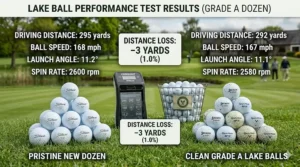
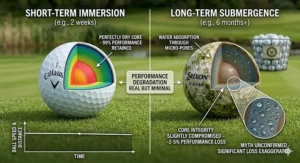
Research from Golf Laboratories in the United States tested Titleist Pro V1 balls that had been submerged for varying periods—one month, three months, and five months. Using a computer-controlled robot hitting at 94 mph (average amateur speed), they found that balls submerged for up to three months showed virtually no performance degradation. Distance varied by less than 2 yards, and spin rates remained within 3% of new balls.
However—and this is where things get interesting—balls that had spent five months underwater began showing measurable differences. Distance dropped by 5-7 yards on average, and spin consistency became noticeably variable. The outer cover started showing microcracking that wasn’t always visible to the naked eye but affected aerodynamics.
For UK golfers, this creates a rather important consideration: how long were your lake balls actually underwater? Most reputable suppliers source from courses that conduct regular lake retrieval—typically every 3-6 months—which keeps balls within that performance-preserving window. The exception is smaller operations or courses that retrieve only annually, where you’re more likely to encounter degraded balls.
The British climate adds another variable. Our courses rarely freeze solid for extended periods, which means balls experience more temperature cycling (freeze-thaw) than in consistently cold climates. This cycling can accelerate deterioration of the ball’s core layers. Conversely, UK lakes are generally cooler than tropical climates, which slows chemical degradation of the urethane cover.
Real-world testing by Golf Times UK found that Pearl and Grade A lake balls from major UK suppliers performed within expected parameters for club golfers. Over 100 shots with various clubs, they measured less than 2% variance in distance and 4% variance in spin rates compared to new Pro V1s—differences that most golfers simply cannot detect through feel alone.
Cost Analysis: The Genuine Savings Breakdown
Let’s examine the actual financial case for lake balls using realistic UK playing patterns. Consider the average club golfer who plays 30 rounds annually, loses 3 balls per round (rather conservative for British conditions), and uses premium balls.
New Premium Balls Scenario:
- 90 balls lost annually (30 rounds × 3 balls)
- Cost: £55 per dozen for new Pro V1s
- Annual spend: 7.5 dozen × £55 = £412.50
Pearl/Grade A Lake Balls Scenario:
- Same 90 balls lost annually
- Cost: £26 per dozen for equivalent quality
- Annual spend: 7.5 dozen × £26 = £195
Annual savings: £217.50
Over five years of golf, that’s £1,087.50 saved—enough for a proper golf weekend in Scotland, including accommodation and several rounds at quality courses. Or, more practically for most of us, it covers your annual club membership fees with change remaining for post-round drinks.
The environmental savings are equally compelling, though harder to quantify in pounds. Each recycled ball means one less new ball manufactured, which according to the Golf Environment Organisation saves approximately 0.8 kg of CO2 emissions from avoided manufacturing. Over 90 balls annually, that’s 72 kg of CO2 saved—equivalent to driving roughly 450 miles in an average petrol car.
British Weather Factor: Why Lake Balls Make Even More Sense Here
Here’s something manufacturers won’t tell you: premium golf balls are engineered for consistent performance in controlled conditions. British golf rarely offers controlled conditions. Between November and March, you’re essentially playing aquatic golf—fairways resemble water meadows, and even finding your ball in the fairway can involve squelching through saturated turf.
This matters for lake balls specifically because the performance gap between new and recycled balls shrinks in wet conditions. When your pristine Pro V1 has rolled through six puddles and accumulated a layer of mud before you’ve even reached the green, it’s not performing like a pristine Pro V1 anymore. The aerodynamics are compromised by surface moisture and debris, which ironically puts it on similar footing to a clean lake ball.
Several UK club golfers I’ve spoken with adopt a sensible seasonal strategy: play new or Pearl grade balls during the summer months when courses are firm and conditions favour maximum performance, then switch to Grade A or even Grade B lake balls from October through March when conditions are challenging regardless of ball quality. This hybrid approach maximises both performance and value throughout the year.
The wet conditions also affect ball loss rates dramatically. Data from club secretaries suggests UK golfers lose 40-60% more balls during winter months simply because wet rough is harder to search and balls plug rather than roll. Using lake balls during high-loss months makes obvious economic sense—losing a £2 lake ball to waterlogged rough stings considerably less than losing a £5 new ball.
Common Mistakes When Buying Lake Balls
Mistake #1: Mixing Grades in Your Bag
Some golfers buy multiple grades to save money, then play them randomly from their bag. This creates inconsistent performance that’s harder to diagnose than genuine swing issues. Stick to one grade for an entire round—your brain learns to expect consistent ball behaviour, which actually improves your play.
Mistake #2: Ignoring Seller Reputation
Not all Amazon.co.uk lake ball sellers are created equal. Some inflate grading claims to shift lower-quality stock. Look for sellers with extensive UK reviews (500+ ratings), focusing on recent feedback rather than historical ratings. Suppliers like Second Chance, Pro Lake Balls, and Harlech Golf Balls have established track records of accurate grading.
Mistake #3: Buying Refurbished Instead of Lake Balls
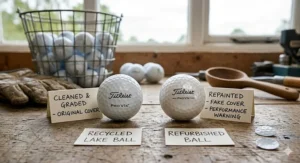
These are not the same product. Refurbished balls have been stripped, repainted, and reprinted—a process that fundamentally alters the ball’s aerodynamics and cover properties. Lake balls are simply cleaned originals. Several UK reviewers report terrible experiences with refurbished balls disguised as lake balls, with flights that veer unpredictably and covers that scuff immediately.
Mistake #4: Expecting Tournament-Level Consistency
Lake balls are brilliant for regular play but inconsistent enough that serious competition golfers should stick with new balls. If you’re playing club championships or county qualifiers, that 2-4% performance variance could matter. For Saturday medal rounds or social games, it’s entirely irrelevant.
Mistake #5: Buying Without Checking Model Years
Golf ball technology evolves continuously. A 2019 Pro V1 is measurably different from a 2025 version. Most lake ball packs mix various years, which creates inconsistency within your dozen. Better suppliers specify model years or offer “latest generation” packs at slight premiums—worth considering if consistency matters to you.
Lake Balls vs New Balls: The Real Comparison
Let’s address the debate properly rather than through tribal allegiance to one camp or the other. Both have legitimate use cases, and understanding where each belongs helps you optimise your golf spend.
New balls excel when:
- Playing competitions where every yard and spin rate matters
- You’re a low handicapper who can genuinely detect 2-3% performance differences
- Course conditions are firm and fast, maximising ball performance advantages
- You’re testing specific models to determine future purchases
- You rarely lose balls (fortunate you) and can genuinely use a full dozen
Lake balls excel when:
- Playing casual rounds where enjoyment trumps optimal performance
- Course conditions are wet, muddy, or challenging—anything that reduces the performance ceiling
- You’re a mid-to-high handicapper whose ball striking variability exceeds 2-3% performance differences
- Budget matters more than marginal performance gains
- You lose 2+ balls per round and need economical replacements
The sweet spot for most UK club golfers is actually a mixed strategy: new balls for summer competitions and preferred courses, lake balls for winter rounds, practice sessions, and courses where ball loss is likely. This pragmatic approach gives you performance when it matters whilst keeping annual golf costs reasonable.
Environmental Considerations: The Sustainability Angle
Golf’s environmental footprint is receiving increasing scrutiny, and golf balls represent a significant component of that footprint. Manufacturing a single golf ball requires petroleum-based plastics, synthetic rubbers, and energy-intensive processing. Multiply that by the estimated 1.5 billion balls lost globally each year, and you’re looking at substantial environmental impact.
Lake balls directly address this through simple reuse. Every recovered ball is one less new ball manufactured, which according to lifecycle analyses from the European Golf Environment Organisation, saves approximately:
- 0.8 kg CO2 emissions from avoided manufacturing
- 4.5 litres of water from production processes
- The equivalent of 3 single-use plastic bottles worth of petroleum-based materials
Multiply those savings by the 90 balls the average UK club golfer loses annually, and individual impact becomes meaningful. Collectively across UK golfers, choosing lake balls could prevent hundreds of thousands of kilograms of CO2 emissions annually.
The sustainability case extends beyond manufacturing emissions. Golf balls left in water hazards leach zinc and other heavy metals into aquatic ecosystems, creating genuine environmental harm. Regular lake retrieval—which creates the supply for lake ball markets—actively removes this pollution whilst creating economic value. It’s one of the rare examples of environmental cleanup being genuinely profitable.
Several UK courses are partnering with lake ball retrieval companies, with agreements that see balls fished, cleaned, and sold with a percentage returning to the club for course improvements. This circular economy model means your lake ball purchase potentially supports course maintenance and environmental stewardship simultaneously.
How to Choose Lake Balls for Your Game
Selecting the right lake balls for your specific situation requires more self-awareness than most golfers exercise when buying equipment. Here’s a practical framework for UK golfers:
For low handicappers (0-9):
Stick to Pearl grade balls from premium brands (Pro V1, Chrome Soft, TP5). You possess the ball-striking consistency to notice performance differences, and your low loss rate means you’re not buying frequently anyway. Consider lake balls primarily for winter rounds when conditions compromise all ball performance regardless of quality.
For mid handicappers (10-18):
Grade A balls from premium or mid-tier brands offer the sweet spot between performance and value. You’ll notice the cost savings whilst maintaining adequate performance for club competitions. Consider mixing: Pearl grade for summer medals, Grade A for casual rounds, Grade B for winter.
For high handicappers (19+):
Prioritise durability and value over marginal performance differences. Grade A and Grade B balls from any reputable brand will serve you well, with the caveat that consistent ball brand helps you learn distance control. Many high handicappers benefit from distance-focused balls (Callaway Warbird, Srixon Soft Feel) in lake ball form—these provide forgiveness and length whilst maintaining budget.
For seniors with moderate swing speeds:
Low compression balls like Wilson DUO or Callaway Supersoft in Grade A provide easier compression for maximum distance with slower swing speeds. The lake ball format makes these accessible without premium pricing, and their durable covers actually benefit from the lake ball treatment.
FAQ: Lake Balls Answered
❓ How long do lake balls last compared to new balls?
❓ Can you tell the difference between lake balls and new balls during play?
❓ Are lake balls legal for competition play in the UK?
❓ What's the difference between lake balls and refurbished balls?
❓ Do lake balls lose distance after being underwater?
Conclusion: The Verdict on Lake Balls for UK Golfers
After examining the evidence—performance testing, cost analysis, environmental impact, and thousands of UK customer reviews—the conclusion is rather straightforward: are lake balls worth it for most UK golfers? Absolutely, provided you purchase the right grades from reputable suppliers.
The performance gap between Pearl/Grade A lake balls and new premium balls is negligible for club golfers, whilst the cost savings are substantial and immediate. You’re looking at £200+ saved annually, performance that’s effectively identical for 95% of golfers, and a measurably reduced environmental footprint. In British conditions where ball loss rates are higher and weather compromises all ball performance during winter months, the case becomes even more compelling.
The exceptions are specific and limited: elite players in serious competitions, golfers with unusually low ball loss rates who can justify new ball costs, and those who simply prefer the psychological confidence of playing new balls regardless of objective performance data. For everyone else—which represents the vast majority of UK golfers—lake balls offer a practical, economical, and environmentally responsible alternative to perpetually buying new.
The key is choosing quality grades (Pearl or Grade A) from established suppliers on Amazon.co.uk with extensive positive UK reviews, sticking with premium brands for best performance (Titleist, Callaway, TaylorMade), and maintaining realistic expectations about the 2-3% performance variance that exists. Follow those principles, and lake balls become one of the smartest purchasing decisions in your golf equipment strategy.
Recommended for You
- 7 Best Lake Balls UK 2026
- Best Bulk Golf Balls for Practice UK 2026 | Top 7 Expert Picks
- 7 Best Cheap Golf Balls in Bulk UK – Save Big in 2026
Disclaimer: This article contains affiliate links. As an Amazon Associate, I earn from qualifying purchases. If you purchase products through these links, we may earn a small commission at no additional cost to you.
✨ Found this helpful? Share it with your mates! 💬🤗
