
In This Article
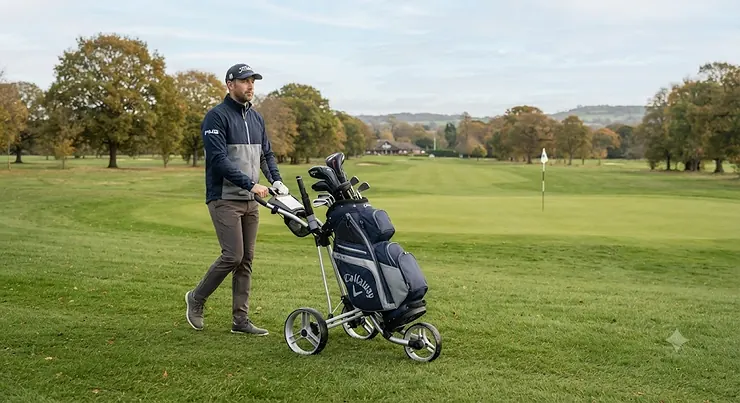
There’s a particular kind of golfer who still carries their bag on their shoulder for all eighteen holes, wincing slightly by the fourteenth, and wearing it like a badge of honour. Respect to them. The rest of us worked out a while ago that a push golf trolley solves this problem entirely, and does it without a battery, a charging cable, or a “range anxiety” moment on the back nine. A push golf trolley is a wheeled frame, usually three or four legs on wheels, that you steer by hand to carry your bag, clubs, and the assorted clutter every golfer accumulates — tees, gloves, a rain jacket you’ll never actually wear. The cart as a design concept stretches back millennia, but the golf-specific version only really took off from the 1940s onward, evolving from lawnmower wheels bolted to a frame into the folding, feature-packed trolleys covered in this guide.
What makes 2026 an interesting year to buy one is choice. The UK market now stretches from featherweight budget carts under £100 to aircraft-grade aluminium builds pushing £250, and the gap between them is genuinely noticeable on a wet, hilly course. This guide walks through seven real, currently available push golf trolley models, compares them honestly against each other, and digs into the details — wheels, brakes, folding mechanisms — that actually decide whether you’ll enjoy using one for the next five years or curse it by June. Prices below are shown as ranges rather than fixed figures, since retailer pricing shifts constantly; always check the current price before buying.
Quick Comparison Table: Best Push Golf Trolleys at a Glance
| Trolley | Best For | Weight | Price Range |
|---|---|---|---|
| Clicgear 4.0 | Overall build quality | 8.45 kg | £220-£250 |
| PowaKaddy Micra | Ultra-lightweight portability | 7.5 kg | £180-£200 |
| Big Max Autofold FF | Fastest folding | 9.5 kg | £220-£240 |
| CaddyTek CaddyLite 11.5 V3 | Budget value | 6.25 kg | £110-£150 |
| Motocaddy Cube Push | Durable steel frame | 9.8 kg | £145-£180 |
A quick glance at this table tells its own story: there’s no single “best” trolley here, only the best trolley for a particular priority. If your boot space is tight and you’re forever cramming a bag in around a pushchair or a dog crate, the Big Max Autofold FF‘s speed-fold wheels earn their premium. If you’re mostly hauling your kit from the car park to a flat parkland course, the CaddyTek CaddyLite 11.5 V3 delivers most of what matters at roughly half the outlay of the pricier options. Weight matters more than people expect, too — every extra kilogram of trolley is a kilogram you’re pushing uphill on top of your clubs, so don’t dismiss it as a footnote spec.
💬 Just one click — help others make better buying decisions too!😊
Top 7 Push Golf Trolleys: Expert Analysis
Choosing a push golf trolley isn’t just about the lightest frame or the lowest price — it’s about matching the trolley to your course, your car, and how fussy you are about gadgets on the handle. Below, each of these seven models is broken down on real specifications, what those specifications mean in practice, and what UK golfers actually report after using them.
1. Clicgear 4.0 — best aircraft-grade build quality for serious golfers
The Clicgear 4.0 has been a fixture of “best of” trolley lists for years, and the reason is straightforward: it’s built like it’s meant to outlast your golf swing’s various phases of self-improvement. The frame is aircraft-grade aluminium, which sounds like marketing flourish until you notice how little flex there is when the cart is fully loaded and being wheeled one-handed across a cambered fairway. It weighs 8.45kg and folds down to a genuinely compact 60 x 38 x 33cm, small enough for most hatchback boots without needing to remove a wheel.
What sets the Clicgear 4.0 apart in practice is the braking system — a redesigned posi-lock mechanism with a cable anchor pivot that’s specifically engineered to resist the wear that plagues cheaper cable brakes after a season or two of damp storage. Based on the spec comparison with rivals in this list, this is the trolley built for golfers who play year-round and want hardware that won’t need replacing by autumn. Reviewers consistently report high satisfaction with the durability and the tour-bag compatibility, with the trolley holding a strong 4.6-out-of-5 aggregate rating across hundreds of verified purchases — genuinely one of the better-reviewed trolleys in this category.
Pros:
- ✅ Aircraft-grade aluminium frame built to last years
- ✅ Posi-lock brakes give reassuring stops on slopes
- ✅ Extra-deep console with 80% more cargo storage
Cons:
- ❌ Heavier than most budget rivals at 8.45kg
- ❌ Premium price sits above entry-level trolleys
Expect to pay in the £220-£250 range depending on colour and retailer promotions. For golfers who play twice a week or more, the Clicgear 4.0‘s durability arguably pays for itself by outlasting two cheaper trolleys bought back to back.
2. PowaKaddy Micra — lightest fold-flat frame around
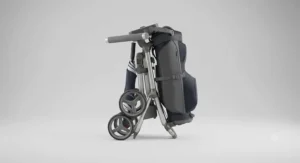
If the Clicgear 4.0 is the trolley built to survive a decade, the PowaKaddy Micra is the trolley built to disappear into your boot without a second thought. At 7.5kg it’s noticeably lighter to lift than most three-wheel rivals, and its folded footprint of roughly 535 x 355 x 380mm means it slots into small car boots that would make other trolleys a genuine Tetris puzzle.
The lightweight alloy frame is the standout feature here, and what most buyers overlook about lighter trolleys is that the weight saving isn’t just about lifting it into the car — it’s about how much less resistance you feel pushing it uphill over four hours of golf. A foot-operated parking brake handles the practical job of holding the trolley still on the tee, while a water-resistant lined pocket protects your phone from a sudden downpour, something the spec sheet won’t shout about but golfers who’ve been caught out will appreciate. Aggregated review sentiment for the PowaKaddy Micra is strong, with buyers consistently praising the compact fold and ease of one-handed manoeuvring, and it holds an impressive rating among its retailer’s best-selling push trolleys.
Pros:
- ✅ Among the lightest trolleys tested at 7.5kg
- ✅ Compact fold suits small car boots easily
- ✅ Water-resistant phone pocket keeps devices dry
Cons:
- ❌ Fewer accessory mounts than console-style rivals
- ❌ Foot brake alone, no lift-lever backup
Typical UK pricing sits around £180-£200. This is the pick for golfers who prioritise portability above all else — particularly those walking from a train station or fitting the trolley into a small hatchback.
3. Big Max Autofold FF — fastest auto-folding wheels on the market
Folding and unfolding a trolley twice a round sounds trivial until you’re doing it in the rain with wet hands and a queue building behind you at the first tee. The Big Max Autofold FF solves this with genuine cleverness: two simple movements see all three wheels automatically flip under the frame for storage, and a flick of the handle lock reopens it in an instant. It’s the kind of feature that seems unnecessary until you’ve used it, at which point every other trolley starts to feel a little clumsy.
Beyond the folding party trick, the Big Max Autofold FF carries a generously sized storage compartment, several accessory mounting points, and a footbrake as standard — the sort of practical detail set that suggests the engineering focus went beyond the headline feature. Here’s what to weigh: the auto-fold mechanism does introduce more moving parts than a simple manual fold, which in principle means more that could eventually need servicing, though there’s no widespread pattern of complaints about reliability in verified feedback. What buyers do note consistently is how much faster getting on and off the course becomes once you’ve stopped wrestling wheels into place by hand.
Pros:
- ✅ Wheels auto-fold under the frame in seconds
- ✅ Large storage compartment for extra kit
- ✅ Footbrake and accessory points as standard
Cons:
- ❌ Auto-fold mechanism adds moving parts to maintain
- ❌ Sits at a higher price than basic 3-wheel carts
Prices typically fall in the £220-£240 range. Golfers who play at busy weekend clubs, where a fast getaway from the first tee actually matters, get the most value from this design.
4. CaddyTek CaddyLite 11.5 V3 — best value for money under £150
Not every golfer needs — or wants to pay for — aircraft-grade aluminium. The CaddyTek CaddyLite 11.5 V3 is proof that a well-designed budget trolley can still tick most of the boxes that matter. At 6.25kg it’s actually lighter than several trolleys costing twice as much, built around a quad-fold aluminium frame with large ball-bearing wheels — 11-inch rears and a smaller front wheel — that roll smoothly across rough ground without needing the bearing maintenance that cheaper plastic-bushed wheels demand.
On paper this means a trolley that punches well above its price bracket, and the real-world reviews back that up. The CaddyTek CaddyLite 11.5 V3 carries one of the largest review pools of any trolley in this list — several thousand ratings averaging around 4.6 to 4.7 out of 5 — with reviewers repeatedly praising the ease of assembly, the smooth foot brake, and the value for money. What reviewers note as weaker points are worth flagging honestly: a handful mention the scorecard holder working loose over time, and the umbrella holder feeling less sturdy in gusty conditions. Neither issue affects the core function of getting your clubs around the course.
Pros:
- ✅ Genuinely lightweight at 6.25kg for the price
- ✅ Large ball-bearing wheels roll smoothly on rough ground
- ✅ Foot brake included even at this budget tier
Cons:
- ❌ Scorecard holder reported to work loose over time
- ❌ Umbrella holder feels flimsy in strong wind
Typical UK pricing lands between £110 and £150. For golfers buying their first trolley, or anyone wanting a reliable spare for a partner or visiting relative, this is difficult to beat on value.
5. Motocaddy Cube Push — sturdiest steel frame at a budget price
Motocaddy built its reputation on electric trolleys, but the Motocaddy Cube Push shows the same design thinking applied to a simpler, non-electric golf trolley. The headline feature is right there in the name: a three-wheeled model that folds into a genuinely neat cube shape, measuring around 82 x 55 x 32cm folded, which stacks and stores far more tidily than trolleys that fold into an awkward flat-pack triangle.
The steel frame construction is the detail worth interpreting properly. Steel adds weight compared with aluminium rivals — this is a heavier trolley to lift than most on this list — but it also shrugs off the dings and scrapes of a full season without the dents that thinner aluminium frames can pick up. Based on the spec comparison, this is the trolley built for golfers who are hard on their kit, or who store their trolley in a shed rather than babying it in a hallway. The air-filled tyres are worth watching, as they need occasional pressure checks, though they rarely puncture if you steer around sharp debris on the fairway edge. Reviewers consistently describe the fold as effortless and the frame as reassuringly solid underfoot on uneven terrain.
Pros:
- ✅ Steel frame construction built for repeated seasons
- ✅ Cube-shaped fold slots neatly into most boots
- ✅ Trusted name backed by wide UK dealer network
Cons:
- ❌ Air-filled tyres need occasional pressure checks
- ❌ Heavier than aluminium framed alternatives
Expect to pay somewhere between £145 and £180. This suits golfers who value ruggedness over shaving off every last gram, and who’d rather check tyre pressure twice a season than replace a bent frame.
6. Wishbone Cube Three — lightest dual-tube frame for easy carrying
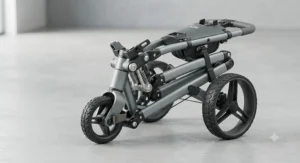
The Wishbone Cube Three takes a genuinely different engineering approach from most of its rivals, and it shows. At just 7.8kg, its dual-tube frame design allows the brand to build in extra structural strength without piling on weight — two thinner tubes working together instead of one thick one, essentially. The result folds down to a tidy 39 x 46 x 57cm package, compact enough for the smallest of car boots or a cupboard under the stairs.
What most buyers overlook about the Wishbone Cube Three is how much feature density is packed into a genuinely budget-friendly frame — this isn’t a stripped-back trolley missing the accessories that matter, it’s a trolley that’s found a clever way to include them without the premium price tag of bigger-name rivals. Here’s what to weigh against that: Wishbone doesn’t have the same nationwide stockist network as Motocaddy or PowaKaddy, so replacement parts and accessories can be slightly harder to track down locally, and the braking system is more basic than the posi-lock designs found on pricier models. Aggregated feedback consistently highlights the trolley’s low weight and compact storage as its biggest selling points.
Pros:
- ✅ Dual-tube frame keeps weight down at 7.8kg
- ✅ Folds to a genuinely compact 39x46x57cm
- ✅ Feature-packed despite its budget-friendly price
Cons:
- ❌ Smaller brand means fewer stockists for spares
- ❌ Basic brake compared with posi-lock systems
Pricing generally sits in the low-to-mid £100s. It’s a strong pick for golfers whose priority is squeezing a capable trolley into minimal storage space, whether that’s a small car or a compact garage.
7. Longridge Eze Glide Smart Fold — simplest entry-level option for beginners
Not everyone wants to think about golf trolleys — some golfers just want something that works, folds down without a manual, and doesn’t cost more than a few rounds of green fees. The Longridge Eze Glide Smart Fold is built for exactly that mindset. It pairs a durable aluminium frame with a lightweight 7.2kg build, delivering what its own product description fairly calls smooth, effortless pushing without the layers of accessories that can overwhelm a first-time buyer.
The practical interpretation here is simple: this is a trolley stripped back to the essentials — frame, wheels, fold, brake — rather than one loaded with console storage and accessory tabs. For a beginner who isn’t yet sure whether they’ll play twice a month or twice a week, that’s arguably the smarter starting point than overspending on features they may never use. What most first-time buyers overlook is that a simpler trolley is also usually a lighter, easier one to learn on — fewer moving parts means fewer things to fumble with at the first tee while a queue watches. Reviewers of entry-level Longridge trolleys consistently note the straightforward assembly and fold as the standout strengths.
Pros:
- ✅ Simple fold-and-go design suits total beginners
- ✅ Durable aluminium frame at an entry-level price
- ✅ Lightweight 7.2kg build is easy to lift
Cons:
- ❌ Fewer premium touches like console storage
- ❌ Basic accessory provision compared with pricier rivals
Prices for the Longridge Eze Glide Smart Fold typically fall under £130, making it one of the more accessible entry points into non-electric golf trolleys on this list.
Full Spec Comparison: All 7 Trolleys Side by Side
| Trolley | Weight | Frame Material | Brake Type | Best For | Price Range |
|---|---|---|---|---|---|
| Clicgear 4.0 | 8.45 kg | Aircraft-grade aluminium | Posi-lock lift brake | Build quality & tour bags | £220-£250 |
| PowaKaddy Micra | 7.5 kg | Lightweight alloy | Foot-operated | Ultra-portability | £180-£200 |
| Big Max Autofold FF | 9.5 kg | Aluminium | Footbrake | Fast, easy folding | £220-£240 |
| CaddyTek CaddyLite 11.5 V3 | 6.25 kg | Aluminium | Foot brake | Budget value | £110-£150 |
| Motocaddy Cube Push | 9.8 kg | Steel | Footbrake | Rugged durability | £145-£180 |
| Wishbone Cube Three | 7.8 kg | Dual-tube aluminium | Basic hand brake | Compact storage | £110-£140 |
| Longridge Eze Glide Smart Fold | 7.2 kg | Aluminium | Foot brake | Beginners | £90-£130 |
Lined up together like this, a pattern emerges: weight and price track fairly closely, but not perfectly — the CaddyTek CaddyLite 11.5 V3 is actually lighter than the far pricier Clicgear 4.0, which tells you weight alone shouldn’t be your only buying criterion. Brake sophistication is the other clear divider between tiers; posi-lock and lift-lever systems on the Clicgear 4.0 offer finer control on steep slopes than the basic foot brakes found on entry-level models, a difference you’ll only really notice the first time you’re holding a loaded trolley on a downhill lie.
Push Golf Trolley Buying Guide
Working out which push golf trolley suits you starts with being honest about how and where you actually play, rather than which model looks best in a shop display. This push golf trolley buying guide breaks the decision into the criteria that genuinely move the needle.
- Course terrain first. Hilly or uneven courses reward wider wheelbases and stronger braking systems; flat parkland courses are far more forgiving of basic models.
- Weight, twice. Consider both the trolley’s own weight and how much extra effort that adds when pushing loaded uphill — a 2kg difference is more noticeable after fourteen holes than at the shop counter.
- Folded size versus your car. Measure your boot before you buy, not after a trolley arrives that won’t fit.
- Brake type. A simple foot brake suits flat courses; posi-lock or lift-lever brakes are worth the extra cost on anything hillier.
- Storage and accessories. Decide honestly whether you need a console, umbrella holder, and phone pocket, or whether you’re paying for features you’ll rarely use.
- Build material. Aluminium saves weight; steel adds durability. Neither is objectively “better” — it depends on how hard you are on your kit.
- Warranty and stockist network. Bigger brands typically offer easier access to spare parts if something wears out down the line.
Working through this list before opening a browser tab tends to narrow seven options down to two or three fairly quickly — and that’s the point of a buying guide: not to pick for you, but to filter out the trolleys that were never going to fit your game.
✨ Don’t Miss These Exclusive Deals!
🔍 Take your golfing kit to the next level with these carefully selected trolleys. Click on any highlighted item to check current pricing and availability — these picks will help you enjoy authentic, effortless rounds all season long!
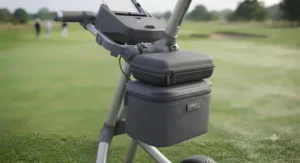
Push Trolley Features to Consider Beyond the Spec Sheet
Manufacturers list dozens of features, but only a handful genuinely change how a push golf trolley feels to use over a season. Here are the push trolley features to consider that reviewers and long-term owners flag most often, once the novelty of a new purchase has worn off.
Adjustable handle height matters more than it seems on a showroom floor — golfers over six feet and under five-foot-six are pushing at very different angles, and an unadjustable handle can quietly strain your lower back over eighteen holes. Console storage depth is another sleeper feature: a shallow console might fit your phone but not much else, forcing you to stuff valuables into your golf bag’s pockets instead. Bag strap systems also vary wildly in usefulness — some silicone strap designs adjust in seconds, while cheaper elastic straps can slip loose on a bumpy downhill stretch, an annoyance that only shows up after you’ve bought the trolley.
Finally, consider how the trolley locks its front wheel for straight-line pushing versus swivel manoeuvring around obstacles. A push-button lock, like the one on the Clicgear 4.0, switches between the two instantly; cheaper trolleys sometimes require an awkward two-handed adjustment that isn’t worth the hassle mid-round.
Trolley Wheels: What Actually Matters
Trolley wheels are one of those specs that get glossed over in marketing copy, yet they arguably affect your day-to-day experience more than the frame material does. Larger wheels — generally 10 to 11 inches — roll more smoothly over rough ground, rough semi-rough grass, and boggy patches after rain, while smaller wheels can feel noticeably twitchier and more prone to snagging.
Ball-bearing hubs, found on models like the CaddyTek CaddyLite 11.5 V3, deliver smoother, quieter rolling with minimal maintenance across seasons, compared with basic bushings that can stiffen up in cold or wet weather. Tyre type is the other consideration: solid rubber or foam-filled wheels never go flat and need zero maintenance, while air-filled tyres, as fitted to the Motocaddy Cube Push, offer a slightly softer ride over bumpy terrain but do require the occasional pressure check to avoid a soft, sluggish push. Neither type is universally superior — flat, well-kept courses suit solid wheels fine, while golfers on rougher, more rural courses often prefer the cushioning of air-filled tyres.
Wide wheelbase spacing, a feature the Clicgear 4.0 specifically engineers for, adds meaningful stability when a fully loaded tour bag and umbrella shift the trolley’s centre of gravity — something narrow-wheelbase budget trolleys can struggle with on a side slope.
Trolley Brake Systems Explained
Trolley brake systems are easy to ignore until the one time you desperately need one — typically the moment you park a loaded trolley on a slope beside the green and turn your back to line up a putt. Understanding the differences here genuinely changes which model makes sense for your course.
Basic foot brakes, standard on entry-level models like the Longridge Eze Glide Smart Fold and the Wishbone Cube Three, engage a single rear wheel with a downward press and work perfectly well on flat or gently rolling courses. Posi-lock brakes with a lift lever, as found on the Clicgear 4.0, use a cable-actuated mechanism engaging both rear wheels simultaneously, offering noticeably stronger holding power on steeper inclines — the sort of terrain common at parkland courses built into old estate grounds across the UK.
What reviewers consistently note is that brake reliability, more than initial stopping power, is what separates good systems from frustrating ones. Cable-based brakes that wear unevenly over a season are a common complaint on cheaper trolleys, which is precisely the failure point the Clicgear 4.0‘s redesigned cable anchor pivot was engineered to address. If your home course has even one genuinely steep hole, this is not a spec worth skimping on.
Non-Electric Golf Trolleys vs Electric Trolleys
The biggest fork in the road for any golfer isn’t which push golf trolley to buy — it’s whether to buy one at all, or step up to an electric model. Non-electric golf trolleys, the entire subject of this guide, offer three clear advantages: significantly lower upfront cost, zero ongoing battery replacement expense, and considerably less weight, since there’s no motor or battery pack to lug around.
Electric trolleys earn their keep on hillier courses or for golfers managing fatigue, injury, or simply wanting to conserve energy for their swing rather than their legs — but that convenience comes at a real cost, typically starting around £350-£400 and climbing well past £1,000 for GPS-equipped, remote-control models, plus the recurring cost and hassle of battery care. A non-electric golf trolley, by contrast, has essentially no moving parts to fail beyond wheels and a brake cable, no charging routine to remember before a round, and a far lower barrier to entry for someone who isn’t sure golf is going to become a weekly habit yet.
| Factor | Non-Electric Push Trolley | Electric Trolley |
|---|---|---|
| Typical Price | £90-£250 | £350-£1,000+ |
| Weight | 6-10 kg | 12-20 kg |
| Ongoing Costs | None | Battery replacement every 2-4 years |
| Physical Effort | Moderate (pushing) | Minimal |
| Best For | Fit golfers, flat-to-moderate courses | Hilly courses, fatigue management |
The analysis here is fairly clear-cut: unless hills, injury, or genuine fatigue are a factor, a well-chosen push golf trolley like the Clicgear 4.0 or CaddyTek CaddyLite 11.5 V3 delivers most of the practical benefit — getting your clubs around without carrying them — at a fraction of the cost and none of the battery maintenance. Research into the health benefits of golf backs this up rather nicely: a controlled study on regular golf walking found meaningful improvements in cardiovascular fitness and body composition among golfers who walked the course regularly, a benefit an electric trolley doesn’t remove but a push trolley actively encourages you to keep.
Top-Rated Push Trolleys: What The Reviews Really Show
Star ratings alone don’t tell the full story, so it’s worth digging into what top-rated push trolleys have in common once you look past the headline number. Across the models featured in this guide, the trolleys with the strongest aggregated review sentiment consistently share three traits: a brake that performs exactly as advertised, a fold that doesn’t loosen or wobble after repeated use, and accessories — umbrella holders, scorecard clips — that survive genuine outdoor conditions rather than just a living-room demo.
The Clicgear 4.0 and CaddyTek CaddyLite 11.5 V3 both stand out in this respect, sitting at opposite ends of the price spectrum yet both earning consistently high marks for reliability rather than flashy extras. What’s notable is that neither budget nor premium status guarantees satisfaction on its own — the mid-tier Big Max Autofold FF and Motocaddy Cube Push also earn strong loyalty, largely because their standout feature (fast folding, rugged build) does exactly what it promises, round after round. The pattern worth taking away: when comparing top-rated push trolleys, weight the reviews that mention long-term use over the first-impression five-star ratings written the week of purchase.
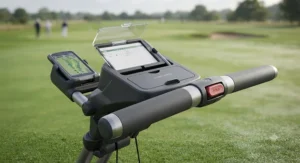
Practical Usage Guide: Getting the Most From Your Trolley
Buying the right push golf trolley is only half the job — using and maintaining it properly is what determines whether it’s still rolling smoothly in three years or creaking and sticking by next spring.
On first use, take ten minutes to properly adjust the handle height and bag straps before your first round rather than mid-fairway; a poorly adjusted trolley is the single biggest cause of first-week frustration. For maintenance, wipe down the frame after wet rounds to prevent grit building up in folding joints, and check wheel bearings or tyre pressure (for air-filled models) roughly once a month during the playing season. A common early mistake is folding the trolley away wet and leaving it in a closed car boot overnight — this is where cable brakes and joints start to corrode prematurely, so a quick dry-off before storage genuinely extends the trolley’s life. For optimisation, keep the front wheel lock engaged for straight fairway pushing and release it only when manoeuvring around bunkers or trees, since constantly switching modes wears the release mechanism faster than needed.
Storage matters too: a trolley left folded in direct summer sun inside a car can see its plastic components become brittle over a couple of seasons, so a garage or shed — out of direct heat — is the better long-term home. None of this is complicated, but it’s precisely the sort of detail that doesn’t come printed on the box.
Real-World Scenarios: Which Trolley Suits Your Game?
Specs only mean so much in the abstract, so here’s how three common types of UK golfer might realistically match up against this list.
The weekend parkland golfer, playing a fairly flat local course twice a month with a modest budget, is well served by the CaddyTek CaddyLite 11.5 V3 or Longridge Eze Glide Smart Fold — both deliver reliable core functionality without paying for features that won’t get used on gentle terrain. The frequent player on a hilly links or heathland course, walking three or four rounds a week, benefits far more from investing in the Clicgear 4.0‘s stronger braking and wide wheelbase, where the extra control on slopes and the longer-term durability genuinely justify the higher outlay. The golfer short on car boot or storage space — perhaps living in a flat or driving a smaller hatchback — should prioritise fold size above almost everything else, making the Wishbone Cube Three or Big Max Autofold FF the more sensible picks, since a trolley that’s a hassle to store tends to end up left at home.
None of these profiles are rigid, but matching your actual playing pattern against the trolley’s strengths, rather than buying on price or brand recognition alone, is what separates a purchase you’re happy with from one gathering dust in the shed by August.
Buyer’s Decision Framework
If you’d rather skip straight to a decision, this simple framework should get you there in under a minute.
If your course is mostly flat and you play occasionally, choose a lightweight budget model like the CaddyTek CaddyLite 11.5 V3, because you’re unlikely to stress-test premium braking or storage features. If your course is hilly and you play weekly or more, choose a trolley with posi-lock brakes and a wide wheelbase like the Clicgear 4.0, because control and durability compound in value the more often you use it. If boot space or storage is your binding constraint, choose the fastest-folding or most compact option — the Big Max Autofold FF or Wishbone Cube Three — because a trolley you resent unfolding won’t get used consistently. And if you’re a complete beginner unsure how often you’ll actually play, choose the simplest, most affordable option, like the Longridge Eze Glide Smart Fold, and upgrade later once your habits are clearer.
Common Mistakes When Buying a Push Golf Trolley
A surprising number of golf trolley purchases go wrong not because of a bad product, but because of an avoidable buying mistake. Here’s expert commentary on the pitfalls that come up again and again.
The first is buying on weight alone, ignoring brake quality — a featherweight trolley with a weak brake is genuinely more dangerous on a slope than a heavier one that holds firm. The second is skipping the boot-space check, leading to a trolley that technically fits but only after removing a wheel and swearing at it weekly. The third is over-buying accessories on a trolley you’ll use twice a season, paying premium prices for console storage and GPS mounts that end up unused. The fourth is ignoring warranty terms, particularly on lesser-known brands where spare parts availability can be patchy if something snaps two seasons in. The fifth, and most common, is not test-folding the trolley in-store or checking demo videos before buying online, since folding mechanisms vary enormously in how intuitive they actually are under real-world, slightly muddy conditions.
Long-Term Cost & Maintenance
The upfront price tag is only part of the real cost of owning a push golf trolley, and it’s worth running the numbers properly before assuming the cheapest option is the best value. A budget trolley at around £110 with a shorter effective lifespan of three to four seasons works out to roughly £30-£35 a year in trolley cost alone, before accounting for any replacement parts. A premium trolley like the Clicgear 4.0, priced around £230 but built to last six to eight seasons based on its component quality and available spare parts, works out closer to £30 a year too — meaning the total cost of ownership can actually be near-identical, just distributed differently across time.
Where this calculation shifts meaningfully is maintenance: trolleys with air-filled tyres, like the Motocaddy Cube Push, carry a small recurring cost in pump usage and occasional inner tube replacement, while solid or foam wheels avoid this entirely. Cable-brake trolleys may eventually need a brake cable replacement, typically an inexpensive part but one worth checking is readily available for your specific model before buying a lesser-known brand. The genuine long-term cost lesson here: don’t assume premium automatically means expensive over time, and don’t assume budget automatically means cheap over time either — the honest answer depends on how many seasons you actually get out of it.
Safety, Course Etiquette & Regulations
Push golf trolleys are entirely permitted under the Rules of Golf, and equipment regulation is generally light-touch compared with clubs and balls — The R&A’s Rules of Equipment focus primarily on clubs, balls, and devices that could create an unfair advantage, rather than transport equipment like trolleys. That said, most UK clubs enforce their own local rules around trolley use, particularly during wet winter months, since trolley wheels can churn up waterlogged fairways and greens surrounds far more than foot traffic alone — always check your club’s winter trolley policy before assuming you can wheel one out after heavy rain.
On etiquette, always park your trolley off to the side of the green, never between the green and the next tee, and keep it well clear of bunkers to avoid damaging the raked sand. It’s also worth knowing that if another player’s trolley accidentally moves your ball, the Rules of Golf generally allow you to restore the ball to its original position without penalty — a genuinely useful bit of knowledge for busy days when trolleys and golf balls inevitably cross paths on narrow fairways.

Frequently Asked Questions
❓ Are push golf trolleys allowed on all golf courses?
❓ How much does a good push golf trolley cost in the UK?
❓ Are three-wheel or four-wheel push trolleys better?
❓ How long should a push golf trolley last?
❓ What's the difference between a pull trolley and a push trolley?
Conclusion
Picking a push golf trolley ultimately comes down to being honest with yourself about how you actually play, not how you imagine you might play once you’ve bought the gear. If durability and braking control on hillier terrain matter most, the Clicgear 4.0 earns its premium price through genuine engineering, not marketing gloss. If portability and a painless fold into a small boot are the priority, the PowaKaddy Micra or Wishbone Cube Three solve that cleanly. And if you’re simply after dependable, no-fuss value, the CaddyTek CaddyLite 11.5 V3 proves a budget trolley doesn’t have to feel like a compromise.
Whichever of these seven you land on, the upgrade from shoulder-carrying to wheeling your clubs around is one of the more immediately noticeable improvements you can make to your enjoyment of a round — your back will thank you well before your handicap does. Take another look at the comparison table above, weigh it against your own course and car boot, and check current prices before you commit, since retailer promotions shift regularly throughout the season.
Recommended for You
- Gokart Electric Golf Trolley: 7 Best UK Picks Tested (2026)
- MGI Golf Trolley: 7 Best Electric Models for UK Golfers (2026)
- Stewart Golf Trolley: 7 Best British Picks (2026)
Disclaimer: This article contains affiliate links. As an Amazon Associate, I earn from qualifying purchases. If you purchase products through these links, we may earn a small commission at no additional cost to you.
✨ Found this helpful? Share it with your friends! 💬🤗
