
In This Article
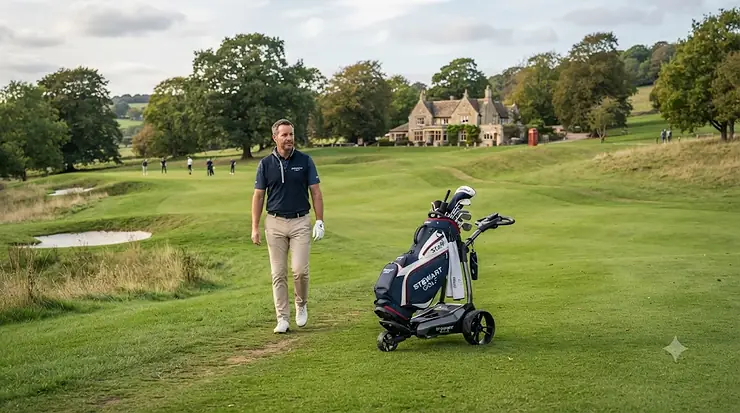
There’s a particular kind of golfer who notices things other people don’t. The stitching on a headcover. The click of a good latch. The way a trolley wheel tracks dead straight down a fairway instead of wandering off towards the rough like it’s got somewhere better to be. If that sounds like you, you’ve probably already had your eye on a stewart golf trolley, and you’ve probably already worked out that this isn’t really a purchase decision so much as a small act of patriotism for British engineering.

So, what is a stewart golf trolley? It’s a range of premium electric and push trolleys, handbuilt in Gloucestershire, best known for pioneering “follow” technology that lets your clubs trail a few paces behind you without a hand on the handle. Founded in 2003, the company has spent two decades building trolleys for golfers who want function and craftsmanship in equal measure — see Wikipedia’s overview of golf trolley development for the wider context of how the category evolved.
This guide lines up three genuine Stewart Golf models against four of their closest British-built and British-sold rivals — Motocaddy, PowaKaddy and Ben Sayers — so you can see exactly where the extra spend goes, and whether it’s worth it for your game. One honesty note before we dive in: Stewart Golf sells the bulk of its range directly through its own site rather than through big-box marketplaces, so availability through any third-party retailer, Amazon UK included, can shift week to week. Always check current stock and pricing before you commit.
Quick Comparison Table
Before the full breakdown, here’s the shape of the market at a glance. Prices are approximate ranges based on research at the time of writing — always check current price on the retailer’s page, as golf equipment pricing moves with stock levels and seasonal offers.
| Trolley | Type | Price Range | Best For |
|---|---|---|---|
| Stewart Golf Q Follow | Follow / Remote | £1,750-£2,400 range | Golfers who want the flagship hands-free experience |
| Stewart Golf X10 Follow | Follow / Remote | £1,450-£1,550 range | Follow tech at a lower step-in price |
| Stewart Golf X10 Remote | Remote only | £1,150-£1,250 range | Remote control without paying for follow |
| Motocaddy M-Tech | Remote / DHC | £1,400-£1,500 range | Stewart’s closest premium challenger |
| PowaKaddy CT8 GPS EBS | Walk-behind + GPS | £950-£1,050 range | Smallest fold with built-in GPS |
| Motocaddy M1 DHC | Walk-behind | £800-£900 range | First electric upgrade that still feels premium |
| Ben Sayers Electric Trolley | Walk-behind | £300-£400 range | Testing the electric-trolley waters cheaply |
Looking across the table, the gap between the cheapest and the most expensive option here is roughly £1,500 — and that gap is almost entirely down to follow technology, build materials and finish options rather than raw motor power. A Ben Sayers Electric Trolley and a Stewart Golf Q Follow will both get your bag around 18 holes without complaint; what changes is how much of the walk you spend thinking about the trolley at all.
💬 Just one click — help others make better buying decisions too!😊
Top 7 Stewart Golf Trolleys & Rival Electric Trolleys: Expert Analysis
1. Stewart Golf Q Follow — flagship follow tech and finish choice
The Q Follow is the trolley Stewart Golf builds its reputation on, and the eighth-generation follow system is the headline reason why. Unlike basic follow trolleys that simply chase a signal, the Q Follow uses 3D distance control to keep pace and position steady across slopes and turns, which matters more than it sounds on a course with any real elevation change.
Under the monocoque bodywork — a one-piece chassis-and-shell construction rather than a frame with panels bolted on — the trolley weighs around 14kg, with a SmartPower battery pitched for improved efficiency over the outgoing generation, and a remote with a genuinely useful 75-metre range. Thirteen colour and finish options push this firmly into “personal statement” territory rather than plain equipment.
This one’s for the golfer who has already decided that hands-free is non-negotiable and wants the most refined version of it money can buy. Reviewers consistently note that the follow function is the standout feature here, with one detailed trade review describing the remote control as easy to use and intuitive, and rating the build quality among the best in class. Aggregated owner feedback elsewhere is more mixed on reliability of the downhill braking feature on the related X10 platform, so it’s worth testing this specific function at a demo day before committing.
Pros:
- ✅ Eighth-generation follow tech with 3D distance control
- ✅ 75m remote range with adjustable cruise control
- ✅ Handbuilt monocoque chassis keeps weight down
Cons:
- ❌ Among the most expensive trolleys on the UK market
- ❌ Limited third-party stockist availability, including on Amazon UK
At around £1,750-£2,400 depending on battery and Carbon finish, the Stewart Golf Q Follow only makes sense if hands-free walking is a genuine priority rather than a nice-to-have — but for that buyer, it’s hard to beat.
2. Stewart Golf X10 Follow — best value hands-free Stewart model
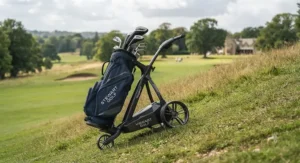
If the Q Follow is the showpiece, the X10 Follow is where most golfers actually land. It runs the same core promise — walk the course with your hands free while the trolley tracks a beacon on your belt or pocket — but at roughly £300-£450 less than the flagship, and with a more conventional frame-and-bodywork chassis rather than the Q’s monocoque build.
The seventh-generation follow system pairs with dual 190W EcoDrive motors that Stewart Golf says are up to 40% more efficient than the previous X-Series generation, translating into meaningfully more rounds per charge on an 18-hole battery before you need to step up to the 36-hole option. Downhill braking in follow mode is included, which matters on undulating parkland courses where an unsupervised trolley picking up speed downhill is a genuinely unnerving sight.
Who’s this for? Golfers who want the follow experience without paying flagship prices, and who are happy with a slightly less exclusive finish list than the Q. Aggregated user reports are largely positive on the follow accuracy, though at least one long-term owner review flagged that the downhill control feature didn’t perform as specified on their unit, which is worth raising with a dealer at purchase rather than assuming it’s guaranteed to work flawlessly out of the box.
Pros:
- ✅ Follow tech at meaningfully lower cost than the Q Follow
- ✅ 50m Bluetooth remote range with USB-rechargeable handset
- ✅ 18 or 36-hole battery options to match your usual round length
Cons:
- ❌ Downhill braking reliability reported as inconsistent by some owners
- ❌ Heavier than remote-only trolleys due to follow hardware
Priced in the £1,450-£1,550 range, the Stewart Golf X10 Follow is the pick if you want the signature Stewart experience without stretching to the very top of the range.
3. Stewart Golf X10 Remote — remote control without the follow premium
Strip the follow sensor array out of the X10 platform and you get the X10 Remote — same EcoDrive motors, same chassis, same handbuilt Gloucestershire construction, but controlled entirely via the Bluetooth handset rather than by walking away from it. That’s a meaningful saving, typically £250-£300 less than the Follow version.
In practice, remote control alone still removes most of the physical effort of a round — you’re steering, not pushing — while sidestepping any of the follow-specific quirks. The trolley benefits from the same latest-generation electronics assembly, now manufactured in the UK after being brought back from Europe, which Stewart Golf frames as tighter quality control on the calibration between handset and drive unit.
This suits golfers who liked the idea of follow mode in theory but, on reflection, actually prefer having positive control over where the trolley sits — useful around bunkers, narrow cart paths, or club car parks where an autonomous trolley isn’t practical anyway. Reviewers who’ve compared the Remote against the Follow tend to describe it as the more “predictable” experience, since you’re never relying on a sensor to make the right call near a hazard.
Pros:
- ✅ Same drivetrain and build quality as the X10 Follow, lower price
- ✅ Full manual override for tight spaces and bridges
- ✅ UK-manufactured electronics for tighter calibration
Cons:
- ❌ No hands-free walking mode
- ❌ Still a premium price point versus mainstream remote rivals
At roughly £1,150-£1,250, the Stewart Golf X10 Remote is the sensible middle path for buyers who want Stewart build quality without paying for a feature they might rarely switch on.
4. Motocaddy M-Tech — Stewart’s closest premium rival
Motocaddy’s M-Tech is the model most likely to appear on a shortlist alongside any stewart golf trolley, and for good reason — it’s aimed at the same buyer who wants top-tier engineering and isn’t shopping by price alone. It sits at the top of Motocaddy’s 2026 line-up, paired with an Ultra lithium battery pitched for extended range.
Where it separates itself from Stewart is scale and support infrastructure: Motocaddy has a far larger UK dealer and service network, which matters if something goes wrong mid-season and you need a quick turnaround rather than a factory-return process. The trade-off, according to comparative testing from equipment reviewers, is that Motocaddy’s overall technology and support package edges ahead of PowaKaddy but the brand is generally viewed as sitting a notch below Stewart on sheer build exclusivity and finish.
Buyers choosing between the two are typically weighing bespoke, low-volume British craftsmanship (Stewart) against a larger, still-British-engineered brand with broader after-sales coverage (Motocaddy). Neither is the wrong answer — it depends whether you value exclusivity or backup.
Pros:
- ✅ Premium build with strong nationwide dealer support
- ✅ DHC-style downhill control tech included
- ✅ Large accessory and spare-parts ecosystem
Cons:
- ❌ Less exclusive than Stewart’s low-volume, handbuilt approach
- ❌ Still a significant investment for a walk-behind format
At around £1,400-£1,500, the Motocaddy M-Tech is the trolley to cross-shop before finalising a Stewart purchase, particularly if after-sales convenience matters as much as pedigree.
5. PowaKaddy CT8 GPS EBS — smallest fold with built-in GPS
The PowaKaddy CT8 range takes a different tack entirely: instead of follow tech, it bakes a full-colour touchscreen GPS with over 40,000 preloaded courses straight into the trolley itself, so you’re not juggling a phone or separate device on the fairway. The EBS (Electronic Braking System) variant adds automatic slope control, similar in spirit to Stewart and Motocaddy’s downhill features.
The compact fold is the other headline — PowaKaddy claims its Simple-2-Fold system collapses roughly 35% smaller than competing designs, which is genuinely useful if your boot space is tight or you’re regularly loading a hatchback rather than an estate. A 30V, 230W motor and MAG-LOK bag attachment round out a spec sheet that reads like a smaller, GPS-first alternative to the follow-focused Stewart range.
This is the pick for golfers who value on-course data as much as convenience, and who’d rather see distances on a built-in screen than carry a separate GPS watch. Owner reviews on retailer sites skew strongly positive, with one verified buyer rating it highly for being noticeably different — in a good way — from an older, heavier trolley they’d previously used.
Pros:
- ✅ Integrated GPS with 40,000+ courses, no subscription needed
- ✅ Ultra-compact fold for tight boot spaces
- ✅ EBS variant adds automatic slope braking
Cons:
- ❌ No follow or remote-control mode at this price point
- ❌ GPS screen adds ongoing software reliance versus a simple dial
Expect to pay in the £950-£1,050 range for the GPS EBS extended-battery version, making the PowaKaddy CT8 GPS EBS a strong alternative if data trumps hands-free convenience for you.

6. Motocaddy M1 DHC — easiest mid-range electric trolley to live with
The M1 is Motocaddy’s newest compact trolley, and the DHC (Downhill Control) version adds automatic braking on descents for a modest premium over the standard model. It’s built around a cable-free CLICK ‘N’ CONNECT battery with an auto-disconnect feature when the trolley folds, which removes one of the most common fiddly steps — unplugging a battery lead — from the pre-round routine.
A 230W motor and 28V system deliver what Motocaddy describes as smooth, reliable performance rather than outright power, and at 9.9kg (excluding battery) it’s noticeably lighter to lift into a boot than any of the follow trolleys above. The nine-speed display and larger 2.8-inch LCD screen make it easy to dial in a walking pace that matches your playing partners rather than dragging you along or lagging behind.
This is squarely aimed at golfers taking their first step into electric trolleys, or those replacing an older, heavier lead-acid model. It doesn’t try to compete on follow or GPS features, and that focus is exactly the appeal — fewer things to configure, more time actually playing.
Pros:
- ✅ Cable-free battery with auto-disconnect on fold
- ✅ Lighter and more compact than premium follow trolleys
- ✅ DHC braking included on the version reviewed here
Cons:
- ❌ No GPS or remote-control functionality
- ❌ Battery capacity trails the extended options on pricier rivals
At roughly £800-£900, the Motocaddy M1 DHC delivers most of what a mainstream golfer actually needs without the price tag attached to Stewart’s flagship models.
7. Ben Sayers Electric Trolley — cheapest genuine lithium entry point
Ben Sayers is a long-standing British golf equipment name, and its electric trolley line exists to answer one specific question: what’s the least you can spend and still get a proper lithium-powered trolley rather than a heavier, shorter-lived lead-acid unit? At around £329-£349, often bundled with a free accessory pack, it undercuts every other trolley on this list by a wide margin.
Full published specifications are thinner here than for the premium brands — Ben Sayers doesn’t publish the same depth of technical detail as Stewart, Motocaddy or PowaKaddy — so what we can say honestly is that it delivers the fundamentals: a lithium battery, a single-speed control dial, and a folding frame, without GPS, remote control or follow functionality of any kind.
This is the trolley for golfers who play occasionally, aren’t sure electric is for them long-term, or simply want a backup for a second household golfer without doubling up on a premium purchase. It’s not a like-for-like rival to a stewart golf trolley in engineering terms, but it belongs on this list precisely because it defines the floor of the market that the premium end is pricing itself against.
Pros:
- ✅ Lowest genuine lithium-battery entry price on this list
- ✅ Simple single-dial operation, nothing to configure
- ✅ Often bundled with a free accessory pack
Cons:
- ❌ Thin published spec sheet compared with premium rivals
- ❌ No GPS, remote or follow functionality at any price tier
For occasional players or as a second trolley, the Ben Sayers Electric Trolley is honest value — just go in knowing exactly what you’re not getting for the saving.
Practical Usage Guide: Setting Up and Maintaining Your Trolley
Getting a new electric trolley right in the first month makes a bigger difference to how long it lasts than most golfers expect. Start by fully charging the battery before first use, even if it arrives showing partial charge — lithium packs settle into their proper calibration after a full cycle, and skipping this step is one of the most common reasons people wrongly assume their battery is faulty.
Once you’re on the course, resist the urge to run the trolley on its highest speed setting for every hole. Matching speed to your actual walking pace, rather than the trolley’s fastest setting, both extends battery life per round and stops the frustrating trolley-overtakes-golfer scenario on tee boxes. If your model has downhill control or EBS, test it gently on a shallow slope near the clubhouse before trusting it on a genuinely steep descent mid-round.
Common first-30-days mistakes include folding the trolley without disconnecting or auto-disconnecting the battery lead on cable-connected models, storing it in direct sun or a hot car boot for extended periods, and over-tightening the bag strap in a way that stresses the frame’s attachment points. A quick wipe-down after wet rounds and an occasional check of wheel bearings for grit build-up will keep any of the seven trolleys above running smoothly well beyond their first season.
Real-World Scenarios: Which Trolley Suits Which Golfer
The weekend regular with a dodgy knee. Playing twice a week on a hilly parkland course, this golfer prioritises reliability over gadgets. A Motocaddy M1 DHC or the Stewart Golf X10 Remote both fit — enough power and braking confidence for real elevation change, without paying for follow tech that isn’t the priority.
The low-handicap player who wants every edge. Playing competitively, walking every round, and increasingly conscious that carrying a rangefinder and a handset is one gadget too many. The PowaKaddy CT8 GPS EBS solves this directly by folding GPS into the trolley itself, while a Stewart Golf Q Follow suits the same golfer if hands-free focus on the next shot matters more than on-screen data.
The occasional player testing the water. Plays a handful of times a season, has always pushed a manual trolley, and isn’t ready to commit four figures to find out whether electric assistance actually changes their enjoyment of the game. The Ben Sayers Electric Trolley is the obvious low-risk entry point — cheap enough that if electric assistance doesn’t suit their game, the cost of finding out stays modest.
Accessory Compatibility: Bags, GPS Mounts and Add-Ons
Accessory compatibility is where the gap between budget and premium trolleys becomes most obvious day to day. Every trolley on this list, from the Ben Sayers Electric Trolley up to the Stewart Golf Q Follow, will carry a standard cart bag, but how securely — and how much fiddling it takes — varies a great deal.
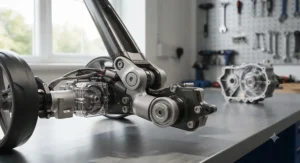
PowaKaddy’s MAG-LOK and Motocaddy’s EASILOCK systems are both designed to let compatible bags click into place without a separate lower strap, which is a genuine time-saver on cold mornings with numb fingers. Stewart Golf trolleys use a more traditional strap-and-bracket approach across the range, which works with virtually any cart bag regardless of brand, at the cost of a few extra seconds of setup.
Beyond the bag itself, check specifically for a rangefinder or phone mounting plate if you use one — the Stewart Golf Q Follow includes a built-in rangefinder mounting plate as standard, which rivals often sell as a separate accessory. Umbrella holders, scorecard clips and drinks holders are near-universal add-ons across every brand here, so they’re rarely a deciding factor — but battery-charging cables, travel covers and anti-tip wheels are worth pricing in separately, as they’re not always included even on trolleys well north of £1,000.
How to Choose a Stewart Golf Trolley
Working through the decision in order saves you comparing specs you don’t actually need:
- Decide follow, remote, or walk-behind first. This single choice eliminates roughly two-thirds of the models on the market and should be driven by how you actually want to spend your walk, not by what looks most impressive.
- Set a genuine budget ceiling before browsing. Premium trolleys are easy to talk yourself into once you’re looking at finish options — decide the number first.
- Check your typical round length against battery capacity. An 18-hole battery is fine if you rarely play more, but regular 36-hole days at a links course justify the extended option upfront.
- Weigh the trolley, folded and unfolded, against your boot space. A trolley you resent loading every week won’t get used, regardless of how good the engineering is.
- Confirm your usual bag is compatible with any quick-lock system. Not every cart bag works cleanly with MAG-LOK or EASILOCK-style attachments.
- Read the warranty terms on the battery specifically, not just the frame — batteries are the part most likely to need replacing first, and terms vary widely between three and five years across this list.
- Test the follow or braking feature in person if possible, rather than relying on the spec sheet alone, since aggregated owner reviews suggest real-world performance of these features can vary between units.
Stewart Golf vs Motocaddy vs PowaKaddy: The Detailed Comparison
All three brands are genuinely British in engineering pedigree, but they’ve made different bets on where value lives. Stewart Golf bets everything on exclusivity and hands-free follow technology, building in relatively low volumes at its Gloucestershire factory and pricing accordingly. Motocaddy bets on scale — a wider dealer network, broader accessory ecosystem, and a spread of price points from entry-level to premium under one badge. PowaKaddy leans hardest into integrated GPS, treating the trolley itself as the display device rather than a separate gadget.
| Factor | Stewart Golf | Motocaddy | PowaKaddy |
|---|---|---|---|
| Signature feature | Follow technology | DHC + broad range | Integrated GPS |
| Manufacturing | Handbuilt, Gloucestershire | UK-engineered, larger scale | UK-engineered |
| Price positioning | Premium only | Entry to premium | Mid to premium |
| Best For | Stewart Golf hands-free purists | Buyers wanting range and support | Data-driven golfers |
The practical upshot: if you already know you want follow mode, Stewart’s specialism means you’re unlikely to find a more refined version of that specific feature elsewhere. If you’re not sure where you’ll land on the price spectrum, Motocaddy’s range gives you room to move between tiers without switching ecosystems, while PowaKaddy is worth a serious look if a separate GPS device has always felt like one gadget too many. Research aggregating expert and owner reviews across the category, such as the roundups published by National Club Golfer, consistently places all three brands among the UK’s strongest, which suggests the honest answer is that you’re choosing a priority, not a winner.
What to Expect: Real-World Performance on the Course
Spec sheets rarely tell you what a trolley actually feels like on a wet Tuesday in February, so here’s the practical translation. A 230W motor, the figure quoted across most mid-range trolleys on this list, comfortably handles gentle-to-moderate inclines at walking pace; it’s on genuinely steep hills that the extra torque and downhill braking systems on premium models start to earn their keep, holding a steady descent rather than needing constant handle pressure to check speed.
Battery range in the real world tends to run a little below the headline “18-hole” or “36-hole” marketing figures once you factor in colder weather, which reduces lithium capacity, and hilly terrain, which draws more current than flat parkland. Budget for roughly 10-15% below the stated range on a cold winter round, and you won’t be caught out on the eighteenth green.
Follow mode, specifically, performs best in open, uncluttered fairways and struggles more in tight, tree-lined corridors where the Bluetooth signal has more obstacles to contend with — worth factoring in if your home course is heavily wooded rather than open parkland or links.
Premium Trolley Engineering: Features That Actually Matter
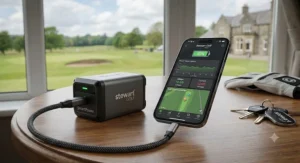
Not every spec on a premium trolley’s marketing page translates into a noticeably better round. Monocoque construction, used on the Stewart Golf Q Follow, genuinely matters — it reduces flex in the chassis, which keeps the trolley tracking straight rather than wandering, and that’s a real, felt difference on uneven ground. Motor wattage, by contrast, matters far less once you’re above roughly 200W; the difference between a 200W and 300W motor is rarely noticeable at typical trolley walking speeds, and is more relevant for extreme gradients than everyday play.
Battery chemistry and warranty length matter enormously and get comparatively little marketing attention — a five-year lithium warranty, offered by several brands here including Motocaddy, is worth more in practice than an extra colour option. Bluetooth remote range, quoted anywhere from 50m to 75m across this list, sounds impressive but is rarely used to its full extent on a standard course layout; it’s more about signal reliability at typical distances than maximum theoretical reach.
Finish options and colourways, appealing as they are, are genuinely cosmetic — they don’t affect performance at all, and are worth paying extra for only if the aesthetic itself is part of why you’re buying a stewart golf trolley over a plainer alternative.
British-Made Golf Trolley: Why British Golf Brands Still Lead
There’s a reason “handbuilt in Great Britain” appears so prominently on Stewart Golf’s marketing — it’s not just heritage messaging. The company’s Gloucestershire factory has expanded more than once over the past two decades specifically to keep hand-assembly and final inspection in-house rather than outsourcing to reduce costs, and it’s brought electronics manufacturing back to the UK after a period based in Europe, citing tighter quality control as the reason.
This matters practically, not just sentimentally: a British-made golf trolley built and warranted from a UK factory tends to mean shorter turnaround on warranty repairs and parts, since stock and technical staff are closer to the customer. It’s also worth noting that Stewart Golf isn’t alone — PowaKaddy was founded in Kent in 1983 and remains UK-engineered, while Motocaddy has built its reputation on UK-based product development even as manufacturing has scaled globally to meet demand.
The trade-off for choosing the most exclusively handbuilt option is volume and, therefore, price — a factory producing thousands of units by hand every year simply can’t match the unit economics of mass production, and that cost is passed directly to the buyer. Whether that premium is worth it depends entirely on how much you value knowing your trolley was assembled and checked by a named technician rather than a production line.
Stewart Golf Trolley Review: What Owners and Testers Say
Pulling together aggregated sentiment across trade reviews and verified owner feedback gives a consistent picture of the stewart golf trolley range. On the positive side, testers repeatedly single out the follow function as working genuinely well rather than as a marketing gimmick, alongside build quality that reviewers describe as best-in-class within the category — one detailed trade review from Golfmagic rated the Q Follow highly on engineering and called the remote control intuitive to use straight out of the box.
Where feedback is more mixed is around specific electronic features on certain units, particularly downhill control accuracy reported by at least one long-term X10 Follow owner, and around battery removal design on older Q Series models, which some owners found less intuitive than expected when upgrading from an X-Series trolley. Neither issue appears to be universal, but both are common enough in aggregated feedback to be worth raising directly with a stockist or demo day representative before you commit to a premium purchase.
What’s harder to verify independently is the exact volume and distribution of reviews behind aggregate star ratings on any single retailer page, so treat any single 5-star listing with the same healthy scepticism you’d apply to any product category — look for consistency across multiple independent sources rather than any one glowing review.
Safety, Battery Regulations and Course Compliance
Every trolley on this list runs on a lithium battery, and UK rules on how those batteries are disposed of at end of life are stricter than many golfers realise. Lithium batteries must never go in general household waste — they need to go via a dedicated recycling point, a household waste recycling centre, or a manufacturer take-back scheme, as set out in official UK government guidance on recycling batteries and electrical waste. Damaged or improperly stored lithium cells carry a genuine fire risk, so it’s worth taping over terminals before disposal and never leaving a damaged battery in a hot car boot.
On the course itself, most UK clubs have no specific restriction on electric trolleys beyond standard etiquette — keeping wheels off greens and bunker edges, and giving way to faster-playing groups. Follow-mode trolleys deserve a moment of extra courtesy: an unsupervised trolley trundling across a fairway can be a genuine surprise to golfers on an adjacent hole, so most experienced owners switch to remote or manual control near blind crossings or shared cart paths as a matter of course.

FAQ
❓ Is a stewart golf trolley worth the extra cost over Motocaddy or PowaKaddy?
❓ How long does a Stewart Golf trolley battery last per round?
❓ Can I buy a Stewart Golf trolley on Amazon UK?
❓ What's the difference between Stewart Golf's Follow and Remote models?
❓ Do premium electric trolleys need more maintenance than budget ones?
Conclusion
Choosing between a stewart golf trolley and its rivals ultimately comes down to how honestly you can answer one question: do you want the trolley to disappear from your attention entirely, or are you happy steering it in exchange for a lower price? The Stewart Golf Q Follow and Stewart Golf X10 Follow answer that question about as well as anything on the UK market, backed by handbuilt Gloucestershire construction and a follow system that reviewers consistently rate as genuinely reliable rather than gimmicky. The Stewart Golf X10 Remote offers nearly the same build quality without paying the follow premium, while the Motocaddy M-Tech remains the strongest premium alternative if broader dealer support matters to you.
Further down the price scale, the PowaKaddy CT8 GPS EBS and Motocaddy M1 DHC both deliver excellent day-to-day value without chasing the follow feature at all, and the Ben Sayers Electric Trolley remains the honest, low-risk way to find out whether electric assistance suits your game before spending four figures to confirm it. Whichever you land on, prioritise the follow-versus-remote-versus-walk-behind decision first — everything else on the spec sheet is secondary to getting that one choice right.
Recommended for You
- Compact Electric Golf Trolley For Small Car Boot: 7 Best Picks for Small Boot (2026)
- Lithium Battery Golf Trolley: 7 Best UK Picks for 2026
- Remote Control Golf Trolley: 7 Best Picks (2026)
Disclaimer: This article contains affiliate links. As an Amazon Associate, I earn from qualifying purchases. If you purchase products through these links, we may earn a small commission at no additional cost to you.
✨ Found this helpful? Share it with your friends! 💬🤗
