
In This Article
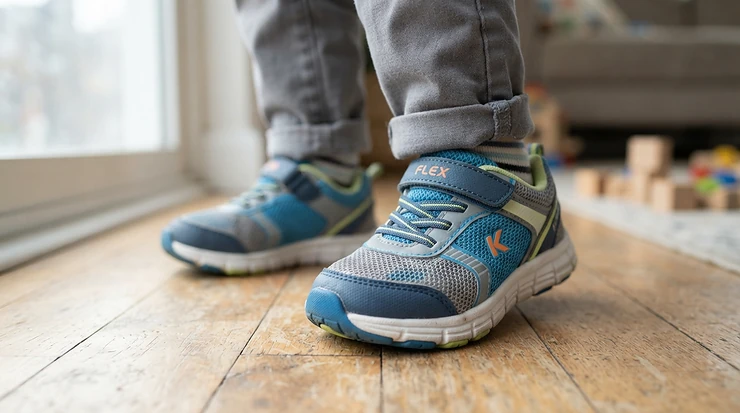
Junior golf shoes for growing feet are golf-specific shoes in children’s and youth sizes, with grip, waterproofing and cushioning scaled for lighter bodies. They also have adjustable fastening and sensible toe room to cope with rapid growth. The target is a locked-down heel and roughly a thumb’s width ahead of the longest toe, as NHS orthotics guidance puts it.

Here’s the parental tightrope. Buy snug and the shoes are finished by spring. Buy two sizes up and your seven-year-old is skating across a damp fairway like a newborn giraffe. Golf makes it trickier, because the swing is a controlled weight transfer. A loose heel robs a young player of balance just when they’re learning to rotate.
Growth is relentless, too. An adidas junior size chart on UK retailer sites shows each size step adding only about 0.7 cm of foot length, so one growth spurt can swallow a whole size. NHS trust leaflets suggest rechecking fit anywhere from every six weeks to every three months.
This guide threads the needle. I compared independent tests from Golf Monthly and Today’s Golfer with manufacturer specs and UK retailer listings. That produced seven pairs that suit kids golf shoes with room to grow, from budget to premium. You’ll also find a plain-English youth sizing explainer, an honest look at hook and loop fastening (rarer in junior golf than you’d expect), and advice on junior spikeless golf shoes for school age. Prices are ranges only and change often, so check current price before you buy.
Quick Comparison: 7 Junior Golf Shoes at a Glance
Short on time? This table puts all seven shoes side by side. Closure details marked “confirm” couldn’t be verified across every UK listing, so check the product page for the exact version you’re buying. I’ve left out star ratings deliberately, because I couldn’t verify review pools large enough to quote fairly.
| Shoe | Traction | Waterproofing | Closure | Price range | Best For |
|---|---|---|---|---|---|
| adidas Tour360 24 BOA Junior | Cleated | Waterproof upper | BOA dial | Mid-£60s–£80 | Keen juniors in wet weather |
| FootJoy Fuel Junior | Spikeless | Waterproof, 1-year guarantee | Laces (confirm) | £60–£70 | All-round year-round use |
| Callaway Apex Junior | Spikeless | Waterproof warranty | Oxford laces | £50–£60 | Wider feet, all seasons |
| adidas Codechaos BOA 25 Junior | Spikeless | Waterproof | BOA dial | £65–£80 | Style-conscious older juniors |
| Puma Fusion Crush Junior | Spikeless | Waterproof (mesh upper) | Laces (confirm) | £55–£70 | Summer comfort, multi-sport |
| Nike Roshe G Junior | Spikeless | Not waterproof | Laces (confirm) | £45–£55 | Dry-weather rounds |
| Stromberg Vector Junior | Spikeless | Waterproof guarantee | Laces (confirm) | £35–£45 | Budget fast-growers |
Read across the table and a pattern emerges. Spikeless dominates, waterproofing is nearly universal, and the dial-fastened pairs sit at the top of the price range. For most families, the FootJoy Fuel Junior and Callaway Apex Junior hit the sweet spot between protection and price, while the Nike Roshe G Junior is strictly a fair-weather shoe. If your child plays all year, a waterproof pair plus a cheap summer pair often beats one expensive do-it-all shoe.
💬 Just one click — help others make better buying decisions too!😊
Top 7 Junior Golf Shoes for Growing Feet: Expert Analysis
Everything below draws on published tests such as Golf Monthly’s kids’ golf shoe guide and Today’s Golfer’s roundup, cross-checked against manufacturer and UK retailer specs. I haven’t tested these shoes myself, so treat the “review sentiment” lines as what independent testers report, not personal verdicts.
1. adidas Tour360 24 BOA Junior — premium all-weather support with dial fit
The headline feature is the BOA dial. Your child twists to tighten and pulls to release, and nobody kneels in a bunker re-tying laces.
Golf Monthly’s testers made the junior Tour360 24 their top pick. They cite a waterproof upper, a Boost sole for cushioning and energy return, an INSITE sockliner and a six-cleat traction pattern backed by rubber teeth. In practice, soft wet ground is less likely to send a nine-year-old sliding, and long walks feel kinder. UK listings run from roughly size 1 to 6, so bigger juniors can keep wearing it as they approach adult sizing. Golf Monthly describes leather, while some retailer listings say synthetic microfibre, so check the exact listing if material matters.
Based on the spec comparison, this suits a keen junior who plays weekly in all weathers. For the occasional round it’s more shoe than you need. The dial also helps with growing feet, because small tightening tweaks can stretch a pair across minor changes in foot volume.
Reviewers consistently praise comfort and looks, and the recurring complaint is a hard-to-clean outsole. I couldn’t verify a deep pool of retailer reviews for the junior version specifically.
Pros:
- ✅ Dial fit adjusts in seconds
- ✅ Cushioned Boost sole suits long rounds
- ✅ Waterproof upper with confident grip
Cons:
- ❌ Outsole traps mud and is hard to clean
- ❌ Among the dearer pairs on this list
Expect roughly the mid-£60s to £80 range. It’s good value if worn weekly and harder to justify for the odd round.
2. FootJoy Fuel Junior — best all-rounder with a waterproof guarantee
FootJoy took its most athletic adult shoe and shrank it, and the result looks like a trainer that happens to know golf.
The upper is a wipe-clean waterproof synthetic. Retailer specs also list a lightweight EVA midsole with FootJoy’s Stability Bridge for mid-foot support, plus a one-year waterproof guarantee. Size ranges vary by source (Today’s Golfer lists UK 1–5). That wipe-clean upper matters because muddy shoes get cleaned in minutes, not hours. The mid-foot support is a quiet bonus while a child is learning to turn through the ball.
Here’s what to weigh: it’s the safe middle path. Golf Monthly’s testers rated it best for grip among their picks, praising traction on hard and slightly soft ground. On genuinely boggy winter fairways, a cleated shoe like the adidas Tour360 24 BOA Junior will bite harder.
Reviewers note a clean, modern look and good comfort. Both publications mention a fairly firm, lightly padded upper, so children with sensitive feet may want a sock-and-walk test first.
Pros:
- ✅ Wipe-clean waterproof upper
- ✅ One-year waterproof guarantee
- ✅ Athletic look juniors actually like
Cons:
- ❌ Upper feels firm with light padding
- ❌ Limited colour choice
Think £60–£70 range. It’s solid value for the protection and brand backing.
3. Callaway Apex Junior — best for wider feet, built for all seasons
Callaway lists this one as a mid wide fit. For broad-footed children, that’s the whole sales pitch.
The spec sheet shows performance leather, Oxford laces, a comfort insole, a die-cut EVA midsole and a breathable mesh liner. Today’s Golfer adds ankle support, a spikeless TPU outsole and a one-year waterproof warranty, with UK sizes around 1–6. A wider last gives toes room to splay without the shoe feeling oversized in length, which is exactly the trade-off parents face.
The honest caveat is the lacing. With no dial or strap, younger children will need help getting a secure heel lock. A heel-lock lacing technique (covered below) solves most of it.
Today’s Golfer named it the most comfortable junior shoe in their guide. The main criticism is a lack of colour choice, so style-led kids may sulk.
Pros:
- ✅ Mid wide fit suits broader feet
- ✅ Supportive around the ankle
- ✅ Breathable and waterproof for all seasons
Cons:
- ❌ Laces only, no quick-adjust option
- ❌ Very limited colour choice
At around £50–£60, it’s one of the stronger value propositions here.
4. adidas Codechaos BOA 25 Junior — lightest trainer-style pick with dial fit
Golf Monthly’s “best looking” pick looks like a running shoe that got lost on the way to the gym.
Their testers describe a lightweight, super-soft midsole and upper, a spikeless outsole, waterproofing, a wipe-clean upper and recycled materials. Listed sizes run roughly UK 2–6.5 in white or black. Weight matters more than it sounds: tired legs on the back nine are the usual reason for a child’s rounds collapsing. The BOA closure adds micro-adjustment.
Based on those specs, this is aimed at style-conscious older juniors who’d refuse anything that looks like “proper golf shoes”. Spikeless grip is adequate for most conditions, though it won’t match cleats on saturated ground.
Reviewers consistently highlight comfort and styling. The only recurring reservation is taste: the bold design won’t suit everyone. Golf Monthly also places it at the premium end of junior pricing.
Pros:
- ✅ Very light, soft and comfortable
- ✅ Dial fit with wipe-clean upper
- ✅ Waterproof with recycled materials
Cons:
- ❌ Bold styling divides opinion
- ❌ Premium price for a pair they’ll outgrow
Expect roughly £65–£80. It’s worth it only if the style genuinely gets them playing more.
5. Puma Fusion Crush Junior — most comfortable trainer-style shoe for summer
If your child lives in trainers, this is the golf shoe that won’t feel like a punishment.
Golf Monthly’s testers praised support around the heel, arch and lacing area, plus spikeless grip better than they expected. It’s waterproof, but the breathable mesh is tricky to clean. Their listing shows sizes 4–7 in two colourways. That looks like US sizing, so confirm the UK conversion before ordering.
Here’s the practical take. Mud clings to mesh, so I’d treat this as a spring-to-autumn shoe rather than a January workhorse. It also works for other sports, which stretches the value when feet are about to outgrow it anyway.
The consistent verdict from testers is comfort first, with a trainer look that kids happily wear off the course. The cleaning difficulty is the standard complaint.
Pros:
- ✅ Trainer-like comfort from the first walk
- ✅ Grip better than most spikeless pairs
- ✅ Doubles up for other sports
Cons:
- ❌ Mesh upper is hard to clean
- ❌ Only two colours and limited size range
Likely £55–£70 range. It’s strong value if it earns double duty.
6. Nike Roshe G Junior — breathable and colourful, strictly for dry weather
Ten colourways is a lot for a kids’ golf shoe, and it explains why the Roshe is a playground favourite.
Golf Monthly lists sizes 2–7 and a spikeless sole with an injected foam midsole for a spongy walk, plus a breathable mesh upper. Crucially, it isn’t waterproof. In sunshine the airflow keeps feet cool. In a wet October, socks will be soaked by the third hole.
Because it trades traction for lightness, Golf Monthly flags weaker grip than the other picks. I’d treat it as the second pair: cheap enough to rotate with a waterproof shoe like the FootJoy Fuel Junior, and stylish enough to wear to the range afterwards.
Reviewers consistently praise comfort, colour range and off-course versatility. Today’s Golfer’s earlier note on the Roshe 2 G junior flags the same lack of waterproofing.
Pros:
- ✅ Ten colours to choose from
- ✅ Light, breathable and cushioned
- ✅ Works off the course too
Cons:
- ❌ Not waterproof
- ❌ Less grip than rivals
Around £45–£55 range. It’s good value as a summer second pair.
7. Stromberg Vector Junior — best budget buy for fast growers
When a child gains a size every few months, a modest price tag is a feature, not a compromise.
Stromberg is American Golf’s own brand. Today’s Golfer’s UK roundups credit it with a one-year waterproof guarantee, a multi-directional rubber outsole and a low-profile athletic look, with UK sizes around 1–5. Check which version is currently stocked, because ranges rotate.
My honest analysis: the trade-off is support. Today’s Golfer notes that pricier models offer more, so this suits younger or lighter children whose feet and swings are still developing. It’s also the least painful pair to replace mid-season.
Testers describe good traction and comfort for the money. The common caveats are modest cushioning and limited colour choice.
Pros:
- ✅ Lowest price on this list
- ✅ One-year waterproof guarantee
- ✅ Low-profile athletic styling
Cons:
- ❌ Less support than pricier models
- ❌ Few colour options
Roughly £35–£45. It’s the clearest value buy for a fast-growing school-age player.
✨ Ready to Find the Right Pair?
🔍 Take your junior golfer’s footwear to the next level with these carefully selected pairs. Click on any highlighted product name to check current pricing and availability, and remember to measure first. These shoes will help you create comfortable, confident rounds your young golfer will love!
Kids Golf Shoes with Room to Grow: How to Measure and Fit Them
Here’s the practical routine. Measure both feet while your child stands, because one foot is usually slightly bigger. Do it later in the day, when feet have swelled a little, and size to the larger foot. Use the socks they’ll actually play in.
Then check three things:
- Toe room: about a thumb’s width between the longest toe and the shoe’s end, per NHS guidance. Any more and golf-specific stability suffers.
- Heel lock: the heel shouldn’t lift when they rise onto their toes.
- Swing test: a few practice swings in the shop or hallway. Today’s Golfer recommends this, and it exposes slipping fast.
Heel slipping despite correct length? Try the “runner’s loop” heel-lock lacing trick: thread each lace through the top eyelet on its own side, then cross and pull. It anchors the ankle without squashing toes.
For kids golf shoes with room to grow, aim for a snug fit now with a modest allowance, not a giant gap. Re-measure every six to twelve weeks, depending on age and which guidance you follow. Society of Shoe Fitters advice cited in a UK leaflet suggests every 10–12 weeks from age four, while NHS trust leaflets quote tighter windows.
Common first-30-day mistakes: skipping break-in rounds, buying two sizes up, and forgetting to air the shoes between rounds. Don’t dry them on radiators, either.

Youth Sizing Explained: UK, US and EU Charts
Youth sizing is where well-meaning parents get tripped up. UK, US and EU numbers don’t line up cleanly, and golf brands each publish their own charts.
For reference, an adidas junior chart on UK retailer sites gives these foot lengths:
- UK 13K: about 19.1 cm (EU 31)
- UK 1J: about 19.8 cm (EU 32)
- UK 2J: about 20.5 cm (EU 33½)
- UK 3J: about 21.2 cm (EU 34½)
- UK 4J: about 21.9 cm (EU 36)
- UK 5J: about 22.6 cm (EU 37½)
Each step is roughly 0.7 cm, which is smaller than a thumb’s-width allowance. A well-fitted pair has perhaps one size of growing room, no more.
The bigger trap is the UK/US gap. Today’s Golfer’s tables show FootJoy Fuel Junior as US 2–6 / UK 1–5, Callaway Apex Junior as US 2–7 / UK 1–6, and Nike Roshe G Junior as US 3–6 / UK 2–5. UK sizes run about one lower than US youth sizing. Golf Monthly’s US edition quotes some of the same shoes in US numbers, so always look at the UK column on the retailer’s own chart. When in doubt, measure in centimetres and compare to the brand’s foot-length table rather than trusting the number on the box.
Hook and Loop Fastening vs Laces vs BOA: What Suits Growing Feet?
Let’s be straight about hook and loop fastening in junior golf. In my research, the shoes with verifiable fastenings were lace-up or BOA dial. I couldn’t confirm a current UK junior golf shoe sold mainly with hook and loop fastening. Adjacent examples exist: Today’s Golfer described a strap-adjusted junior model, the Puma Fusion Evo Junior, and adult Skechers Arch Fit Front Nine golf shoes use two hook and loop straps. So the concept is proven in golf, even if junior options are scarce. Hook and loop fasteners trace back to a 1940s idea by Swiss engineer George de Mestral. UK children’s footwear guidance generally lists them among adjustable fastenings that keep a foot secure.
| Closure | How it works | Growing-feet advantage | Watch out for | Best For |
|---|---|---|---|---|
| Laces | Tied and adjustable at each eyelet | Fully tuneable, heel-lock possible | Slow, come undone | Callaway Apex Junior for older, wider-footed kids |
| BOA dial | Twist to tighten, pull to release | Micro-adjustment in seconds | Dial can be fiddly for tiny hands | adidas Tour360 24 BOA Junior, adidas Codechaos BOA 25 Junior |
| Hook and loop fastening | Straps pressed onto fabric | Easy for small hands | Grass and lint clog the hooks | Younger kids if you find a strapped model such as the Puma Fusion Evo Junior |
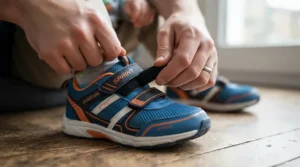
For five-to-seven-year-olds, a dial or strap saves tantrums, but laces win on precision for older players. Whichever you choose, brush grass and fluff from strap surfaces after every round. If you’re stuck with laces on a younger child, no-tie elastic laces are a cheap workaround.
Junior Spikeless Golf Shoes for School Age: What Works at 5, 8 and 11
Junior spikeless golf shoes for school age make sense for most children. They’re lighter, kinder on feet and easier to walk in from car park to first tee. Today’s Golfer notes spikeless pairs have improved a lot, though cleats still win on saturated ground. Most UK clubs have moved away from metal spikes, but check your own club’s dress code.
Growth changes the equation by age. Clarks says feet can grow up to two sizes a year in the earliest fitting years. That favours budget buys for five-to-seven-year-olds, like the Stromberg Vector Junior or Nike Roshe G Junior for summer. By eight to ten, the FootJoy Fuel Junior or Callaway Apex Junior offer more support and weather protection, and sizing becomes more predictable. From eleven upwards, children approach the top of junior size ranges, so the adidas Tour360 24 BOA Junior or adidas Codechaos BOA 25 Junior (both listed up to around UK 6–6.5) can last longer.
If the shoes will double as PE or after-school trainers, check your school’s kit rules first, because policies on footwear vary. Waterproofing is the other big variable in a British winter. A shoe like the Nike Roshe G Junior that isn’t waterproof needs a cheap, dry-weather role, not a winter one.
Spiked vs Spikeless vs Trainers: Which Is Right for Juniors?
The debate matters less for children than adults, because lighter bodies generate less slip. Golf Monthly’s testers say spiked shoes give better grip and stability but sit higher off the ground, while spikeless models are lighter and more versatile. Today’s Golfer adds that spiked pairs have replaceable spikes, which helps durability, but spikes create pressure points that can reduce comfort.
| Option | Grip | Comfort and weight | Versatility | Best For |
|---|---|---|---|---|
| Cleated | Highest on wet, soft ground | Slight pressure points | Golf only | adidas Tour360 24 BOA Junior for wet winter golf |
| Spikeless | Good on most UK conditions | Light and flexible | On and off course | FootJoy Fuel Junior, Callaway Apex Junior |
| Trainers | Poor on wet or uneven ground | Very comfortable | Everyday use | Casual range sessions only |
Trainers can work in summer, but Today’s Golfer warns they tend to struggle when the ground is wet or uneven. For most juniors, spikeless wins on comfort, price and versatility. Cleats only pay off for children who play several times a week in poor conditions.
How to Choose Junior Golf Shoes for Growing Feet
Follow these steps in order and you’ll avoid most expensive mistakes.
- Measure both feet. Use the larger foot and a foot-length chart, not last year’s size.
- Pick your traction. Spikeless suits most UK juniors; choose cleats only for regular wet-weather play.
- Check waterproofing. For winter, insist on a waterproof upper or warranty. For summer, breathability wins.
- Choose the fastening. Laces suit older kids, a dial or strap suits younger ones.
- Prioritise heel lock over extra length. A loose heel hurts the swing more than a snug toe box ever will.
- Match budget to lifespan. If feet will outgrow a pair in six months, spend less.
- Schedule the next check. Put a re-measure reminder in your calendar.
Following these steps tends to settle the decision quickly. A child with wide feet, regular winter play and laces-ready hands points to the Callaway Apex Junior. A fast-growing six-year-old on a budget points to the Stromberg Vector Junior.

Features That Actually Matter (And Those That Don’t)
Marketing loves a flashy foam name. Children need basics done well.
What matters:
- A secure heel and enough toe room for junior golf shoes for growing feet
- A waterproof upper or warranty for UK weather
- Light weight, so late-round fatigue doesn’t wreck swing tempo
- A wipe-clean upper, because muddy shoes get ignored otherwise
- A fastening your child can manage alone
What doesn’t:
- Tour-pro endorsements, which say little about how a nine-year-old swings
- Premium energy-return foams if the child plays monthly
- Bold colourways, unless they genuinely motivate your child to practise
Based on the spec comparison, the biggest value gap is between waterproof and non-waterproof pairs, not between mid-priced and premium ones. That’s why the FootJoy Fuel Junior and Callaway Apex Junior tend to beat fancier alternatives on sense-per-pound for typical juniors.
Long-Term Cost and Maintenance: Making a Growing-Feet Budget Stretch
Today’s Golfer’s buying guide argues there’s little point splashing out on shoes unless the child plays several times a week. That’s sound economics. The real cost is price divided by rounds worn before outgrowing.
| Tier | Price range | Typical lifespan logic | Best For |
|---|---|---|---|
| Budget | £35–£55 | Replace every size jump | Stromberg Vector Junior, Nike Roshe G Junior |
| Mid-range | £50–£70 | One or two seasons | Callaway Apex Junior, FootJoy Fuel Junior, Puma Fusion Crush Junior |
| Premium | £65–£80 | Best if worn weekly or passed on within a family | adidas Tour360 24 BOA Junior, adidas Codechaos BOA 25 Junior |
The table shows that budget makes sense for young, fast-growing feet, while premium only pays back with frequent play. Hand-me-downs between siblings are tempting, but guidance generally warns second-hand shoes can mould to the first child’s foot.
Maintenance extends life. Wipe uppers after every round, remove insoles to dry, and keep shoes away from radiators. Replace worn spikes on cleated pairs promptly. Hold on to purchase receipts if a waterproof guarantee applies, and read the terms. With winter and the busy shopping season approaching, prices will move, so check current price before ordering.
Real-World Scenarios: Matching Shoes to Real Juniors
These are three illustrative profiles, not case studies from real purchases.
The casual six-year-old. Plays nine holes most Sundays from April to September, on dry fairways, with a tight budget. A cheap, light pair with room for one growth spurt fits best: the Nike Roshe G Junior for sunshine or the Stromberg Vector Junior if showers are likely. Re-measure every six to eight weeks, because growth at this age is fast.
The club-junior ten-year-old. Plays weekly year-round with broader feet. The Callaway Apex Junior‘s mid wide fit and waterproof warranty suit this profile, with the FootJoy Fuel Junior as an alternative if feet are standard width. Budget around £50–£70, and expect to replace at the next size jump.
The county-level thirteen-year-old. Plays two or three rounds weekly in all conditions, size near the top of junior ranges. The adidas Tour360 24 BOA Junior offers cleated grip, cushioning and a dial fit, and larger sizes mean it can last longer. If style matters more than grip, the adidas Codechaos BOA 25 Junior is the lighter alternative.
Problem → Solution Guide: Fixing Common Kids’ Golf Shoe Headaches
Heel slipping. Use the heel-lock lacing method, or move to a dial-fastened pair such as the adidas Tour360 24 BOA Junior, whose micro-adjustment helps lock the heel.
Blisters. Usually a sign of poor fit or seams rubbing. Check length with the thumb test, wear proper socks, and break shoes in over a couple of short sessions.
Wet feet. Choose waterproof pairs for winter. The FootJoy Fuel Junior, Callaway Apex Junior and Stromberg Vector Junior carry waterproof guarantees or warranties according to published reviews, whereas the Nike Roshe G Junior doesn’t.
Muddy, hard-to-clean soles. Cleated pairs like the adidas Tour360 24 BOA Junior and mesh uppers such as the Puma Fusion Crush Junior are the worst offenders. A stiff brush and a damp cloth after each round beats a weekend scrub.
Outgrown mid-season. Don’t panic-buy. Keep a cheap spare pair in the next size, and measure before every purchase.
Laces undone. For younger children, a dial or strap solves it, or use no-tie elastic laces on lace-up models like the Callaway Apex Junior.

FAQ
❓ Do junior golf shoes come with hook and loop fastening?
❓ Is it fine to buy kids golf shoes with room to grow a size up?
❓ Are junior spikeless golf shoes for school age good enough for winter?
❓ How often should I check youth sizing for golf shoes?
❓ Can kids just wear trainers instead of junior golf shoes?
Conclusion
Choosing junior golf shoes for growing feet comes down to balance: enough room for growth, enough security for a stable swing, and a price that respects how fast feet change. For most families, the FootJoy Fuel Junior is the sensible all-rounder, the Callaway Apex Junior is the one to pick for wider feet, and the Stromberg Vector Junior is the budget hero for fast-growing school-age players. Dial-fastened pairs such as the adidas Tour360 24 BOA Junior and adidas Codechaos BOA 25 Junior reward keen juniors who’ll wear them weekly, while the Puma Fusion Crush Junior and Nike Roshe G Junior shine in summer.
Remember the three rules that matter more than any brand: measure both feet, keep the heel locked, and re-check fit regularly. If hook and loop fastening matters to you, shop carefully, because verified junior options are scarce. Prices will keep moving, so check current price before you buy, and revisit your youth sizing every few weeks.
Recommended for You
- Ladies Lightweight Golf Shoes For Narrow Feet: 7 Proven Picks (2026)
- Wide Fit Golf Shoes For Bunions: 7 Best Picks For 2026
- Golf Shoes For Flat Feet With Arch Support: 7 Proven Picks (2026)
Disclaimer: This article contains affiliate links. As an Amazon Associate, I earn from qualifying purchases. If you purchase products through these links, we may earn a small commission at no additional cost to you.
✨ Found this helpful? Share it with your friends! 💬🤗
