
In This Article
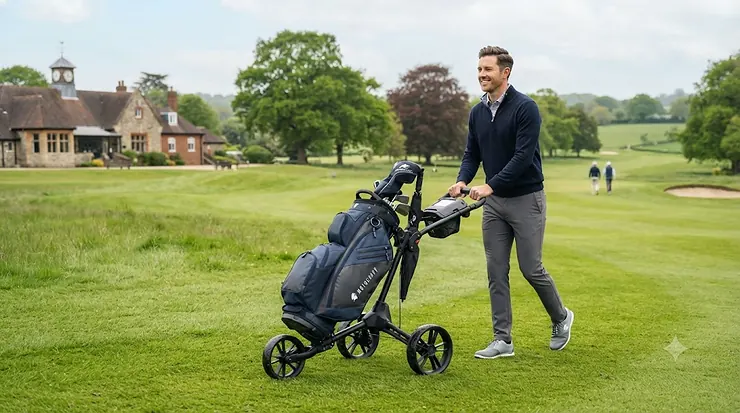
Somewhere between the caddie-and-tips era and the age of remote-controlled electric buggies sits the humble 3-wheel golf push trolley — unglamorous, unbothered by batteries, and quietly the best £100-odd you’ll ever spend on your golf game. If you’ve ever watched a two-wheeler tip sideways on a cambered fairway, or wrestled a four-wheel design through a narrow car boot, you’ll understand why the triangular wheelbase has stuck around for decades. It’s a simple bit of engineering — one wheel out front, two behind — but that simplicity is precisely the point.
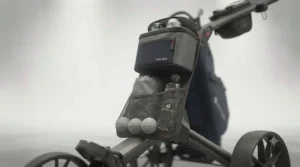
A 3-wheel golf push trolley is a manually operated cart with a single front wheel and two rear wheels, designed to carry your bag around the course while distributing weight for easier steering on slopes and rough ground. Compared with two-wheel pull carts, the triangular footprint resists tipping on sidehill lies, and compared with four-wheel models, it folds smaller and turns tighter around greenside bunkers.
This guide walks through seven genuinely available trolleys — from budget stainless-steel basics under £100 to premium flat-folding models nudging £300 — with honest analysis of what the specs actually mean on the course, not just what’s printed on the box. We’ll get into balance, single front wheel design, and how each copes when the terrain stops being flat. Prices below are ranges only, since retail pricing shifts constantly — always check current price before buying.
Quick Comparison Table
| Trolley | Weight | Folded Size | Standout Feature | Best For |
|---|---|---|---|---|
| Motocaddy QB2 | ~9.5kg | Compact cube-fold | Auto-fold front wheel | Boot space |
| PowaKaddy Micra | ~7.5kg | Ultra-compact | Wide 3-wheel stance | All-round balance |
| Clicgear 4.0 | ~8-9.5kg | 38 x 33 x 60cm | Adjustable front wheel | Serious stability |
| Big Max Autofold FF | ~8kg | 12.5cm flat-fold | One-lever flat fold | Storage-tight garages |
| Caddytek CaddyLite EZ V8 | ~8.4kg | 12.5″ x 14.4″ x 28.4″ | Wide EVA wheels | Uneven terrain |
| MacGregor MacTec | Mid-weight | Compact | Front folding wheel | Budget buyers |
| Longridge Tri-Cart | ~5kg (frame) | Two-stage fold | 11″ ball-bearing wheels | First-timers on a budget |
Looking at the spread here, weight and folded footprint tell only half the story — the Caddytek CaddyLite EZ V8‘s wider wheelbase and oversized EVA tyres are doing real work on rough ground that lighter, narrower carts can’t match. Meanwhile the Big Max Autofold FF trades a touch of extra weight for a genuinely class-leading fold, which matters enormously if your boot also has to swallow a full stand bag. Budget doesn’t necessarily mean compromised stability, either — the Longridge Tri-Cart‘s wide-set wheels punch above its price point for basic balance, even if the plastic frame won’t match the aluminium models for long-term durability.
💬 Just one click — help other riders keep their frames rust-free too!😊
Top 7 3-Wheel Golf Push Trolleys: Expert Analysis
Choosing between budget, mid-range and premium options really comes down to how often you play, how far you’re carrying, and what kind of ground your home course throws at you. Here’s the honest breakdown of seven real, currently available models.
1. Motocaddy QB2 — smallest fold in its class
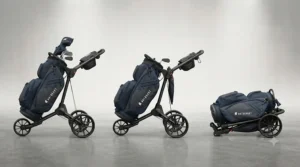
The standout feature here isn’t really the wheels, it’s what happens when you’re done with them: the QB2’s auto-fold front wheel tucks itself away as part of a two-step folding sequence, shrinking the whole unit by over 20% compared with Motocaddy’s previous Cube model. That matters more than it sounds — anyone who’s ever knelt in a wet car park fighting with a stubborn hinge will appreciate a trolley that collapses in seconds rather than minutes.
Weighing around 9.5kg, the QB2 isn’t the lightest trolley here, but the oversized wheels more than make up for it, gliding with noticeably less resistance across both manicured fairways and rougher fringe grass. Reviewers testing it back-to-back against the PowaKaddy Micra reported a tangible difference in how much easier the QB2 was to push, though the trade-off is slimmer wheels that can rock a little on genuinely bumpy terrain.
Based on the spec comparison, this is the trolley for golfers whose priority is car-boot efficiency — regular travellers, members of clubs with tight trolley stores, or anyone who’s simply fed up wrestling with awkward folding mechanisms. The ergonomic, height-adjustable handle and EASILOCK bag compatibility add genuine day-to-day convenience rather than gimmick value. Aggregated feedback collected by retailer comparison pages puts it among the highest-rated compact push trolleys currently sold, with buyers consistently praising the fold speed and handle comfort over multi-hour rounds.
Pros:
- ✅ Auto-fold front wheel shrinks storage footprint dramatically
- ✅ Oversized wheels reduce push effort on most terrain
- ✅ Height-adjustable, ergonomic handle suits varied golfer heights
Cons:
- ❌ Slimmer wheel profile can feel less planted on rough ground
- ❌ No built-in phone storage unlike some rivals
Typically found in the £170-£190 range at the time of research, the QB2 justifies its price against bulkier premium trolleys if compact storage is genuinely your priority.
2. PowaKaddy Micra — best overall balance for the price
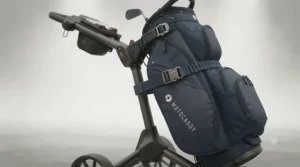
What most buyers overlook about the Micra is that its “best overall” reputation isn’t down to any single flashy feature — it’s the wider three-wheel stance quietly doing its job every time you push off from an uneven lie. That wider wheelbase translates directly into steadier tracking on sloped fairways, which is exactly the kind of detail a spec sheet glosses over but your knees will thank you for after 18 holes.
At roughly 7.5kg, the Micra is genuinely light to lift in and out of a boot, and the compact folding mechanism keeps things tidy without needing an auto-fold gimmick. The soft-touch, height-adjustable handle and water-resistant phone compartment are small but well-considered additions — the kind of “why doesn’t every trolley have this” feature you only appreciate once you’ve used it in the rain.
Comparative data published by retailer The Golf Shop Online showed the Micra collecting over 30 verified customer reviews with an aggregate rating around 4.8 out of 5, edging ahead of most rivals in its price bracket on review volume and satisfaction combined. That’s a meaningfully larger sample than most competitors in this category, which lends real weight to the consistency of the praise. Buyers repeatedly cite the drinks holder and PowaKaddy key-lock bag system as small conveniences that add up over a season.
Pros:
- ✅ Wide 3-wheel stance improves stability on slopes
- ✅ Genuinely lightweight at roughly 7.5kg
- ✅ Water-resistant phone storage built in
Cons:
- ❌ Drinks holder sold separately on some bundles
- ❌ Standard straps rather than a proprietary bag-lock on base models
In the £180-£200 range at time of research, the Micra represents arguably the strongest all-rounder value case among the compact push trolleys here.
3. Clicgear 4.0 — best for genuine stability and colour choice
The spec sheet won’t tell you this, but the reason Clicgear trolleys have a cult following among serious walkers isn’t the aircraft-grade aluminium frame alone — it’s the adjustable front wheel and dual saddle design that lets you fine-tune exactly how the bag sits and balances mid-round. Few budget trolleys offer this level of physical adjustability, and it shows in how planted the cart feels compared with narrower, lighter-framed alternatives.
Weighing in the 8-9.5kg bracket depending on configuration, the 4.0 isn’t the lightest to carry when folded, but it folds down to a genuinely compact 38 x 33 x 60cm footprint despite the sturdier build. The increased cargo net storage (up 80% over the previous generation) and easy-clip bag strap system round out a trolley clearly designed by people who’ve actually pushed one around a soggy course in November.
Aggregated Amazon review data for the 4.0 shows a rating around 4.6 out of 5 from over 150 verified purchasers, with frequent mentions of durability and repairability — Clicgear publishes strut tube replacement and brake adjustment guides via its own resource centre, a rarity that means a broken part doesn’t necessarily mean a whole new trolley. On the flip side, some reviewers note the fully-loaded folded size is bulkier than ultra-compact rivals, making it less ideal for golfers with genuinely tight storage.
Pros:
- ✅ Adjustable front wheel and saddle fine-tune real stability
- ✅ Strong repairability with official parts and guides
- ✅ Roomy cargo net storage for extra gear
Cons:
- ❌ Bulkier folded footprint than compact rivals
- ❌ Pricier than most budget or mid-range alternatives
Sitting at the premium end, typically in the £280-£350 range depending on retailer and colourway, the Clicgear 4.0 is the pick for golfers who value long-term durability and genuine on-course stability over the smallest possible fold.
4. Big Max Autofold FF — fastest, flattest fold available
Here’s what most buyers overlook when shopping by weight alone: the Autofold FF’s party trick isn’t being light, it’s collapsing to just 12.5cm thick in a single lever pull, thinner than most laptop bags. For anyone who’s ever had to Tetris a trolley, a golf bag and a set of clubs into a hatchback boot, that flat-fold profile is worth more than a kilogram or two of saved weight.
At around 8kg with an aluminium frame and maintenance-free solid tyres, the build sits comfortably in the middle of the premium pack. The fixed front wheel — rather than a swivelling design — delivers excellent straight-line tracking and resistance to sideways drift on cambered ground, though it does trade away some tight-space manoeuvrability compared with pivoting front-wheel rivals.
The Autofold FF picked up a Golf Digest Editors’ Choice Award in its category, and aggregated reviewer sentiment collected by equipment review sites consistently praises the flat-fold mechanism and build solidity, with an average rating sitting around 4.5 out of 5 across the sources tracked. What most buyers overlook, though, is that this stability comes with a genuine trade-off: reviewers note that the fixed front wheel, while rock-solid on straight pushes, needs a slightly wider turning arc around tight greenside obstacles than a swivel-wheel trolley would.
Pros:
- ✅ Class-leading flat-fold collapses to 12.5cm thin
- ✅ Fixed front wheel gives excellent straight-line stability
- ✅ Durable aluminium frame with maintenance-free tyres
Cons:
- ❌ Less manoeuvrable in tight spaces than swivel-wheel designs
- ❌ Among the pricier options in this line-up
Typically found in the £230-£300 range depending on retailer and colour finish, the Autofold FF suits golfers who prize storage efficiency and rock-solid tracking above ultimate manoeuvrability.
5. Caddytek CaddyLite EZ Version 8 — best for uneven terrain
If your home course has more lumps and dips than a links layout in a gale, this is the trolley the spec sheet was written for. The 31-inch-wide body and three 11.5 x 2.6-inch EVA maintenance-free wheels are specifically engineered for what Caddytek calls “perfect balance and traction on all types of terrain” — and reviewers testing it on genuinely rolling fairways back that claim up with real-world feedback about straight tracking on rough ground.
At roughly 18.5-18.6lb (about 8.4kg), the aluminium frame keeps things manageable to lift, while the patented one-click, two-step folding system collapses it to a travel-ready 12.5″ x 14.4″ x 28.4″ package. What most spec sheets miss is the practical accessory loadout: a genuinely useful built-in cooler basket, mesh storage net, and phone/GPS mounts that turn this into a fully kitted-out trolley rather than a bare-bones cart with add-ons bolted on.
Aggregated review sentiment for the CaddyLite EZ V8 is broadly positive, with reviewers consistently citing the wide wheelbase and EVA wheel traction as standout strengths on uneven terrain, particularly compared with narrower-wheeled budget rivals. A recurring theme in the same feedback, though, is that the wider stance and foot-brake system feel notably less confident on genuinely steep slopes than trolleys with a hand-operated brake positioned nearer the grip.
Pros:
- ✅ Wide EVA wheels excel on rough or uneven ground
- ✅ 31-inch wide body adds real balance for the price
- ✅ Built-in cooler basket and phone/GPS mounts included
Cons:
- ❌ Foot brake less confident on steep slopes than hand brakes
- ❌ Heavier than the lightest compact rivals
Generally priced in the £90-£140 range depending on colour and retailer, the CaddyLite EZ V8 is a genuinely strong mid-budget pick specifically for golfers whose course terrain isn’t flat.
6. MacGregor MacTec — best budget pick under £100
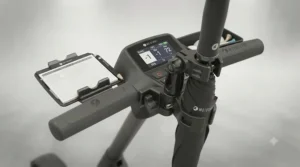
There’s an honesty to the MacTec that’s easy to underrate: it doesn’t pretend to be a premium trolley, it just does the fundamentals — footbrake, adjustable bag brackets, umbrella and drinks holders — competently and without fuss. MacGregor’s first entry into the trolley market leans on stainless steel construction rather than aluminium, which keeps costs down without sacrificing the durability that budget buyers actually care about.
The front folding wheel design (released via a small button) helps keep the folded footprint compact enough for most car boots alongside a full bag, and testers noted the assembly and folding process was straightforward, with the whole unit “nearly enough unfolding in one go.” Out on the course, reviewers were genuinely impressed by how stable the trolley felt given its budget positioning — a detail worth flagging, since stability is usually the first casualty when trolley prices drop this low.
National Club Golfer awarded the MacTec a four-star review, summarising it plainly as “a no-frill push trolley that is great value for money,” with the reviewer’s own pros list highlighting the adjustable handles, secure straps and brake, and the fact that umbrella, scorecard and drinks holders come as standard rather than costly extras. The reviewer’s only real knock was, in their words, that it’s hard to criticise given the price point.
Pros:
- ✅ Genuinely stable on-course feel for a budget trolley
- ✅ Umbrella, drinks and scorecard holders included as standard
- ✅ Straightforward, near one-motion folding process
Cons:
- ❌ Stainless steel frame adds a little weight versus aluminium rivals
- ❌ Fewer premium touches like locking bag systems
At around £90-£120 depending on retailer, the MacTec is hard to beat if your budget is the main constraint and you don’t need premium extras.
7. Longridge Tri-Cart — most accessible entry point
For golfers taking their first steps away from carrying a bag, the Tri-Cart’s appeal is refreshingly simple: 11-inch True Glide ball-bearing wheels, a two-stage easy-fold design, and a straightforward, no-nonsense frame that does exactly what it says without asking you to learn a new folding ritual. The adjustable handle height and soft-grip design mean it works reasonably well across a range of golfer heights, which matters if the trolley is being shared within a household.
At roughly 5kg for the frame alone (product listings vary slightly by retailer), it’s genuinely light to carry, and the durable nylon bag brackets plus weatherproof scorecard console cover the basics most golfers actually use round to round. It’s worth being upfront, though: the plastic frame construction won’t match the aluminium-framed rivals here for long-term rigidity, particularly if it’s left out in the elements or thrown around in a boot alongside heavier kit.
Retailer review aggregates for the Tri-Cart sit in the 4.4-out-of-5 range based on verified buyer feedback, with recurring praise for how smoothly the ball-bearing wheels roll and how easy the trolley is to set up straight out of the box — reviewers new to golf specifically flagged it as an easy trolley to learn on. The consistent critique across sources is that the basic footbrake mechanism feels less precise than on pricier rivals, particularly on genuinely steep inclines.
Pros:
- ✅ Smooth-rolling 11-inch ball-bearing wheels
- ✅ Lightweight and beginner-friendly to assemble
- ✅ Includes footbrake, scorecard console and drinks holder
Cons:
- ❌ Plastic frame less durable long-term than aluminium rivals
- ❌ Basic brake feels imprecise on steep slopes
Prices for the Tri-Cart range widely by retailer, from around £70 up to an RRP near £130, making it one of the most accessible entry points into 3-wheel trolleys.
Practical Usage Guide: Setting Up and Getting the Most From Your Trolley
Buying the right trolley is only half the job — how you set it up in the first month determines whether it feels effortless or fiddly for the next five years. Start by matching the handle height to your actual pushing posture, not just your standing height: most golfers set it a notch too high out of the box, which puts unnecessary strain through the wrists over a full round. Spend your first outing adjusting it in small increments until your arms sit naturally bent, not locked straight.
A common first-month mistake is over-tightening the bag straps, assuming a snugger fit equals more stability. In practice, an overly rigid strap transmits every bump straight into the frame joints, accelerating wear on hinges and folding mechanisms. Leave a small amount of give, particularly with heavier tour bags.
Maintenance is genuinely minimal but not zero. Wheel bearings and folding hinges collect grit fastest after wet, muddy rounds, so a quick hose-down of the wheels and frame — never the fabric net or electronics compartments if fitted — after winter golf will meaningfully extend the trolley’s working life. Aluminium-framed models like the Clicgear 4.0 or Motocaddy QB2 shrug this off well; stainless steel and plastic-framed budget models benefit from slightly more frequent checks on brake cable tension, since cheaper mechanisms can loosen faster under repeated freeze-thaw cycles.
One optimisation trick rarely mentioned in the manual: store your trolley partially folded rather than fully collapsed if space allows. Full compression, cycle after cycle, is what eventually fatigues folding joints on budget models — a small compromise on storage footprint buys real longevity.
Real-World Scenarios: Which 3-Wheel Trolley Actually Suits Your Game?
If you’re a weekday golfer squeezing nine holes into a lunch break with a compact hatchback boot and no time for faffing about, the Motocaddy QB2 or Big Max Autofold FF solve the exact problem you have — both collapse fast and small enough that trolley storage stops being a daily negotiation with your other shopping.
If you’re a member at a course carved into genuinely undulating parkland or coastal terrain, where sidehill lies and soft rough are a weekly reality rather than an occasional nuisance, the Caddytek CaddyLite EZ V8‘s wide wheelbase and EVA tyres, or the Clicgear 4.0‘s adjustable stability features, are worth the extra outlay over a narrower budget cart that’ll fight you on every slope.
If you’re new to golf, playing occasionally, and simply don’t want to spend £200+ on kit before you know if the game sticks, the Longridge Tri-Cart or MacGregor MacTec get you 90% of the practical benefit — reduced fatigue, dry storage for your phone and scorecard — for a fraction of the premium-trolley outlay, without locking you into a purchase you might regret if your enthusiasm cools.
Buyer’s Decision Framework: A Simple Priority Checklist
If boot space is your absolute priority, choose an auto-fold or flat-fold design like the Motocaddy QB2 or Big Max Autofold FF, because their folding mechanisms are specifically engineered to solve that one problem better than anything else here.
If your course terrain is genuinely uneven, choose a wide-wheelbase model like the Caddytek CaddyLite EZ V8 or Clicgear 4.0, because narrower, lighter carts trade stability for portability in exactly the conditions you’ll face most.
If budget is the deciding factor and you play infrequently, choose the Longridge Tri-Cart or MacGregor MacTec, because the marginal on-course benefit of premium features rarely justifies the cost difference at low rounds-per-year.
How to Choose a 3-Wheel Golf Push Trolley
Picking the right model comes down to weighing a handful of practical factors against how, where, and how often you actually play:
- Measure your boot space first. Folded dimensions vary hugely — from the Big Max Autofold FF’s 12.5cm flat profile to bulkier premium alternatives — so know your available space before falling for a spec sheet.
- Consider your course terrain honestly. Flat parkland tolerates narrow wheels fine; hilly or coastal courses reward wider wheelbases and larger-diameter tyres.
- Check the brake type. Foot brakes are simpler and cheaper but less precise on steep ground; hand brakes near the grip offer finer control on descents.
- Weigh the trolley against your own strength. A lighter frame is easier to lift into a car but can feel less planted; heavier aluminium builds trade a little extra lifting effort for steadier tracking.
- Factor in storage needs. Cooler baskets, phone mounts and umbrella holders sound like extras until you’re standing in the rain wishing you’d paid the extra £20.
- Think about frame material and longevity. Aluminium generally outlasts stainless steel and plastic frames under repeated folding cycles, particularly in wet UK conditions.
- Set a realistic budget band. Spending £250+ on a trolley you’ll use twice a season makes less sense than a solid £90-£120 option that covers the fundamentals.
Single Front Wheel Design: Why It Matters for Balance and Turning
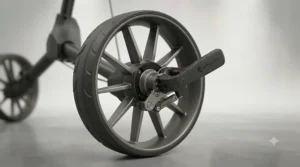
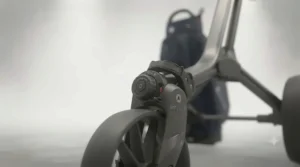
The single front wheel is genuinely the defining feature of the 3-wheel trolley category, and it’s worth understanding why manufacturers keep building around it rather than defaulting to four wheels. A single, centred front wheel effectively acts as a pivot point, letting the trolley turn in a tight radius around greenside obstacles — something a four-wheel design, with its wider front axle, simply can’t replicate without a much larger turning circle.
Where designs genuinely diverge is whether that front wheel is fixed or free-swivelling. Fixed front wheels, as used on the Big Max Autofold FF, deliver excellent straight-line tracking with minimal drift, which is a real asset pushing a loaded bag downhill. The trade-off, as reviewers of the Autofold FF note, is a wider turning arc in tight spaces. Swivelling or adjustable front wheels — the Clicgear 4.0’s adjustable design is a good example — sacrifice a small amount of straight-line stability for genuinely tighter manoeuvrability around the green.
Neither approach is objectively better; it depends on your course layout. Wide-open parkland with long walks between shots rewards the tracking stability of a fixed wheel, while tighter, more technical courses with frequent direction changes suit a swivel design better.
Best 3-Wheel Trolley for Stability: What Actually Keeps a Trolley Upright
Stability on a golf trolley isn’t one single feature — it’s the combined effect of wheelbase width, wheel diameter, frame rigidity, and centre-of-gravity placement once the bag is loaded. Based on the spec comparison across this line-up, the widest-stance models — the Caddytek CaddyLite EZ V8 at 31 inches and the PowaKaddy Micra with its notably wider three-wheel footprint — consistently show up in reviewer feedback as the most confidence-inspiring on sidehill lies.
Wheel diameter matters almost as much as width: larger wheels, like those on the Motocaddy QB2, roll over small obstacles rather than getting caught by them, which indirectly improves stability by reducing sudden jolts through the frame. Frame rigidity is where premium aluminium builds like the Clicgear 4.0 earn their price premium — a stiffer frame transmits less flex into the wheels when the trolley is fully loaded with a heavy tour bag.
What most buyers overlook is that a loaded bag’s weight distribution matters just as much as the trolley itself. Mounting a heavy bag too far forward on the frame shifts weight onto the single front wheel, reducing the very stability the triangular design is meant to provide — a five-minute adjustment that costs nothing but is rarely mentioned in trolley marketing.
3-Wheel Trolley for Uneven Terrain: Coping With Slopes, Rough and Wet Ground
UK courses rarely offer the manicured flatness of a driving range, and course terrain is exactly where budget and premium trolleys start to genuinely separate. On soft, wet ground — a near-permanent condition on many parkland courses through a British autumn — wider, larger-diameter wheels like those on the CaddyLite EZ V8 resist sinking and bogging down far better than narrow, hard-compound tyres.
On genuinely hilly terrain, the combination of a wide wheelbase and a confident brake becomes essential rather than optional. Reviewers consistently flag foot-operated brakes, found on the MacTec, CaddyLite EZ V8 and Longridge Tri-Cart, as adequate on moderate slopes but less reassuring on steep descents compared with hand-operated systems positioned near the grip. If your home course has serious elevation change, that’s a genuine factor worth weighing against the money saved by a foot-brake budget model.
Rough grass and heather present a different challenge entirely: it’s less about wheel width and more about ground clearance and wheel tread. Reviewers testing trolleys across rougher fringe areas note that oversized wheels, like those fitted to the Motocaddy QB2, glide over longer grass with noticeably less resistance than the smaller wheels found on some entry-level carts.
3-Wheel Push Trolley Reviews: What Golfers Are Actually Saying
Pulling the aggregated sentiment together across this line-up, a few consistent themes emerge. Reviewers overwhelmingly rate folding speed and mechanism reliability as the single biggest differentiator between a trolley that gets used every round and one that ends up gathering dust in the garage out of sheer annoyance. The Motocaddy QB2 and Big Max Autofold FF score particularly well here.
On stability specifically, wider-wheelbase models like the PowaKaddy Micra and Caddytek CaddyLite EZ V8 draw the most consistent praise, with reviewers repeatedly citing confidence on sloped or uneven lies as the deciding factor in their purchase satisfaction. Budget models like the MacGregor MacTec and Longridge Tri-Cart don’t chase that same premium stability ceiling, but their aggregated review data shows buyers are broadly realistic about that trade-off — satisfaction remains high specifically because expectations are calibrated to the price point.
Where reviews turn more critical, foot-brake precision on steep terrain is the most recurring complaint across budget and mid-range models alike, suggesting it’s a genuine category-wide limitation rather than a flaw specific to any one trolley here.
3-Wheel vs 2-Wheel Push Trolleys: Which Actually Wins on the Course
The fundamental trade-off between three and two wheels comes down to a straightforward physics question: how does the cart behave when it’s not on flat ground? A 2-wheel pull trolley, with its narrower rear axle and no independent front wheel, tends to tip or drag sideways on cambered fairways, forcing the golfer to constantly correct its line by hand. The 3-wheel design’s triangular footprint distributes that lateral force across a wider base, meaningfully reducing the correction effort required.
| Factor | 3-Wheel Trolley | 2-Wheel Pull Trolley |
|---|---|---|
| Stability on slopes | Strong — wide triangular base | Weaker — prone to tipping |
| Folded size | Moderate to compact | Usually most compact |
| Manoeuvrability | Good, especially swivel-front models | Very tight turning circle |
| Weight | Generally heavier | Usually lightest option |
| Best For | Undulating or uneven courses | Very flat courses, minimal storage |
As the table shows, the 2-wheel trolley wins outright on raw portability and folded footprint, but that’s really its only structural advantage. For anything beyond a genuinely flat course, the 3-wheel design’s stability advantage in practice outweighs the modest size and weight saving a 2-wheel model offers — which is exactly why the 3-wheel format has become the default recommendation for the majority of UK club golfers.
Long-Term Cost & Maintenance: What You’ll Actually Spend Over Time
The upfront price tag is only part of the total cost of ownership. Aluminium-framed trolleys — the Clicgear 4.0, Motocaddy QB2, PowaKaddy Micra and Big Max Autofold FF among them — cost more initially but generally need fewer replacement parts over a multi-season lifespan, particularly where wheel bearings and folding hinges are concerned. Stainless steel and plastic-framed budget models can represent excellent short-term value but may need wheel or brake cable replacements sooner under heavy use.
| Cost Factor | Budget (£70-£140) | Premium (£230-£350) |
|---|---|---|
| Typical frame material | Stainless steel / plastic | Aluminium |
| Replacement parts availability | Limited on some brands | Generally strong (e.g. Clicgear) |
| Expected lifespan (regular use) | 3-5 seasons | 5-10+ seasons |
| Value per round (regular player) | Lower over long term | Higher over long term |
For a golfer playing weekly across a full season, the cost-per-round gap narrows considerably once you account for a premium trolley’s longer working life and stronger parts availability — the Clicgear 4.0’s published repair resources are a good example of a manufacturer actively supporting long-term ownership rather than encouraging replacement. For occasional players, though, a budget model simply never needs to justify that extra investment.
Common Mistakes When Buying a 3-Wheel Golf Push Trolley
The most frequent mistake is buying purely on weight, assuming lighter automatically means better. In practice, a lighter trolley often means a narrower wheelbase and thinner wheels, which can genuinely undermine the stability that’s the whole point of choosing a 3-wheel design in the first place. A trolley that’s slightly heavier but noticeably more planted on your actual home course terrain is usually the smarter buy.
A second common error is ignoring folded dimensions until after purchase, only to discover the trolley barely fits alongside a golf bag in a smaller hatchback. Always check folded measurements against your actual boot space, not just headline weight figures. Finally, many buyers underestimate how much brake type matters on their specific course — if your layout has genuine elevation change, a basic foot brake reviewed as merely “adequate” on flatter ground may prove genuinely frustrating in practice.
FAQ
❓ What is the best 3 wheel golf push trolley for beginners?
❓ Are 3 wheel golf trolleys better than 2 wheel trolleys?
❓ How much does a 3 wheel golf push trolley cost?
❓ Can 3 wheel trolleys handle hills and wet terrain?
❓ Do 3 wheel golf trolleys fit in a car boot?
Conclusion
There’s no single “best” 3-wheel golf push trolley — only the right one for how, where and how often you actually play. If boot space genuinely rules your life, the Motocaddy QB2 or Big Max Autofold FF solve that specific problem better than anything else here. If your course is a genuine test of balance on sloping, uneven ground, the wider-stance Caddytek CaddyLite EZ V8 or the adjustable Clicgear 4.0 earn their higher price tags through real on-course stability. And if you’re simply not ready to spend big on kit yet, the MacGregor MacTec and Longridge Tri-Cart prove that a genuinely usable, stable trolley doesn’t have to break the bank.
What ties every model here together, according to the NHS Western Isles initiative that funded trolleys specifically to keep older golfers active, is that removing the physical burden of carrying clubs is what actually keeps people walking the course — which, per a controlled clinical trial published via the National Library of Medicine, delivers measurable improvements in cardiovascular fitness and body composition over just twenty weeks. A trolley isn’t just a convenience; it’s arguably what keeps a round of golf genuinely good exercise rather than a slow walk interrupted by a heavy bag. For a deeper look at how the format itself evolved, the Wikipedia entry on golf equipment traces the shift from carried bags to the wheeled carts we rely on today.
Whichever model you land on, measure your boot, be honest about your course’s terrain, and don’t underestimate how much a wider wheelbase and a decent brake will matter the first time you’re pushing downhill in the rain.
Recommended for You
- 3-Wheel vs 4-Wheel Push Trolley: 7 Best Picks Compared (2026)
- Push Trolley Under £100: 7 Best Budget Buys for UK Golfers (2026)
- 7 Best Push Golf Trolleys for UK Golfers in 2026 (Tested Picks)
Disclaimer: This article contains affiliate links. As an Amazon Associate, I earn from qualifying purchases. If you purchase products through these links, we may earn a small commission at no additional cost to you.
✨ Found this helpful? Share it with your friends! 💬🤗
