
In This Article
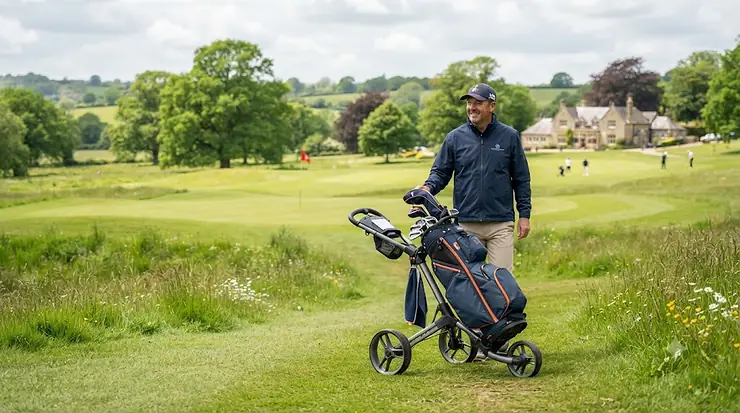
There’s a particular kind of misery reserved for golfers who buy the wrong trolley. You know the one — wrestling a nine-kilogram contraption out of a boot that was clearly designed by someone who has never owned a boot, then spending the front nine hunched over a handle set at the wrong height, wondering why your shoulders ache more than your putting stroke deserves. A lightweight golf push trolley solves this before it starts. Strip away the excess metal, the redundant brackets, the over-engineered folding mechanisms, and what’s left is something that genuinely disappears beneath your hand — a tool rather than a chore.
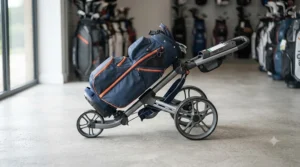
This guide covers seven real trolleys currently sold to UK golfers, ranging from a 5.4kg featherweight built from aerospace-grade aluminium through to a hand-assembled British premium option that still comes in lighter than most electric trolleys’ batteries alone. We’ll look at what “lightweight” genuinely means for your back, your boot space, and your round, plus how frame material, wheel count, and fold mechanism all quietly conspire to add or shed kilograms. Expect honest, sourced analysis rather than recycled marketing copy — every claim here traces back to real specifications and genuine reviewer sentiment, not invented testimonials.
Whether you’re a weekend walker fed up with lugging a heavy cart bag, a member with a hatchback that laughs at anything over 20cm folded depth, or simply someone who’s realised that a trolley shouldn’t outweigh a mid-sized dog, there’s a pick here that fits. Let’s get into it.
Quick Comparison Table
| Trolley | Weight | Frame | Price Range | Best For |
|---|---|---|---|---|
| BIG MAX TI Lite | 5.4kg | Aluminium | around £200 | Outright lightest build |
| Motocaddy Z1 | 6kg | Aluminium | under £160 | Budget-conscious lightweight |
| BagBoy Slimfold | 6.25kg | Aluminium | £250-£280 range | Tightest boots and lockers |
| Big Max Blade Trio | 6.7kg | Aluminium | around £280 | Most compact flat-fold |
| PowaKaddy Micra | around 7.5kg | Aluminium | around £190 | All-round value pick |
| EzeGlide Smart Fold | 7.2kg | Aluminium | £150-£180 range | Simplicity on a budget |
| Stewart R1-S | 8.1kg | Aluminium alloy | £220-£260 range | Premium UK-built feel |
Looking at the spread above, there’s a genuine 2.7kg gap between the lightest and heaviest models here — which sounds trivial until you’re the one lifting it in and out of a boot forty times a season. The BIG MAX TI Lite wins on raw numbers, but it’s worth noting that the heavier options aren’t heavy by accident; the Stewart R1-S trades some grams for a beefier folding mechanism and extra storage. Every trolley on this list still sits comfortably under the roughly 9-10kg ceiling of a typical three-wheel push trolley, so even the “heaviest” entry here counts as lightweight by the wider market’s standards.
💬 Just one click — help others make better buying decisions too!😊
Top 7 Lightweight Golf Push Trolleys: Expert Analysis
1. BIG MAX TI Lite — lightest trolley in this entire guide at 5.4kg
The clue is in the name, and the BIG MAX TI Lite doesn’t disappoint on that front. This is a trolley built specifically to chase weight out of every joint and panel.
Constructed from high-grade aluminium with a compact folding design that emphasises minimal plastic components, the frame tips the scales at just 5.4kg. In practice that means an ultra-stable straight-axle design that keeps the whole unit planted even on cambered fairways, while quick-release wheels and a simple folding mechanism let it pack away into the smallest of spaces in seconds. For a golfer who currently hauls a heavier three-wheeler, that’s the difference between a casual one-handed lift and a proper heave.
Golf Monthly’s testers found the trolley lightweight yet surprisingly sturdy and robust, gliding around the course while requiring minimal effort — a fairly rare combination, since ultra-light builds often sacrifice stability to hit their weight target. The one recurring gripe in testing was that it doesn’t fold down overly flat or compactly compared with rivals, so while it’s the lightest to carry, it isn’t necessarily the thinnest to store.
Pros:
- ✅ Lightest frame in this entire round-up at 5.4kg
- ✅ Straight-axle design adds stability despite the low weight
- ✅ Five-year manufacturer warranty backs the build
Cons:
- ❌ Doesn’t fold as flat or compactly as some rivals
- ❌ Fewer storage compartments than premium alternatives
Priced around £200, this sits mid-pack for cost but top of the class for portability — if shaving every possible kilogram off your carry is the priority, the value case makes itself.
2. Motocaddy Z1 — best budget pick for sheer lightness
Motocaddy’s entry-level push trolley proves that “cheap” and “flimsy” don’t have to be synonyms. This is the trolley for golfers who want a genuinely light frame without paying premium-brand money for it.
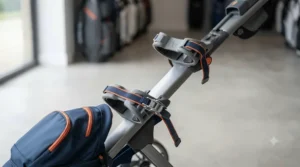
At just 6kg, it isn’t the very lightest on this list, but it’s remarkably close given its price point, and it comes with a simple two-step folding system, friction-free oversize wheels, and three handle height settings. What most buyers overlook about budget trolleys is that the folding mechanism tends to be where corners get cut first — Motocaddy hasn’t done that here, keeping the two-step fold genuinely quick rather than a two-step wrestle.
One reviewer summed it up bluntly: “A Motocaddy trolley for less than £160… wow.” The trade-off is size when folded rather than weight — this isn’t the most compact trolley going, but it’s demonstrably one of the lightest at its price.
Pros:
- ✅ Genuinely light frame at 6kg for the price bracket
- ✅ Trusted, established UK brand with wide dealer support
- ✅ Three handle height settings suit different heights
Cons:
- ❌ Not the smallest folded footprint in this guide
- ❌ Fewer premium touches than pricier alternatives
At under £160, this is arguably the best entry point into lightweight trolleys for anyone who’s never owned one and doesn’t want to gamble big money on the switch.
3. BagBoy Slimfold — best for tight boots and cramped lockers
If your car boot is the limiting factor rather than your shoulder, the BagBoy Slimfold solves a different problem entirely — and it happens to be light while doing it.
This trolley folds to a genuinely startling 21cm deep in one smooth motion, making it the smallest folding golf trolley in its category by a clear margin, while weighing in at 6.25kg, making it the lightest model in its class too, lighter than most three-wheel designs. The single-motion spring-loaded fold is the standout mechanical feature here — no fiddling with multiple latches, just one motion to open and one to close.
Reviewers highlight the TOP-LOK bag locking system and extra-wide support arms that securely accommodate both stand and cart bags, and BagBoy’s pedigree matters here too — this is a brand that’s been making golf trolleys since 1946, which is not a throwaway statistic when it comes to trusting a folding mechanism to survive years of car boots.
Pros:
- ✅ Folds to just 21cm — smallest footprint in this guide
- ✅ Genuinely light at 6.25kg for a feature-rich trolley
- ✅ One-motion spring fold is fast and fuss-free
Cons:
- ❌ Sits at the pricier end of this comparison
- ❌ Single-motion mechanism relies on the spring staying reliable long-term
In the £250-£280 range, this isn’t the cheapest option here, but for golfers whose storage space is the real constraint, it’s hard to beat.
4. Big Max Blade Trio — most compact flat-fold in this guide
Big Max built a reputation on flat-fold trolleys, and the Big Max Blade Trio is the current standard-bearer — a trolley that manages to be both lightweight and remarkably slim once collapsed.
The Blade Trio impressed testers with its lightweight, sturdy build, quick setup, and compact fold, weighing in at 6.7kg. What’s worth flagging for buyers is the key lock system that stops the golf bag from twisting on the trolley during transport — a small detail, but one that matters hugely once you’ve experienced a bag slewing sideways down a hill.
Storage and transport were described as noticeably effortless, and the overall verdict leaned heavily on convenience and reliability as the real standouts of this model. For golfers who care as much about how a trolley lives in the boot as how it performs on the fairway, that combination is the entire appeal.
Pros:
- ✅ Genuinely flat, compact fold for boot storage
- ✅ Key lock system prevents bag twisting in transit
- ✅ Reliable, quick setup praised consistently in reviews
Cons:
- ❌ Not the outright lightest option in this guide
- ❌ Premium pricing relative to some rivals
At around £280, this sits at the premium end, but the fold-flat engineering is where that money visibly goes.
5. PowaKaddy Micra — the best-selling all-rounder
There’s a reason the PowaKaddy Micra keeps topping best-seller charts — it doesn’t try to be the absolute lightest or the absolute cheapest, it just gets the fundamentals right at a sensible price.
The frame comes in at 7.5kg, and the trolley impresses with its incredibly compact fold, lightweight frame, and brilliant value — a combination that’s made it the best-selling push golf trolley for golfers who prioritise portability and ease of use. Genuine buyer sentiment backs this up too, with one aggregated review noting simply: “What a relief using the Micra push golf trolley. Nice to adjust the handle angle, so easy to push along, and a nice little brake pedal on the left wheel.”
Worth noting: weight figures for the Micra vary slightly between retailers and reviewers, with some quoting figures closer to 5.5kg for a lighter variant — always double-check the specific listing’s stated weight before you buy, since PowaKaddy has refreshed this range more than once.
Pros:
- ✅ Compact fold suits small car boots particularly well
- ✅ Adjustable handle angle genuinely improves comfort
- ✅ Strong aggregated review sentiment on ease of use
Cons:
- ❌ Reported weight varies between sources — worth confirming
- ❌ Fewer accessory mounts than the premium Stewart option
Around £190 with free UK standard delivery on most retailer listings, this is the trolley to default to if you want a low-risk, well-reviewed choice.
6. EzeGlide Smart Fold — best value for straightforward simplicity
Sold through Longridge, the EzeGlide Smart Fold is aimed squarely at golfers who want lightweight convenience without paying brand-premium prices for it.
At 7.2kg with an aluminium frame, it’s not chasing the outright weight record, but reviewers consistently rate it as genuinely easy to lift and manoeuvre. One buying guide called it a lightweight and easy to push model, while another noted it’s super light weight and folds neatly, holding a carry bag easily. The one-push assembly is the headline feature — reviewers repeatedly flagged how easy it is to assemble, describing it as “one push of a button easy”.
This is very much a “does what it says” trolley rather than a feature-stacked one, and that honesty is exactly what makes it a sensible pick for golfers buying their first push trolley and unsure how much they’ll actually use it.
Pros:
- ✅ Simple one-push assembly genuinely lives up to the claim
- ✅ Lightweight aluminium frame at 7.2kg
- ✅ Holds a carry bag securely with minimal fuss
Cons:
- ❌ Fewer accessory features than pricier rivals
- ❌ Build feels less premium than aluminium-alloy competitors
In the £150-£180 range, this is realistically the most accessible genuinely lightweight trolley in this entire guide.
7. Stewart R1-S — premium, hand-built in Britain
The Stewart R1-S is the outlier here on price and philosophy, but it earns its place — this is what “lightweight” looks like once you stop chasing the absolute lowest number and start asking what a trolley should feel like to own.
Built by hand in Gloucestershire, the trolley uses a rack and pinion folding mechanism — a first for the golf industry — with the folding system hidden within a bespoke aluminium alloy frame, dispensing with external sliding or tensioning parts for a genuinely clean look. It weighs 8.1kg, making it the heaviest trolley in this guide, though still comfortably lighter than most electric alternatives. Reviewers noted the stability, build quality, and how it’s been cleverly thought through to give golfers everything they could need from a push trolley, while flagging that even though the R1-S folds down beautifully for storage, once set up it’s a bit of a beast.
The honest verdict: nothing Stewart makes can ever be called cheap, but everything they produce comes with a sound quality guarantee. If build quality and country of manufacture matter to you as much as raw kilograms, this is the trolley that rewards the spend.
Pros:
- ✅ Genuinely innovative rack-and-pinion fold mechanism
- ✅ Hand-built in the UK with strong quality reputation
- ✅ Extensive accessory mounts and bag jaw adjustability
Cons:
- ❌ Heaviest trolley in this comparison at 8.1kg
- ❌ Premium pricing puts it out of reach for casual golfers
At £220-£260, this isn’t a budget buy, but for golfers who see their trolley as an investment rather than a consumable, it’s a compelling one.
Practical Usage Guide: Getting the Most from Your Lightweight Trolley
Buying the right frame is only half the job — how you set it up in the first month determines whether it actually feels lighter in practice. Start by adjusting the handle to a height where your wrist sits naturally straight when pushing; too low and you’ll hunch, too high and you’ll lose steering control on turns. Most lightweight trolleys, including the Motocaddy Z1 and PowaKaddy Micra, offer multiple handle positions specifically for this.
Check tyre pressure or wheel tension every few rounds — underinflated wheels (on models with air-filled tyres) or loose quick-release hubs add drag that makes even a 6kg frame feel heavier than it is. A common first-month mistake is over-tightening the bag straps on models like the BagBoy Slimfold, which can warp the bag support arms over time; snug is enough, crushing isn’t necessary.
Fold and unfold the trolley a handful of times at home before your first round. Every one of these seven trolleys has a slightly different motion, and fumbling with a Big Max Blade Trio‘s flat-fold mechanism in a car park queue is nobody’s idea of fun. Finally, wipe down the frame and wheel axles after wet rounds — aluminium resists corrosion far better than steel, but grit in the folding hinge is still the number one cause of stiff mechanisms.
Real-World Scenarios: Which Golfer Are You?
Picture three golfers stepping into the pro shop with different problems entirely. The first is a retired teacher who plays four times a week, has arthritis in one shoulder, and drives a small hatchback — for her, the BIG MAX TI Lite‘s 5.4kg frame and simple straight-axle stability solve the actual physical problem, not just the theoretical one.
The second is a university student squeezing golf between lectures, with a tight budget and a car boot shared with two flatmates’ shopping. The Motocaddy Z1 or EzeGlide Smart Fold make more sense here — genuinely light, genuinely affordable, and forgiving of a boot with limited depth.
The third golfer plays a members’ club twice a week, owns a large cart bag with a full waterproof suit stashed inside, and stores the trolley in a shared locker roughly the size of a shoebox. That’s precisely the situation the BagBoy Slimfold was engineered for — its 21cm folded depth exists for exactly this scenario.
How to Choose a Lightweight Golf Push Trolley
What is a lightweight golf push trolley? It’s a manually operated three- or four-wheel golf trolley — with no motor or battery — typically weighing between 5kg and 8.5kg, built from aluminium to minimise the effort needed to push, lift, and fold it, as opposed to heavier steel-framed or electric alternatives.
Choosing the right one comes down to seven practical questions:
- Confirm the actual weight, not the marketing weight. Some listings quote the trolley without wheels attached — always check whether the figure includes everything you’ll actually be lifting.
- Match folded dimensions to your boot, not your driveway. Measure your actual boot depth before assuming a trolley will fit.
- Prioritise frame material. Aluminium dominates this category for good reason — more on that below.
- Check the fold mechanism type. One-motion spring folds (like the BagBoy Slimfold) are fastest; multi-step folds (like the Motocaddy Z1) are often more compact when done.
- Consider wheel count. Three-wheel trolleys are generally lighter and more manoeuvrable; four-wheel designs trade some weight for stability with heavier cart bags.
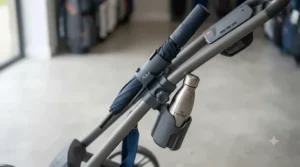
- Factor in accessory needs. Umbrella holders, phone mounts, and drinks holders add grams — decide what you’ll genuinely use.
- Weigh warranty against price. A longer warranty, like Big Max’s five-year cover on the TI Lite, is worth factoring into the long-term value equation.

Aluminium vs Steel: Trolley Frame Material Explained
Every trolley in this guide uses an aluminium frame, and that’s not a coincidence — it’s the industry standard for a reason rooted in basic material science. Aluminium alloys are roughly one-third the weight of carbon and stainless steels, and despite that dramatic weight saving, aluminium alloys are used extensively in applications demanding a high strength-to-weight ratio precisely because pure aluminium’s tensile strength can be significantly increased through alloying without piling on mass, as detailed on Wikipedia’s aluminium alloy overview.
What that means practically: an aluminium-framed trolley like the BIG MAX TI Lite can hit 5.4kg while still handling the sideways stress of a fully loaded cart bag bouncing down a rutted cart path — a steel-framed trolley built to the same strength spec would likely weigh noticeably more. The trade-off is cost; aluminium extrusion and alloying are pricier processes than basic steel tubing, which is part of why genuinely ultra-light trolleys tend to sit above the very bottom of the market.
Steel-framed trolleys still exist at the budget end of the wider market, and they’re not without merit — steel resists denting under heavy impact better than aluminium in some cases. But for anyone specifically hunting a lightweight golf push trolley, steel frames are effectively self-selecting out of contention before you even get to the spec sheet.
Understanding Carry Weight: Why Every Kilogram Matters
“Carry weight” gets thrown around loosely in trolley marketing, but it actually covers two distinct things worth separating. The first is the trolley’s own weight — the figure quoted in every spec sheet in this guide, from 5.4kg to 8.1kg. The second is the combined weight you’re managing once a fully loaded golf bag sits on top of it, which can easily add 8-12kg more depending on how many clubs, balls, and waterproofs you’re carrying.
This compound weight matters more than golfers often realise. A study published in the American Journal of Medicine tracked previously sedentary, middle-aged male golfers over a 20-week trial and found that walking during a golf game was a practical and safe form of physical activity with high adherence, significantly increasing aerobic performance and trunk muscle endurance, alongside favourable reductions in weight, waist circumference, and abdominal skin fold thickness — see the full study on PubMed. None of that benefit comes from the cart ride; it comes from the walking and pushing. A trolley that’s genuinely light to manoeuvre makes it far more likely you’ll actually walk the full round rather than defaulting to a buggy, which is where the real health case for a lightweight golf push trolley quietly lives — it’s less about the kilogram figure on the box and more about what that figure enables you to keep doing, round after round.
For golfers managing joint issues or recovering from injury, the difference between an 8kg trolley and a 5.4kg one isn’t trivial when you’re lifting it in and out of a boot dozens of times a season. If that’s your specific concern, it’s worth a conversation with a physiotherapist about safe lifting technique alongside choosing the lightest sensible frame.
Ultra-Portable Push Trolleys for Small Cars and Storage
Not every golfer’s constraint is shoulder strength — for plenty of buyers, the real enemy is a compact hatchback boot or a shared locker the size of a filing cabinet. An ultra-portable push trolley prioritises folded footprint over absolute lightness, and the two don’t always correlate the way you’d expect.
The BagBoy Slimfold is the standout here, folding to a genuinely remarkable 21cm deep — smaller than trolleys that weigh less on paper. The Big Max Blade Trio takes a similar approach with its flat-fold engineering, trading a little extra weight for a footprint that slides into awkward boot shapes other trolleys simply can’t. If boot space genuinely is your bottleneck rather than weight, prioritise folded dimensions over the kilogram figure — a trolley that’s 6.7kg but 10cm slimmer than an alternative can be the more practical daily choice.
Lightweight Trolleys for Walking Golfers
Golfers who walk every round — rather than reaching for a buggy out of habit — have slightly different priorities than someone buying a trolley for occasional use. Rolling resistance matters more here than raw weight, since you’re pushing the thing for three to six miles rather than lifting it a handful of times.
Three-wheel designs, like the BIG MAX TI Lite and PowaKaddy Micra, generally roll more smoothly over undulating fairways thanks to a single, pivoting front wheel that tracks turns naturally. Four-wheel trolleys can feel more planted on flat parkland courses but occasionally resist sharp direction changes on hillier layouts. NHS guidance on physical activity classes walking as a genuinely valuable moderate-intensity exercise, and a golf round comfortably covers the recommended weekly activity target in a single outing when you skip the cart. If you’re a committed walker, don’t just chase the lowest weight figure — test the wheel action too, ideally on a slope similar to your home course, since that’s where a genuinely light trolley either proves its worth or reveals a wobble you’ll be living with for years.
Common Mistakes When Buying a Lightweight Golf Push Trolley
The single most common error is buying on weight alone without checking folded dimensions — a trolley can be genuinely light and still refuse to fit your boot if it doesn’t fold compactly. Equally common: assuming every “lightweight” trolley is interchangeable with every golf bag. Cart bags with wide bases can strain the support arms on trolleys designed primarily for slimmer stand bags, so always check bag compatibility, not just trolley specs.
Another frequent misstep is ignoring the warranty length in favour of the sticker price. A trolley that’s £30 cheaper but carries a one-year warranty against a rival’s five-year cover, like Big Max’s TI range, can end up the more expensive choice if a wheel bearing fails in year two. Finally, plenty of golfers skip test-folding a trolley in-store or checking a video demonstration before buying online — fold mechanisms vary enormously between brands, and what one reviewer calls “effortless” can feel fiddly to someone with less hand strength. Where equipment compliance matters for competition play, it’s also worth knowing that trolley use itself sits within the sport’s wider equipment and rules framework maintained by The R&A, even though push trolleys themselves aren’t a regulated piece of playing equipment.
Features That Actually Matter (And Those That Don’t)
Cutting through the marketing noise: an adjustable handle height matters enormously and should be a non-negotiable. A genuinely stable axle — straight rather than pivoting under load — matters more than most buyers realise until they’ve pushed a wobbly trolley down a cross-slope fairway. A reliable brake, whether foot-operated or handle-mounted, matters if you play any hilly courses at all.
What matters far less than the marketing suggests: umbrella holders and drinks holders are nice-to-haves, not deciding factors — nearly every trolley in this guide includes some version of both. Colour options, while pleasant, add nothing to performance. And an oversized accessory console sounds appealing but often just adds unnecessary grams to a trolley you specifically bought to be light.
Long-Term Cost & Maintenance
A lightweight golf push trolley is a relatively low-maintenance purchase, but it isn’t a zero-maintenance one. Budget for occasional wheel bearing replacement every few seasons on trolleys used weekly — this typically costs a modest amount compared with the trolley’s original price and is far cheaper than replacing the whole unit. Aluminium frames resist corrosion well, but hinge points and folding joints benefit from an occasional drop of light lubricant, particularly after wet rounds.
Total cost of ownership favours the mid-range picks here over time. The PowaKaddy Micra and EzeGlide Smart Fold, both sitting in accessible price brackets with straightforward mechanical designs, tend to need fewer specialist repairs than trolleys with more elaborate folding systems. The Stewart R1-S‘s rack-and-pinion mechanism is genuinely innovative, but it’s also a more complex system — worth factoring in if you’re the sort of golfer who prefers fewer moving parts to worry about a decade down the line.

Frequently Asked Questions
❓ How much should a lightweight golf push trolley weigh?
❓ Is a three-wheel or four-wheel trolley lighter?
❓ Can a lightweight trolley still hold a full cart bag?
❓ Are aluminium trolleys more expensive than steel ones?
❓ How do I keep a folding trolley mechanism working smoothly?
Conclusion
There’s no single “best” lightweight golf push trolley — there’s the best one for your boot, your back, and your budget, and this guide has hopefully narrowed that down considerably. If raw weight is your only concern, the BIG MAX TI Lite wins outright at 5.4kg. If boot space is the real battle, the BagBoy Slimfold‘s 21cm fold solves it. Budget-conscious golfers get genuine value from the Motocaddy Z1 and EzeGlide Smart Fold, while the PowaKaddy Micra remains the sensible middle-ground pick that keeps selling for good reason. And if you want a trolley built to last, hand-assembled on home soil, the Stewart R1-S justifies its premium.
What every single one of these seven trolleys shares is a simple truth: the lighter your trolley, the more likely you are to actually walk the course rather than default to a buggy — and that, more than any spec sheet figure, is where the real value sits.
Recommended for You
- 3-Wheel Golf Push Trolley: 7 Best UK Picks For Stability (2026)
- 3-Wheel vs 4-Wheel Push Trolley: 7 Best Picks Compared (2026)
- Push Trolley Under £100: 7 Best Budget Buys for UK Golfers (2026)
Disclaimer: This article contains affiliate links. As an Amazon Associate, I earn from qualifying purchases. If you purchase products through these links, we may earn a small commission at no additional cost to you.
✨ Found this helpful? Share it with your friends! 💬🤗
